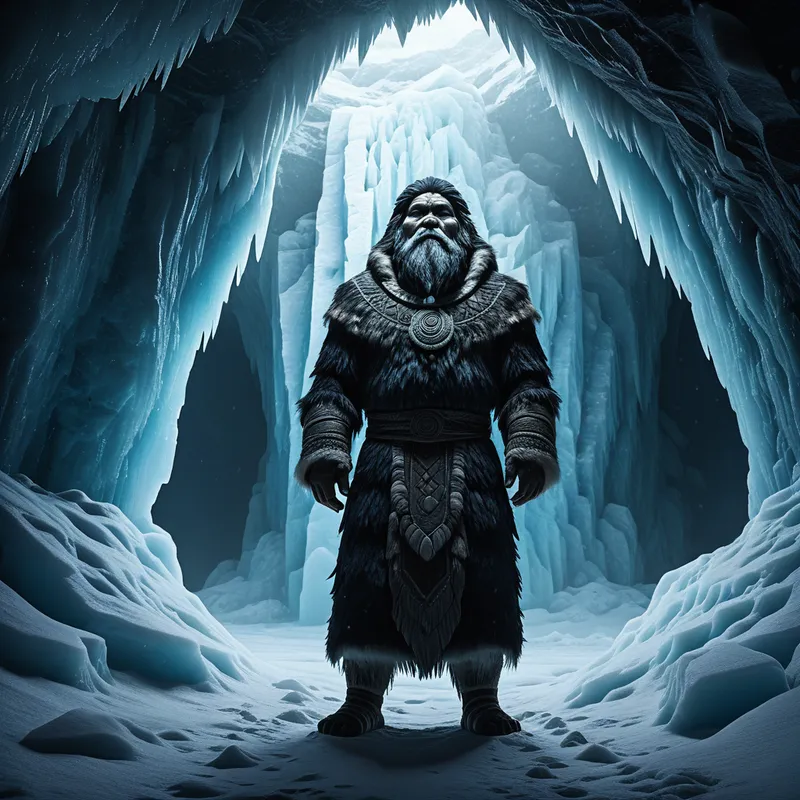
Anguta God of the Dead Myth Meaning & Symbolism
The myth of Anguta, the father who retrieves his daughter from the underworld, embodies the profound Inuit relationship with death, grief, and the soul's journey.
The Tale of Anguta God of the Dead
Listen. The wind does not just blow across the ice; it carries whispers from the time before time, when the boundaries between the living and the dead were thin as a seal’s bladder. In that time, there was a great hunter, a man of formidable will named Anguta. He had a daughter, Sedna, whose spirit was as deep and untamable as the ocean itself.
Sedna grew into a woman of such fierce independence that she refused all suitors. But a cunning fulmar spirit, in the guise of a handsome hunter, sang promises of a soft life far from hardship. Sedna, yearning for something beyond her father’s world, went with him across the sea. What she found was not a warm home, but a desolate cliff nest, betrayal, and hunger. The fulmar’s true nature was revealed: harsh, selfish, and cruel.
Her cries for help were carried by the very winds that had deceived her. They reached the ears of Anguta. His heart, a frozen sea of paternal love and rage, cracked. He set out alone in his qajaq across the treacherous, ice-floe studded waters. When he found her, she was a shadow of her former self, clinging to the rocks of despair. Without a word, he took her into his boat and turned for home.
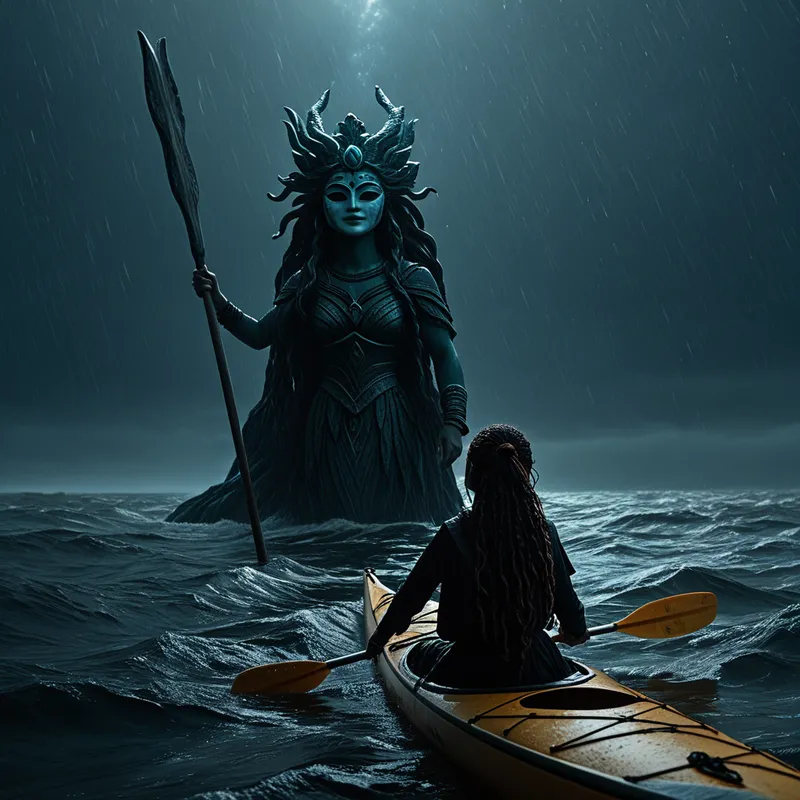
But the betrayed fulmar, enraged, summoned a titanic storm. The sky became a roiling cauldron of black clouds; the sea rose in mountainous waves, intent on swallowing them whole. As the qajaq pitched violently, Anguta, gripped by a terror deeper than any he had known hunting bear or whale, saw only the wrath of the spirits. In a moment of catastrophic survival instinct, a thought colder than the sea itself seized him: the storm wanted her. To save himself, to calm the fury, he must give the sea what it demanded.
With a cry that was lost to the thunder, he did not push her, but as she clung to the boat’s side, he raised his paddle or harpoon—the stories vary, but the action is eternally the same—and struck at her hands. Her fingers, severed at the joints, tumbled into the raging foam. But Sedna did not sink. Her spirit, mingled with her blood and her monumental betrayal, transformed. Her fingers became the first seals, whales, and walruses. She herself, sinking beneath the waves, became the mighty, vengeful Goddess of the Sea, mother of all marine life.
Anguta, surviving the now-calmed storm, returned to land carrying not his daughter, but an abyss of guilt within his chest. He did not die a mortal death. His grief transformed him. He became the ferryman of souls, the one who must descend to the frozen underworld of Adlivun, where Sedna now rules. His eternal task is to gather the souls of the dead, guide them to his daughter’s realm, and there, in the depths, help them cleanse their impurities. He is the father who cast his child into the abyss, now condemned to forever dwell at its threshold, serving as the bridge he once shattered.
Cultural Origins & Context
This myth, central to the Inuit spiritual worldview across the Arctic, is not a singular, fixed text but a living narrative constellation. It was traditionally passed down orally by elders and storytellers during the long winter nights, a vital thread in the fabric that connected the community to the invisible forces governing their survival. The figures of the father (Anguta) and the daughter (Sedna, Nuliajuk, Arnapkapfaaluk, among other names) are archetypal anchors in a cosmology where the human, animal, and spirit worlds are in constant, delicate negotiation.
The myth served profound societal functions. It explained the origin of sea game, the very source of life, framing it as born from sacrifice, betrayal, and transformation. It established a sacred, transactional relationship with Sedna: when game was scarce, it was because her hair, tangled with the sins of humanity, needed combing by an angakkuq who would journey to her in Adlivun. Most critically, it provided a complex map of the afterlife and the moral landscape surrounding death. Anguta’s role as psychopomp reinforced the Inuit understanding of death as a transition, not an end, governed by familial—however fractured—connections.
Symbolic Architecture
The myth is a profound symbolic drama of the psyche’s relationship with its own creative and destructive depths. Sedna represents the deep, instinctual, and creative feminine principle, the source of all life-sustaining nourishment. Her journey is one of naive consciousness (the innocent seeking paradise) being lured and wounded by the trickster spirit of naive desire, resulting in a catastrophic, yet generative, fall into the depths.
Anguta embodies the complex patriarchal principle. He is protector, provider, but also the agent of a necessary—though traumatic—separation. His act is not one of simple evil, but of a consciousness faced with an overwhelming crisis, choosing survival in a way that severs its connection to the deep feminine. His subsequent fate is the key.
The one who inflicts the wound is condemned to tend the gateway of the wound for all eternity. In this, guilt is alchemized into function; the perpetrator becomes the priest of the mystery he violated.
His eternal descent mirrors the psychological necessity of confronting what we have rejected or betrayed within ourselves. The underworld of Adlivun is not a hell of punishment, but a cold, reflective state of purification, where the soul is cleansed. Anguta’s endless journey between the worlds symbolizes the ego’s necessary, repeated engagement with the unconscious contents it has cast out.

The Dreamer's Resonance
When this myth stirs in modern dreams, it often signals a profound encounter with the shadow and the deep feminine. To dream of being on a stormy sea in a fragile boat may speak to a life situation feeling violently out of control, where one’s deepest attachments (the Sedna within) are threatened. The figure of a stern, grieving father or the act of a terrible, survivalist betrayal points to a harsh inner critic or a patriarchal complex forcing a painful but perhaps necessary severance from a dependent state.
Somatically, this can feel like a cold dread in the chest, a numbness in the hands, or a sense of sinking. Psychologically, it is the process of “hitting bottom.” The dreamer is at the crisis point where an old identity or attachment must be sacrificed—not out of malice, but out of a brutal, survival-level truth—to give birth to something new and autonomous. The dream may ask: What deep, creative source have I betrayed or neglected? What painful separation am I both perpetrating and mourning?
Alchemical Translation
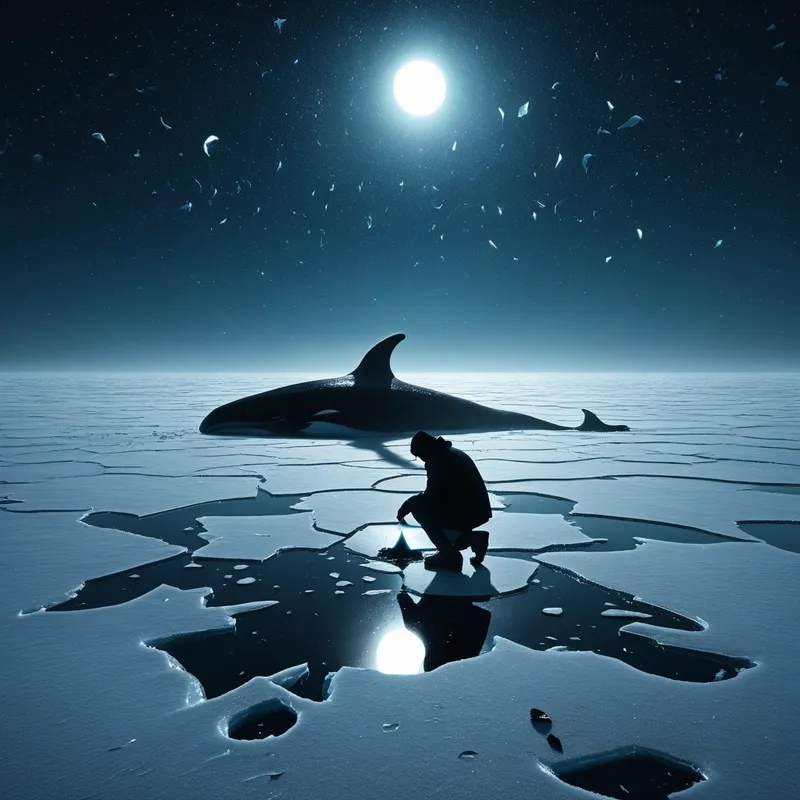
The individuation process modeled here is the Descent of the Father. It is not the heroic journey of the son to slay a monster, but the weary, obligated journey of the established authority figure into the consequences of his own actions. For the modern individual, this translates to the often-overlooked work of late-stage psychological development: the responsibility of the conscious ego to retrieve and reconcile with the aspects of life and soul it has, often for seemingly good reason, condemned to the underworld.
This is the alchemy of coniunctio through shared suffering. Anguta does not rescue Sedna; he joins her domain. His power is no longer that of the hunter on the ice, but of the guide in the darkness. The transmutation occurs when we stop trying to “fix” or “save” our inner wounds (the betrayed Sedna) from a position of superiority, and instead consent to dwell with them, to serve the process they govern.
The psychic gold is not found in avoiding the fall, but in the eternal return to the scene of the crime, not as a criminal, but as a keeper of the threshold. The guilt becomes the vocation.
To integrate this myth is to accept that one’s greatest failure—the betrayal of one’s own depth, creativity, or vulnerability—becomes the very foundation of one’s spiritual function. The caregiver archetype is fulfilled not through pristine protection, but through steadfast companionship in the bleak, cleansing lands of grief, shame, and consequence, thereby transforming personal tragedy into a communal bridge between life and death, consciousness and the unconscious.
Associated Symbols
Explore related symbols from the CaleaDream lexicon:
- Ocean — The vast, unconscious realm ruled by Sedna, representing the source of life, deep emotion, and the perilous journey of the soul.
- Father — Anguta embodies the complex archetype of the father as protector, perpetrator, and ultimately, psychopomp, guiding souls to reconciliation.
- Daughter — Sedna as the daughter represents the soul's deep feminine essence, its creative potential, and its capacity for transformative wounding.
- Death — The central theme of the myth, reframed not as an end but as a necessary descent and purification in the underworld of Adlivun.
- Journey — The eternal voyage of Anguta between worlds, modeling the psyche's obligatory engagement with its own shadow and history.
- Grief — The consuming force that transforms Anguta from a mortal man into a deity, the raw material of his eternal purpose.
- Sacrifice — Sedna's mutilation, a brutal sacrifice that generates all marine life, symbolizing how profound loss can give birth to new sustenance.
- Bridge — Anguta himself becomes the living bridge between the world of the living and the dead, a symbol of connection forged from fracture.
- Shadow — The underworld of Adlivun and the repressed guilt of Anguta represent the shadow realm where disowned parts of the self are kept.
- Ritual — The angakkuq's journey to comb Sedna's hair mirrors the internal ritual of tending to neglected psychic complexities to restore flow.
- Wound — The severed fingers of Sedna are the primal wound that creates both abundance and the eternal rift requiring mediation.
- Dream — The entire myth operates as a cultural dream, mapping the landscape of the Inuit collective unconscious and its relationship to survival.