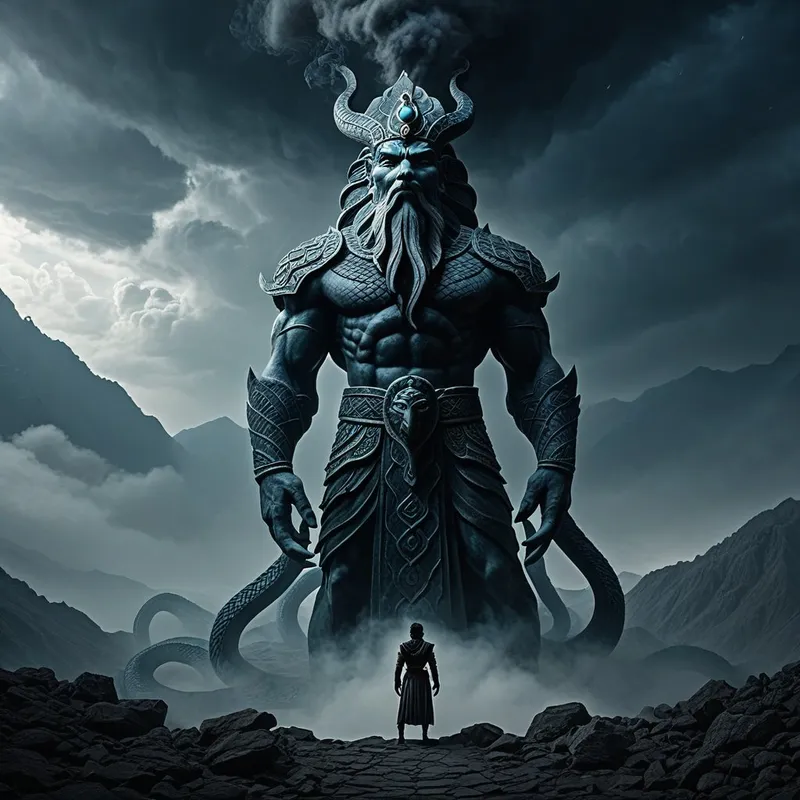
Angra Mainyu Myth Meaning & Symbolism
The cosmic struggle between Ahura Mazda's truth and Angra Mainyu's lie, a foundational myth of choice, moral duality, and the soul's ultimate responsibility.
The Tale of Angra Mainyu
Listen, and hear the tale of the First Choice, the sound that shattered eternity.
Before time was measured, before the mountains were rooted, there existed only Zruvan Akarana. And within that endlessness, two spirits stirred. Not as brothers, but as twins born of a single thought: existence itself. One was Ahura Mazda, whose essence was Asha—the radiant principle of Truth, Order, and Righteousness. His light was not a flame, but a song, a perfect, harmonious frequency that wove the potential for all that was straight, good, and living.
The other was Angra Mainyu. The Hostile Spirit. His essence was Druj—the Lie. Not merely falsehood, but the active, corrosive principle of deceit, disorder, and decay. Where Ahura Mazda’s light sang, Angra Mainyu’s presence was a counter-vibration, a dissonant hum that promised not creation, but undoing.
They beheld each other across the featureless expanse, and in that beholding, the universe was conceived. Ahura Mazda, in his boundless wisdom, saw the path of Asha stretching into a glorious future—a world of flourishing creatures, clean waters, and minds aligned with truth. He spoke this vision into the void, and the first shadows of form trembled into being.
Angra Mainyu saw this, and his choice was made. Not from a place of equal power, but from a fundamental no. He would not join. He would not harmonize. He would oppose. With a roar that was the first sound of violence, he declared his own nature: “I shall not sanctify the living! I shall not choose the right! I shall undo all you plan!”
Thus began the Gumezishn—the great mingling. Like two vast rivers of light and anti-light, they rushed together. Ahura Mazda, knowing the Hostile Spirit’s choice, fashioned his good creation—the sky, the waters, the earth, the plants, the primal bull, and the first man, Gayomard—not as a finished paradise, but as a fortress, a battleground made beautiful. He set it within Time, a bounded span of nine thousand years, for he knew the conflict must have an end.
And Angra Mainyu attacked. He did not create from nothing, but corrupted from the something Ahura Mazda had made. He pierced the sky and brought a plague of darkness. He poisoned the pure waters with salt. He struck the earth and raised mountains not as majestic peaks, but as jagged, painful teeth. He afflicted the primal bull with sickness and slew Gayomard. From this death and corruption, Angra Mainyu fashioned his own legion: demons (daevas), noxious creatures, disease, and death itself—a twisted mirror of the good creation.
The world became the arena. Every sunrise is a skirmish won by Ahura Mazda. Every venomous snake, every lie spoken, every moment of despair, is a raid by Angra Mainyu. The myth tells us the struggle is real, it is now, and our every thought and deed is a soldier on one side or the other. The final battle is prophesied, but the outcome, the ancients whisper, is forged by our hands.

Cultural Origins & Context
This is not merely a story; it is the cosmological bedrock of Zoroastrianism, one of the world’s oldest continuously practiced monotheistic religions, founded by the prophet Zarathustra (Greek: Zoroaster) in ancient Persia (likely circa 1500-1000 BCE). The myth of the two primal spirits is central to the faith’s dualistic worldview, meticulously preserved in the Avesta.
It was a myth for a society defining itself against chaos. In the vast, often harsh Iranian plateau, the struggle for order—against drought, invading tribes, and social strife—was literal. The myth provided a cosmic framework for this struggle. It was recited by priests (Magi) during rituals, embedding its logic into law, morality, and daily life. It answered the perennial question of the origin of evil not with a fall from grace, but with an eternal, conscious choice made by a distinct, uncreated intelligence. This positioned every follower not as a passive sinner, but as an active combatant in a universe where their choices held cosmic weight. The myth’s function was to awaken moral responsibility and define a life of active goodness (Humata, Hukhta, Huvarshta: Good Thoughts, Good Words, Good Deeds) as the only effective resistance.
Symbolic Architecture
At its heart, the myth of Angra Mainyu is a profound map of psychic duality. It externalizes an internal reality: the human capacity for both sublime creation and utter destruction.
Angra Mainyu represents the psychic fact of the counter-will—the innate, often unconscious force within that opposes life, growth, and integration purely for the sake of opposition.
Ahura Mazda symbolizes the organizing, unifying principle of consciousness—the ego’s drive toward meaning, structure, and relationship. Angra Mainyu is the shadow of that drive: the spirit of deconstruction, entropy, and nihilism. He is not “evil” as a cartoonish villain, but as the embodiment of Druj—the Lie. This Lie is not just false information; it is the fundamental distortion of reality that says: “Nothing matters. Connection is an illusion. Growth is futile. Isolate, consume, and deny.”
Psychologically, Angra Mainyu is the archetypal Shadow in its most absolute form. He is the part of the psyche that would rather see the whole self destroyed than submit to the discipline of wholeness. He corrupts rather than creates because his identity is built entirely on reaction. His “power” is parasitic, dependent on the good creation to defile.
The myth’s genius is in making them twins. They emerge from the same source. This tells us that our destructive potential is not alien; it is born from the same ground as our creative potential. The primordial choice is re-enacted in every human moment: do we move toward Asha (truth, alignment) or toward Druj (the lie, fragmentation)?

The Dreamer's Resonance
When this myth stirs in the modern unconscious, it rarely appears as a bearded Persian demon. Its resonance is more intimate and insidious.
To dream of Angra Mainyu is to encounter the Spirit of Sabotage. You may dream of a beloved project—a painting, a relationship, a career path—suddenly rotting from within for no reason. You may hear a voice, often sounding eerily like your own, whispering convincing lies: “You are a fraud. Your love is a burden. Give up.” The dream environment may be a once-familiar home now filled with creeping mold, or a clear stream you are compelled to poison.
Somatically, this dream pattern accompanies periods of profound inner conflict where a part of the self is actively working against conscious goals. It is the psychology of self-sabotage, addiction, or sudden, inexplicable rage that ruins something good. The dream is showing you the “Hostile Spirit” not as an external devil, but as an autonomous complex within your own psyche—a bundle of thoughts, feelings, and memories that has chosen, and continues to choose, the path of Druj. The chilling realization is that you are the arena. The battle is between your own Ahura Mazda (your striving, truthful self) and your own Angra Mainyu (your destructive, deceitful counter-will).

Alchemical Translation
The Zoroastrian myth does not offer a facile victory of light over darkness. It prescribes a lifelong process of psychic alchemy—the Frashokereti (Making Wonderful) or renovation of the self.
The alchemical work is not to destroy Angra Mainyu, but to exhaust his argument, to transmute his chaotic energy by steadfastly building the good creation within.
The first step is Recognition. One must stop projecting the “Hostile Spirit” onto others—the difficult boss, the political opponent, the frustrating partner—and acknowledge this force as an internal reality. My jealousy, my spite, my laziness, my cynicism: these are the legions of Angra Mainyu within me.
The second is Containment in Time. Ahura Mazda bound the conflict to 9,000 years. Psychologically, this means we must bound our inner conflicts. We give them a “time”—a therapy session, a period of reflection, a ritual—so they do not consume our entire identity. We say, “For this hour, I will face this hostility within me,” preventing it from becoming our eternal state.
The third and most crucial is Active Cultivation. Angra Mainyu can only corrupt what exists. The alchemical strategy, therefore, is to create so much robust, truthful inner structure—through good thoughts (mindfulness, study), good words (honest communication, affirming speech), and good deeds (right action, service)—that the corrosive force has less and less to attack. We starve the Hostile Spirit by feeding the Wise Lord.
The ultimate transmutation is realizing that the energy of opposition, when fully confronted and understood, loses its hostile autonomy. Its chaotic force can be integrated as a necessary catalyst for strength and discernment. The rebel without a cause becomes a guardian of the boundary. The lie, when exposed, clarifies the truth. In the end, the myth guides us toward a profound individuation: to become a complete, bounded self where the choice for Asha is no longer a struggle against a twin, but the natural expression of a healed and sovereign soul.
Associated Symbols
Explore related symbols from the CaleaDream lexicon: