Andvaranaut Myth Meaning & Symbolism
A cursed ring of power, forged from dragon's gold, that binds its bearers to a tragic fate of greed, vengeance, and ruin.
The Tale of Andvaranaut
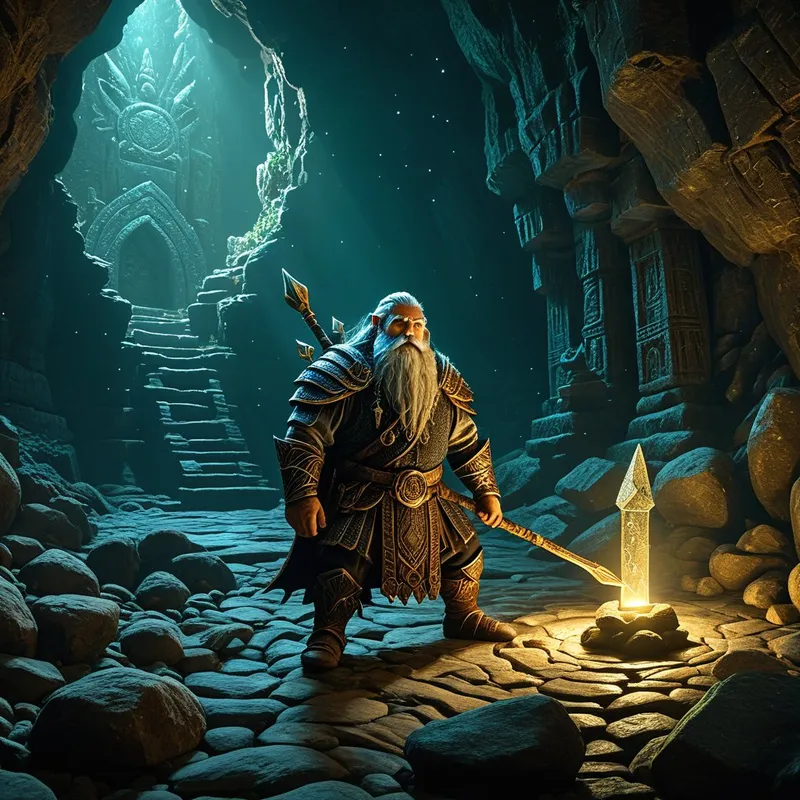
Listen, and hear the whisper of gold that speaks of doom. In the deep places of the world, where the roots of Yggdrasil drink from dark waters, lived the dwarf Andvari. He dwelt not in a hall, but in the stone itself, and his wealth was the wealth of the earth: rivers of gold, mountains of glittering gems, all hoarded in a cavern lit only by the cold fire of precious metal. His greatest treasure was a ring of power, Andvaranaut, from which, like a magical loom, more gold could be woven. In the form of a pike, he swam in the waters of his domain, a scaled guardian of his glittering curse.
Above, in the realm of gods and men, a killing had occurred. The gods Odin, Thor, and the trickster Loki had, through grim fate, slain Otr, who took the form of an otter. The slain one’s father, Hreidmar, demanded a weregild—a ransom of gold so vast it must fill the otter’s skin and cover every hair on its outside.
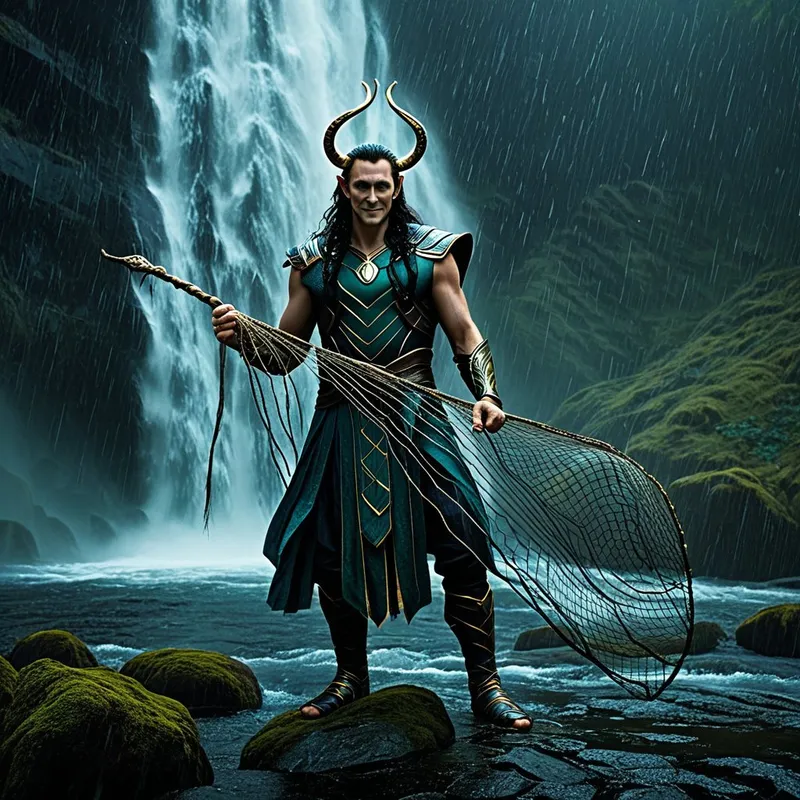
The gods scattered to gather the hoard. It was Loki, the weaver of schemes, who was given the net of the sea-goddess Ran. He journeyed to the waterfall of Andvarafors, cast the net, and caught the shining pike. The dwarf, forced back into his form, stood captive before the laughing god. “Your life,” said Loki, “for your gold.” Andvari, with a heart of stone cracking, led him to the cavern. Loki stripped it bare, taking every coin, every ingot, every gleaming gem. As a final, cruel afterthought, he spied the ring on Andvari’s finger and demanded it too.
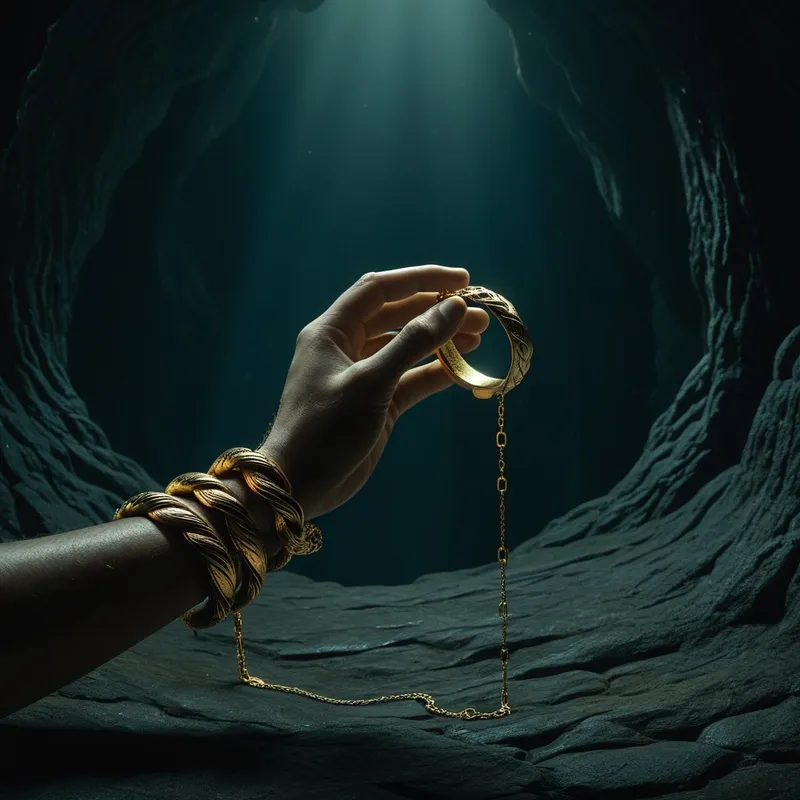
Then the dwarf’s sorrow turned to venom. As Loki pried the ring from his hand, Andvari spoke a curse into the hollow of the metal, a whisper that would echo through the ages: “This ring, and the gold that was drawn from it, shall be the death of all who possess it. It shall breed only avarice, fratricide, and despair. May it be a fire that consumes all who touch it!”
Loki, shrugging off the curse as mere words, delivered the hoard. The otter-skin was filled and covered, but one whisker remained visible. Loki placed Andvaranaut upon it, sealing the payment and sealing the doom. The moment the ring settled, the curse took root in Hreidmar’s hall. Greed, sharp and sudden, pierced his sons, Fafnir and Regin. Fafnir murdered his father for the gold, and, poisoned by its possession, crawled into the wilderness, his humanity sloughing away like dead skin. He grew scales, wings, a fiery breath—he became the dragon Fáfnir, coiled upon his hoard in gnawing, lonely malice. The ring’s work had begun.
Cultural Origins & Context
This tale is part of the great tapestry of the Poetic Edda and is elaborated in the Völsunga Saga. These were not scriptures, but stories carried in the breath of skalds around hearth-fires in the long, dark winters of Scandinavia and Iceland. They were told in halls smelling of smoke and mead, serving as both entertainment and profound instruction.
The myth of Andvaranaut functions as the foundational tragedy for the later hero-saga of Sigurd the Völsung. It establishes the “dragon’s gold” not as a reward for heroes, but as an active, psychic poison. In a culture where wealth, measured in rings and armbands given by lords to retainers, was the literal bond of society (comitatus), this story presents a terrifying inversion: wealth that severs bonds. It asks a critical question of a warrior society: what happens when the symbol of loyalty and honor becomes an object of private, all-consuming avarice? The myth provides the answer: it transforms a man into a monster, and it curses a lineage.
Symbolic Architecture
The ring is not merely a cursed object; it is the perfect symbol of a closed, self-referential system of desire. A ring has no beginning and no end. Andvaranaut, which can breed more gold, is a ring that creates only more of itself—an infinite loop of acquisition devoid of life, connection, or meaning.
The cursed gold is not wealth, but congealed desire, the psychic energy that should flow between beings petrified into a dead weight.
Andvari represents the primal, hoarding instinct of the unconscious—the treasure of potential that lies in the dark, watery depths of the psyche. Loki’s theft is the violent, necessary, yet ultimately corrupting act of bringing this potential to consciousness without respect for its guardian. The curse is the shadow’s price for being plundered. Fáfnir is the ultimate image of this possession: the ego that has identified entirely with its treasure (its status, its wealth, its trauma) and has thereby become isolated, paranoid, and monstrous, dwelling in a barren landscape of its own making.
The myth presents a devastatingly clear psychology of “the shadow of wealth.” The gold is neutral; the curse is in the relationship to it. The moment the gold is seen not as a means for relationship (the weregild to restore balance) but as an end in itself, the curse activates. It is the archetypal pattern of the “tainted gift,” where the fulfillment of a wish carries the seed of its own destruction.

The Dreamer's Resonance
When this myth stirs in the modern soul, it rarely appears as a literal dragon or a dwarf. It manifests in the somatic texture of dreams: the dreamer finding a vault of cold, hard coins that feel repulsive to touch; a beautiful piece of jewelry that, when put on, causes the dreamer’s skin to turn gray and numb; or a looped corridor where every door opens onto the same empty room filled with glittering dust.
Psychologically, this is the process of confronting a “complex” that has turned toxic. The “gold” could be a talent, a relationship, an ideology, or a memory that we have over-identified with and hoarded. It once had value, but our relationship to it has become closed, defensive, and isolating. The curse is the symptom: the chronic anxiety, the envy, the feeling of being trapped by the very thing we thought would liberate us. The dream is signaling that a part of the psyche, like Fafnir, has become dragon-like—it guards a hoard at the cost of all else, and it must be faced and transformed for life to flow again.
Alchemical Translation
The individuation process modeled here is not about slaying the dragon to win the gold, but about breaking the curse on the gold itself. The hero’s journey, which for Sigurd follows this myth, is one of transmutation, not acquisition.
The alchemical work is to take the aurum nostrum—our own cursed “gold” (our fixated ego, our trauma, our grandiosity)—and subject it to the transformative fire of consciousness so it may become the aurum non vulgi, the gold of the philosophers, which is spiritual value.
The first step, embodied by Loki, is the ruthless confrontation with the shadowy hoarder within (Andvari). We must “steal” our own hidden potential from the clutches of unconsciousness, even if it feels like a violation. We must accept that this act will invoke a “curse”—the backlash of old patterns, guilt, and resistance.
The second step is to witness the Fafnir within—to see with clear-eyed compassion how we have become monstrously attached to our positions, our grievances, our treasures. This is not a battle to kill that part, but to understand its origin in pain and fear.
The final, crucial transmutation is what the myth itself lacks but the larger saga hints at: the gold must be put back into circulation. It must be used for life, for building, for love—not hoarded. In psychological terms, the energy bound in a neurosis or a toxic complex must be released and reinvested in the world, in relationship, in creativity. Only then is the ring’s closed circle broken, and the curse lifted. The gold loses its lethal shine and becomes, simply, metal—a tool for the living, not a tomb for the soul.
Associated Symbols
Explore related symbols from the CaleaDream lexicon: