Andromeda & Perseus Myth Meaning & Symbolism
A princess sacrificed to a sea monster is rescued by a hero bearing the head of Medusa, forging a constellation of fate from chains of despair.
The Tale of Andromeda & Perseus
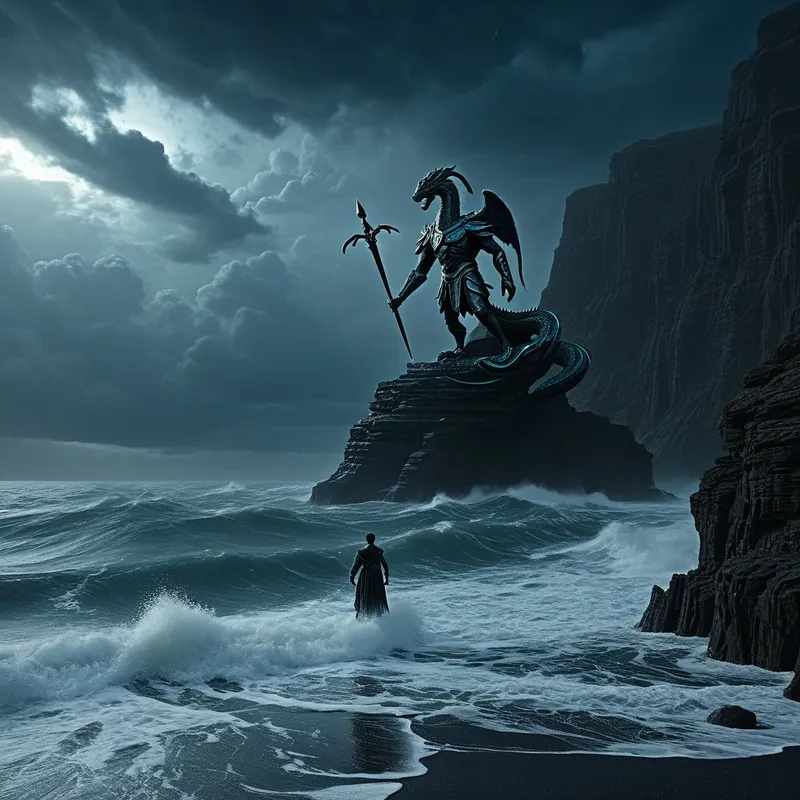
Hear now a tale written in starlight and carved from the bedrock of human fear. It begins not with a hero, but with a mother’s fatal pride. Cassiopeia, seated upon a throne of ivory and gold, dared to boast that her daughter’s beauty surpassed that of the [Nereids](/myths/nereids “Myth from Greek culture.”/). [The sea](/myths/the-sea “Myth from Greek culture.”/) heard her vanity. The waves carried the insult to [Poseidon](/myths/poseidon “Myth from Greek culture.”/) himself, whose wrath is as deep and untameable as the ocean. In retribution, he unleashed Ketos, a beast of scales and terror, to ravage the coast of Aethiopia.
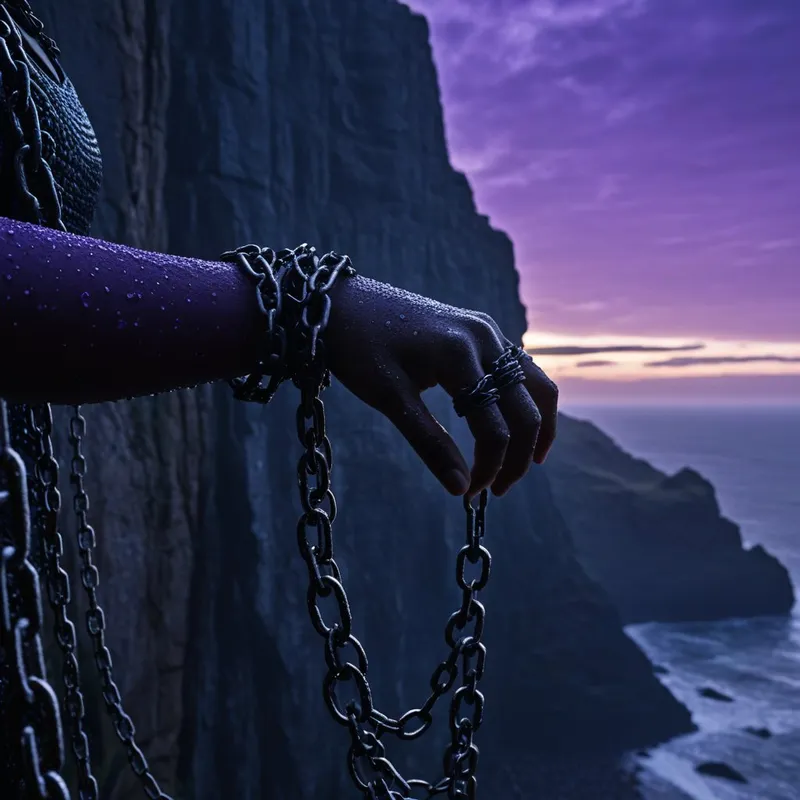
The oracles spoke in smoke and riddles: only the sacrifice of the princess, Andromeda, could appease the god and spare the kingdom. Her own parents, King Cepheus and the now-silent Cassiopeia, bound their daughter in unyielding iron. They chained her to a jagged cliff facing the hungry sea, an offering left to [the wind](/myths/the-wind “Myth from Various culture.”/)’s lament and the approaching shadow beneath the waves. There she stood, not as a princess, but as a monument to despair, the salt spray mingling with her tears, watching [the horizon](/myths/the-horizon “Myth from Various culture.”/) darken with her doom.
But [the Fates](/myths/the-fates “Myth from Greek culture.”/) were weaving another thread. From the western sky, where the sun dies in glory, came [Perseus](/myths/perseus “Myth from Greek culture.”/), returning from his own impossible quest. On his feet were the winged sandals of [Hermes](/myths/hermes “Myth from Global/Universal culture.”/); in his pouch, wrapped in the kibisis, lay the ultimate prize and weapon: the severed head of [Medusa](/myths/medusa “Myth from Greek culture.”/). He saw the scene below—the beauty in chains, the kingdom in mourning, the monstrous ripple far out at sea. His heart, still echoing with [the Gorgon](/myths/the-gorgon “Myth from Various culture.”/)’s curse, understood a different kind of captivity.
As Ketos surged from the depths, its maw a cave of teeth, Perseus dove. The air whistled past his ears. He did not charge blindly; he held aloft the mirrored shield, a gift from [Athena](/myths/athena “Myth from Global/Universal culture.”/), turning it towards the beast. In that polished bronze, he saw not his own reflection, but the true form of the terror—and the strategy to defeat it. With a cry that was part prayer, part battle-shout, he drew the adamantine sword and fell upon the monster. The battle was a tempest of wing, scale, and spray. Finally, with a thrust guided by divine insight, he struck the mortal spot. The beast sank, staining the sea with its dark life.
On the cliff, Perseus used the very chains that bound Andromeda to pull her to safety. The cold iron that was her sentence became the instrument of her liberation. He freed her, and in her eyes, the reflection of the hero replaced the image of the sacrifice. Later, he would use the Gorgon’s head once more, not to destroy, but to petrify a rival suitor and secure his destiny. Andromeda, the bound maiden, became his queen. And when their mortal journey ended, Zeus placed them among the eternal stars—a hero, a princess, a monster, and a mother’s pride, forever fixed in the celestial tapestry.
Cultural Origins & Context
This myth is a quintessential product of the Greek storytelling tradition, most comprehensively recorded in the Bibliotheca of Pseudo-Apollodorus and immortalized in the stars by Ptolemy. It was not a singular, static tale but a living narrative performed by [bards](/myths/bards “Myth from Celtic culture.”/) and rhapsodes, its details shifting like sea-foam across the Aegean. Its societal function was multifaceted. On one level, it was a foundational etiological myth, explaining the origins of the [constellations](/myths/constellations “Myth from Various culture.”/) that bore the names of its characters—Perseus, Andromeda, Cepheus, Cassiopeia, and [Cetus](/myths/cetus “Myth from Greek culture.”/). These celestial maps served as both calendar and cosmology, embedding the story in the nightly reality of every Greek.
On a human level, the myth reinforced core cultural values: the catastrophic consequences of hubris (Cassiopeia’s boast), the absolute necessity of fulfilling divine will (the sacrifice), and the idealized paradigm of the heroic rescue, which cemented social bonds and royal legitimacy. Andromeda’s plight also touched upon the deep-seated anxiety of the ancient world regarding the untamed sea and the monsters of the unknown, making Perseus’s victory a symbolic [triumph](/myths/triumph “Myth from Roman culture.”/) of human courage and cunning (aided by the gods) over primal [chaos](/myths/chaos “Myth from Greek culture.”/).
Symbolic Architecture
Beneath the [epic adventure](/symbols/epic-adventure “Symbol: The epic adventure symbolizes a significant journey, often filled with challenges and triumphs, reflecting personal growth and transformation.”/) lies a profound symbolic [architecture](/symbols/architecture “Symbol: Architecture in dreams often signifies structure, stability, and the framing of personal identity or life’s journey.”/). Andromeda represents the innocent, creative, or sovereign [aspect](/symbols/aspect “Symbol: A distinct feature, quality, or perspective of something, often representing a partial view of a larger whole.”/) of the [psyche](/myths/psyche “Myth from Greek culture.”/) that is chained and offered up—not by a [villain](/symbols/villain “Symbol: A character representing opposition, moral corruption, or suppressed aspects of self, often embodying fears, conflicts, or societal threats.”/), but by the well-intentioned yet flawed parental or cultural complex (Cassiopeia and Cepheus). Her chains are the obligations, [shame](/symbols/shame “Symbol: A painful emotion arising from perceived failure or violation of social norms, often involving exposure of vulnerability or wrongdoing.”/), or projected fears that bind one’s true [nature](/symbols/nature “Symbol: Nature symbolizes growth, connectivity, and the primal forces of existence.”/) to the rock of collective expectation.
The monster from the deep is never merely an external threat; it is the embodied consequence of neglected truth, the psychic eruption caused by a collective lie.
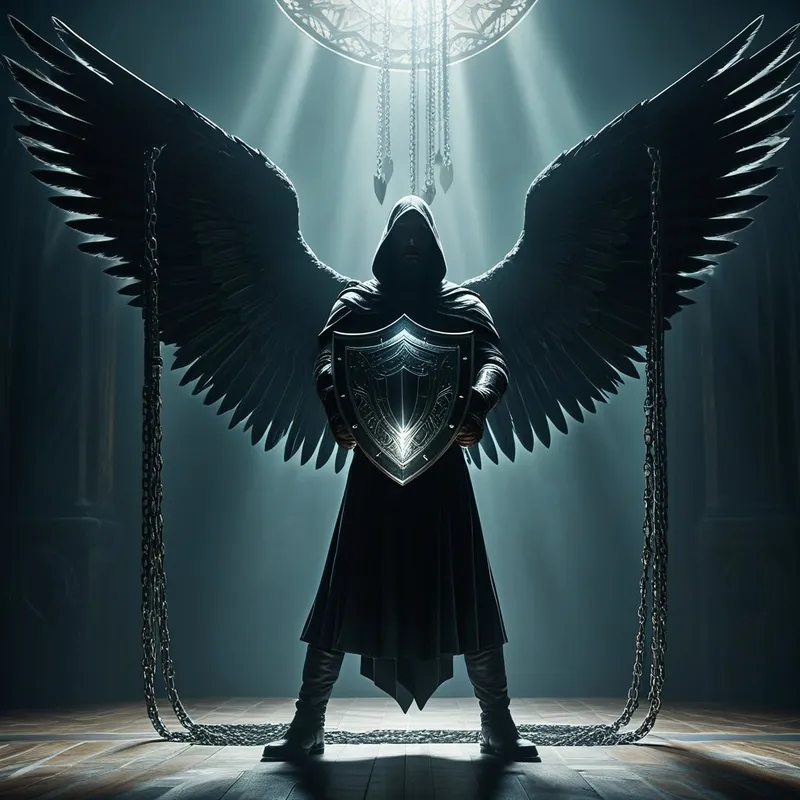
Perseus is not a brute-force [hero](/symbols/hero “Symbol: A hero embodies strength, courage, and the ability to overcome significant challenges.”/). He is the [archetype](/symbols/archetype “Symbol: A universal, primordial pattern or prototype in the collective unconscious that shapes human experience, behavior, and creative expression.”/) of the guided, resourceful [consciousness](/symbols/consciousness “Symbol: Consciousness represents the state of awareness and perception, encompassing thoughts, feelings, and experiences.”/). His tools are symbolic: the winged sandals (elevated [perspective](/symbols/perspective “Symbol: Perspective in dreams reflects one’s viewpoints, attitudes, and how one interprets experiences.”/), agility of thought), the mirrored [shield](/symbols/shield “Symbol: A symbol of protection, defense, and boundaries, representing personal security, resilience, and the need to guard against external threats or emotional harm.”/) (self-[reflection](/symbols/reflection “Symbol: Reflection signifies self-examination, awareness, and the search for truth within oneself.”/), the [ability](/symbols/ability “Symbol: In dreams, ‘ability’ often denotes a recognition of skills or potential that one possesses, whether acknowledged or suppressed.”/) to view [trauma](/symbols/trauma “Symbol: A deeply distressing or disturbing experience that overwhelms the psyche, often manifesting in dreams as unresolved emotional wounds or psychological injury.”/) indirectly), the sword (discernment and decisive [action](/symbols/action “Symbol: Action in dreams represents the drive for agency, motivation, and the ability to take control of situations in waking life.”/)), and the head of Medusa (the transformative, petrifying power of facing the ultimate [shadow](/symbols/shadow “Symbol: The ‘shadow’ embodies the unconscious, repressed aspects of the self and often represents fears or hidden emotions.”/)). His [flight](/symbols/flight “Symbol: Flight symbolizes freedom, escape, and the pursuit of one’s aspirations, reflecting a desire to transcend limitations.”/) signifies the necessary [distance](/symbols/distance “Symbol: Distance in dreams often symbolizes emotional separation, unattainable goals, or the need for personal space and reflection.”/) one must gain from a complex before engaging it. He does not fight the [monster](/symbols/monster “Symbol: Monsters in dreams often symbolize fears, anxieties, or challenges that feel overwhelming.”/) of collective consequence head-on at first; he uses reflection to understand it, then acts with [precision](/symbols/precision “Symbol: The quality of being exact, accurate, and meticulous. It represents control, clarity, and the elimination of error in thought or action.”/).
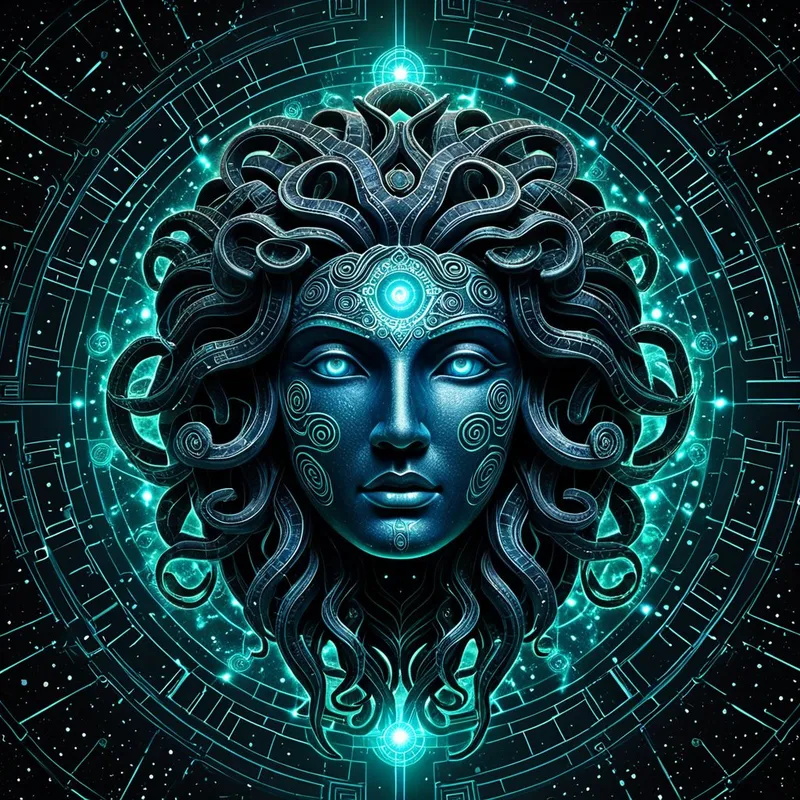
Medusa’s head, the prize from his prior [journey](/symbols/journey “Symbol: A journey in dreams typically signifies adventure, growth, or a significant life transition.”/), is key. It represents the conquered, integrated shadow. What was once a paralyzing gaze of [terror](/symbols/terror “Symbol: An overwhelming, primal fear that paralyzes and signals extreme threat, often linked to survival instincts or deep psychological trauma.”/) becomes, upon [integration](/symbols/integration “Symbol: The process of unifying disparate parts of the self or experience into a cohesive whole, often representing psychological wholeness or resolution of internal conflict.”/), a tool of immense power—able to freeze ongoing, petrified patterns (like the pursuing suitor) in their tracks.
The Dreamer’s Resonance
When this myth stirs in the modern dreamscape, it signals a profound somatic and psychological process. Dreaming of being chained to a rock overlooking a vast, threatening body of [water](/myths/water “Myth from Chinese culture.”/) often correlates with feelings of being sacrificially trapped—by a job, a relationship, a family dynamic, or an internalized belief system. The somatic experience is one of constriction, helplessness, and cold dread, a literal feeling of being “bound” by circumstances.
The appearance of the sea monster in dreams is rarely a literal beast. It manifests as an overwhelming wave of anxiety, a consuming depression, a looming deadline, or a health crisis—the “monstrous” consequence of a situation that feels oceanic and unstoppable. The dreamer is Andromeda, awaiting the devouring culmination of a problem they feel powerless to solve.
If Perseus enters the dream, even as a distant figure or a sudden feeling of potential, it marks the emergence of a rescuing function from within the psyche. This is not a call to wait for an external savior, but an indication that the tools for liberation—the reflective capacity, the winged perspective, the sharp discernment—are now assembling. The dream is staging the conflict between the sacrificed self and the heroic, integrative function that can engage the monster of consequence.
Alchemical Translation
The myth of Andromeda and Perseus is a precise alchemical manuscript for the process of psychic transmutation, or individuation. The [prima materia](/myths/prima-materia “Myth from Alchemical culture.”/), the base matter, is the entangled situation: the hubris (inflated ego/complex), the resulting curse (neurosis/symptom), and the sacrificial victim (the repressed or captive Self).
The first operation is [separatio](/myths/separatio “Myth from Alchemical culture.”/): Andromeda is chained apart from the community. This painful isolation is necessary; [the Self](/myths/the-self “Myth from Jungian culture.”/) must be distinguished from the identity that the family or collective has constructed for it. The rock is the harsh, impersonal reality of one’s own condition.
Perseus’s journey represents the [coniunctio](/myths/coniunctio “Myth from Alchemical culture.”/), the bringing together of disparate, powerful elements (the tools from the gods, his own courage, the lesson of Medusa) to confront [the nigredo](/myths/the-nigredo “Myth from Alchemical culture.”/), the black chaos of the monster. His use of the shield is the quintessential act of psychological work: viewing the terrifying complex not directly, which paralyzes, but through reflection and analysis, which allows for understanding and strategy.
Liberation is achieved not by breaking the chains from the outside, but by using the tension of the chains themselves—the very pressure of the problem—as the leverage for pulling oneself free.
The final transmutation is threefold. Andromeda is freed and elevated to queen (the integrated Self attaining its rightful place). Perseus uses Medusa’s head to solidify his new reality (the integrated shadow becomes a protective, boundary-setting force). And both are stellified—translated into the celestial realm. This is the alchemical [rubedo](/myths/rubedo “Myth from Alchemical culture.”/), the reddening: the permanent transformation of a painful, earthly drama into a guiding, eternal pattern within the cosmos of the individual soul. The myth teaches that our deepest binds, when engaged with reflective heroism, can become the very constellations by which we navigate our lives.
Associated Symbols
Explore related symbols from the CaleaDream lexicon: