Ancestral Beings Myth Meaning & Symbolism
In the Dreaming, Ancestral Beings emerge from the formless earth, singing the world into existence through their epic journeys, struggles, and transformations.
The Tale of Ancestral Beings
In the beginning, there was no time as we know it. There was only the Alcheringa, the Dreaming. The earth lay sleeping, a vast, flat, and featureless plain beneath a silent sky. It was not empty, but potent—pregnant with the shapes of things to come, dreaming of itself.
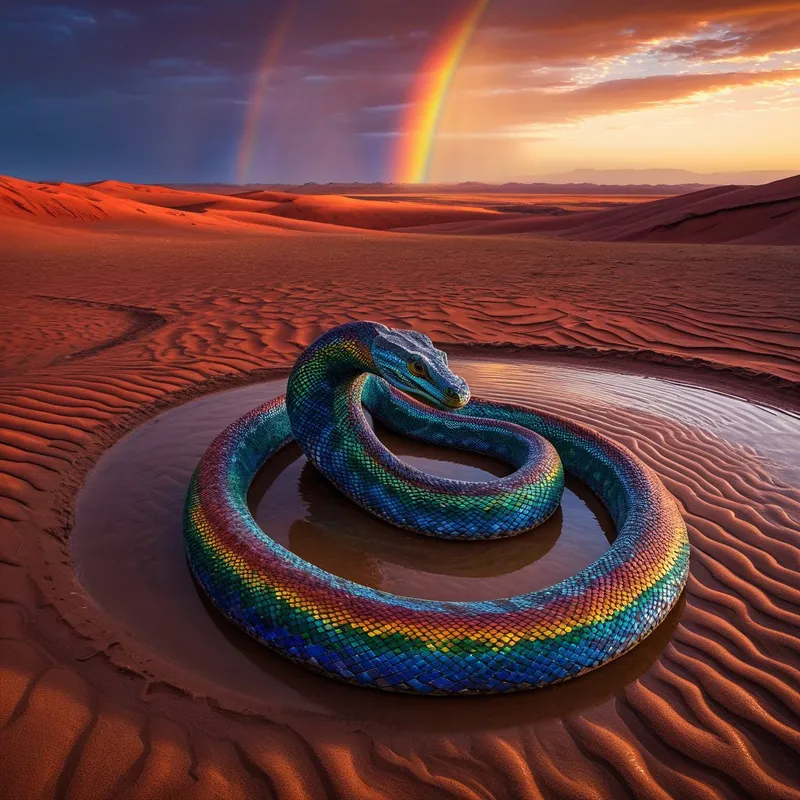
Then, they stirred. From beneath the ground, from within the water, from the very substance of the potential world, the Ancestral Beings awoke. They were not gods from a distant heaven, but embodiments of the land itself taking conscious form. Some rose as immense, shimmering serpents, coils holding the memory of underground rivers. Others emerged as giant kangaroo-men, their powerful legs tense with the need to journey. There were honey-ant women, witchetty grub ancestors, and celestial sisters who were at once human and star.
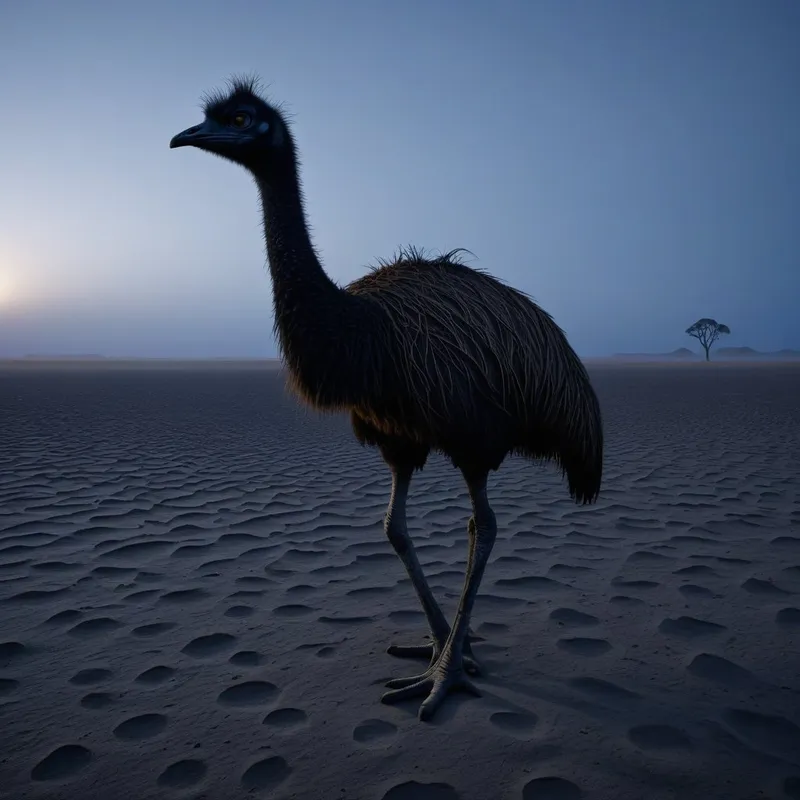
They began to move across the soft skin of the world. And as they moved, the world happened. Where the Rainbow Serpent dragged its colossal body, deep gorges and winding creeks were carved, and water sprang forth where it plunged into the earth. The Emu Ancestor, striding on long legs, pressed depressions that became vital waterholes. The Wati Kutjarra, the two young men on a initiatory journey, threw their spears to create mountain ranges.
This was not mere landscaping. It was a sacred utterance. They sang as they traveled. With every step, with every ritual act, they sang the names of the places into being—the rocks, the trees, the animals, the very air. The song was the law, and the law was the landscape. A conflict arose not from malice, but from the nature of creation itself. Beings clashed, loved, hunted, and performed great ceremonies. In a pivotal struggle, the Rainbow Serpent might swallow the initiates only to disgorge them, transformed and reborn, establishing the ritual of initiation. In their triumphs and failures, the proper order of life—the relationships between species, the rules for marriage, the methods of finding food—was laid down.
Finally, their work complete, the Ancestral Beings did not die. They underwent a final transformation. Some sank back into the landforms they had created, becoming that particular waterhole or that distinctive mountain. Others ascended into the sky, becoming the constellations that watch over the country. They retreated, but they did not leave. Their essence and power remained, sleeping within the features of the land, waiting in the eternal, ever-present Dreaming. The world was now awake, charged with meaning, a living testament written in earth and song.
Cultural Origins & Context
This is not a singular "myth" in the Western sense, but the foundational framework for over 250 distinct Aboriginal Australian language groups and nations. The narratives of the Ancestral Beings constitute The Dreaming or Tjukurrpa (in Central Australian languages). It is not a remote past but a parallel, continuous reality that underpins the present.
Transmission is oral, ceremonial, and custodial. Knowledge is not owned, but held in trust. Specific stories, songs, dances, and artworks belong to particular kin groups and are passed down through generations by Elders. The primary vehicle is the songline or dreaming track—an intricate oral map that details the journey of an Ancestral Being across the country. By singing the songs in sequence, one can navigate vast distances, recounting the creation of each landmark. Its societal function is total: it is cosmology, law, history, geography, and moral instruction. It answers how the world came to be, dictates how to live within it sustainably, and connects every person and every creature to a specific, sacred place of origin.
Symbolic Architecture
The myth presents a radical ontology where being and place are inseparable. The Ancestral Being is not a symbol for the river; it is the river in its eternal, creative aspect.
The world is not a created artifact, but a continuous act of imagination made solid. Identity is not a psychological state, but a geographical and relational fact.
Psychologically, the Ancestral Beings represent the archetypal patterns of the unconscious as they erupt into form. They are the primal drives, instincts, and potentials that, when they "move" through the psyche, structure our inner landscape. Their conflicts and resolutions establish the internal laws—the complexes, the values, the inner ethics—that govern our personal world. The journey is not one of linear progress, but of differentiation: from undifferentiated potential (the featureless plain) to a complex, ordered, and meaningful psychic structure (the sung world). The final "retreat" of the Beings signifies how these foundational archetypes recede from conscious awareness once the basic structures of the personality are laid down, yet they remain as the permanent, living bedrock of the self.
The Dreamer's Resonance
When this mythic pattern stirs in the modern dreamer, it often manifests as dreams of profound connection to or emergence from landscape. One might dream of discovering a hidden map on their own skin, of hearing a compelling song that makes rocks shift shape, or of feeling an animal consciousness awaken within while walking a familiar path that has become strangely sacred and ancient.
Somatically, this can feel like a deep, tectonic settling or re-alignment—a sense of "coming home" to a body that is suddenly recognized as country. Psychologically, it signals a process of foundational identity formation or re-formation. The dreamer is not just learning something new; they are being sung into being anew. It is the psyche working to establish or repair its core laws, its essential relationships between different parts of the self (instincts, passions, intellect). The struggle between Beings in the dream mirrors the necessary inner conflicts that forge a cohesive self. To dream this is to participate in one's own Dreaming.

Alchemical Translation
The alchemical process mirrored here is the opus contra naturam—the work against (or through) nature—but in this cosmology, culture and nature are never split. The psychic transmutation is the journey from potential to essence.
Individuation is not becoming who you are, but singing the world you inhabit into conscious reality. The goal is not to leave the earth, but to become so utterly specific to your place in it that you and it are co-creators.
For the modern individual, lost in abstraction and dislocation, the myth models a path of profound grounding. The "hero's journey" is reframed as the "Ancestor's track." Your task is not to slay dragons in a far-off land, but to walk your own interior songline with full attention. Each challenge, each relationship, each creative act is a step that forms your internal geography. The conflicts are the places where you carve your canyons; the loves are where you leave your waterholes. The triumph is not in conquest, but in commitment to the journey itself, leaving a trail of meaning in your wake. Ultimately, it is the process of discovering that your most personal struggles and joys are the very forces that shape your soul's landscape, and that by living authentically, you do not follow a path—you become the path, a living part of the eternal Dreaming.
Associated Symbols
Explore related symbols from the CaleaDream lexicon: