Anatta Myth Meaning & Symbolism
A journey into the heart of Buddhist wisdom, revealing the liberating truth that the solid 'self' is a story woven from clinging and perception.
The Tale of Anatta
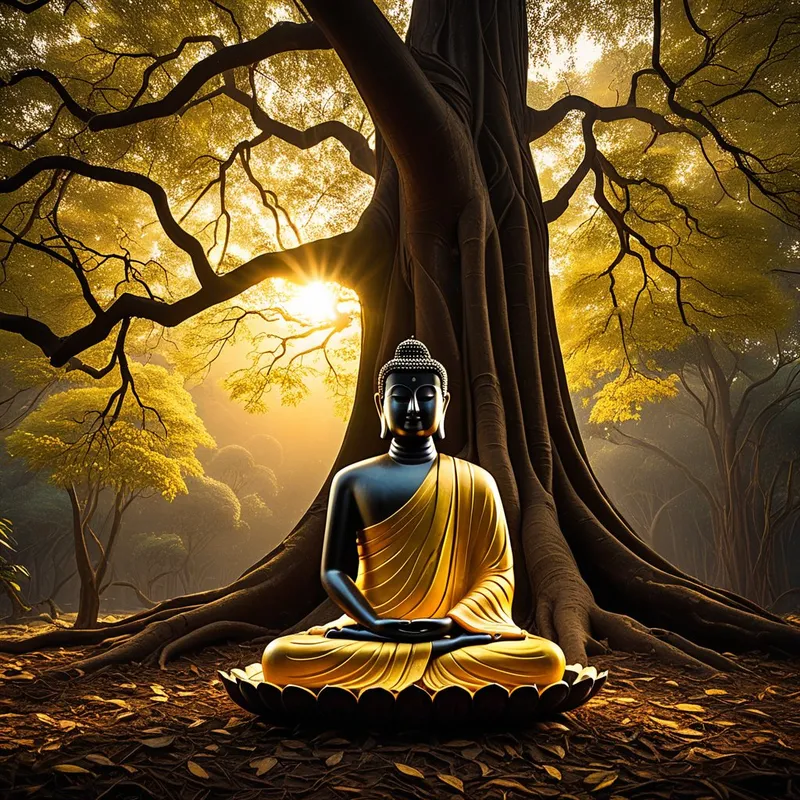
Listen. The story begins not with a bang, but with a profound and unsettling silence. It begins with a man sitting beneath the spreading arms of a Bodhi tree, his body weary from years of seeking, his mind a battlefield.
His name was Siddhartha Gautama, a prince who had traded palaces for forests. For six long years, he had walked the paths of extreme ascetics, starving his flesh, holding his breath until the world swam, seeking the immortal Self, the Atman, that the sages said lay hidden within, untouched by sorrow. He sought it as a man dying of thirst seeks water. He found only bones, breathlessness, and a deepening shadow.
On this night, the air thick with the scent of earth and night-blooming jasmine, he resolved to sit. He would not rise until he knew. The great tempter, Mara, sensing a threat to his dominion of illusion, arose. He did not come as a monster, but as the most intimate of whispers. He sent his daughters, Desire, Discontent, and Lust, who danced with the grace of longing itself. Siddhartha saw them as passing clouds. Mara then marshaled his army—Fear, Doubt, and Derision—a terrifying host that shook the very ground, casting monstrous shadows. Siddhartha did not flinch.
Finally, Mara himself stood before the seated figure, colossal and imposing. “Who are you to claim this seat of enlightenment?” Mara thundered, his voice the sum of all doubt. “By what right do you sit here?” The ascetic, in a gesture of ultimate grounding, reached down and touched the earth with his fingertips. The earth itself roared in witness. “This ground is my witness,” he said, his voice quiet yet filling the universe. “I have earned this seat through countless lifetimes of compassion, through patience as deep as the oceans.” Mara and his legions shattered like clay pots, vanishing into the night.
But the true battle was only beginning. With the outer demons gone, the inner inquiry turned razor-sharp. In the deep watch of the night, he turned his attention to the very seeker, to the one who asked “Who am I?” He observed the five aggregates—form, sensation, perception, mental formations, consciousness—the components from which the sense of “I” is constructed. He saw them with the clarity of a surgeon’s light. He saw form, this body, born of parents, sustained by food, subject to sickness and decay. Not me, not mine. He saw sensations, pleasant and painful, arising and passing like sparks from a fire. Not me, not mine. He saw perceptions, naming and labeling a transient world. Not me, not mine. He saw mental formations, the volitions, the desires, the fears, weaving stories without a storyteller. Not me, not mine. He saw consciousness itself, a knowing that depended on an object, empty and cognizant, like a mirror reflecting whatever appeared before it.
Where in this flowing, dependent, impermanent process was there to be found a permanent, unchanging, independent self? He looked and looked. He found only the process itself—arising, lingering, ceasing. A chariot is a convenient name for an assembly of axle, wheel, chariot-body, and yoke, but search for the chariot apart from these parts, and you find nothing. So too with the self. In that moment of seeing, the great burden—the burden of “I,” “me,” and “mine”—was lifted. The knot of craving that had bound him for eons untied itself. He saw things as they are. And with that seeing, he awoke. He was now the Buddha. The first truth he would later utter was not a declaration of a self found, but of a fundamental misperception corrected: to cling to anything as “self” is to invite suffering.
Cultural Origins & Context
This is not a myth of gods on mountaintops, but a direct report from the frontier of human consciousness. The doctrine of Anatta is the revolutionary heart of the Buddha’s teaching, delivered in the groves and monasteries of ancient India roughly 2,500 years ago. It was a radical counterpoint to the prevailing Vedic and Upanishadic quest for the Atman. The Buddha presented it not as a philosophical speculation, but as a practical, verifiable truth to be realized through mindful observation.
It was passed down orally for centuries by the Sangha, preserved in collections like the Sutta Pitaka. Its societal function was profoundly subversive and liberating. By deconstructing the absolute reality of the self, it undermined the foundations of caste, pride, attachment to clan, and possessive identity. It offered a path to freedom that was dependent not on birthright or ritual, but on direct insight available to anyone willing to look deeply. It was the ultimate democratization of liberation.
Symbolic Architecture
The myth’s symbolic architecture dismantles the central fortress of human suffering: the illusion of a separate, solid self. The Bodhi tree represents the grounded, patient investigation into the nature of reality. Mara is not an external devil, but the personified resistance of the egoic mind—all our clinging, fear, and narcissistic self-concern that fights to maintain its central role.
The self is not a thing to be found, but a process to be understood; not a noun, but a verb.
The five aggregates are the raw materials of our experience. The profound realization is that we habitually grasp one or more of these transient processes, identify with them (“I am my body,” “I am my feelings,” “I am my thoughts”), and thus suffer when they inevitably change. Anatta is the liberating insight that these aggregates are empty of a permanent owner. They are like a river—you can point to it, name it, and use it, but you cannot find a permanent “river” entity separate from the flowing water.
The Dreamer's Resonance
When this myth stirs in the modern psyche, it often manifests in dreams of dissolution, transformation, or unsettling anonymity. You may dream of your face melting or shifting in a mirror, of being in a familiar house where the rooms rearrange themselves, or of being an anonymous figure in a crowd, feeling both terrifying loss and eerie freedom. These are not nightmares of annihilation, but somatic signals of the psyche grappling with the deconstruction of a rigid self-image.
The psychological process is one of ego-dismantling. The dream ego, which normally stars in our nocturnal dramas, begins to lose its solidity. This can feel like a crisis—a “dark night of the soul” where old identities (the successful professional, the devoted parent, the wounded victim) are seen as costumes. The body may register this as vertigo, weightlessness, or a profound somatic release as the armor of a fixed identity loosens. It is the unconscious beginning the alchemical work of solve—the breaking down of outworn forms.

Alchemical Translation
The journey of the Buddha under the Bodhi tree is the ultimate map for the modern individuation process. Psychic transmutation does not occur by building a bigger, better, more spiritual ego. It happens through the courageous negation of what we falsely believe ourselves to be.
Individuation is not the perfection of the personality, but the realization that one is not merely the personality.
The modern seeker’s “Mara” is the inner critic, the attachment to trauma narratives, the pride in our achievements, and the shame in our failures—all claiming, “This is who you really are.” The “touch of the earth” is the movement into embodied presence, into the somatic reality of the here and now, which grounds us beyond our stories.
The alchemical translation of Anatta is the shift from identification to observation. It is to sit with a feeling of anger and know, “This is anger,” not “I am angry.” It is to see a thought of inadequacy arise and know it as a passing mental formation, not the truth of the self. This creates a psychic space—a witnessing consciousness—where the contents of the psyche can be seen, felt, and integrated without being owned absolutely. The “self” becomes a fluid, dynamic center of awareness and relationship, rather than a static statue to be defended. The triumph is not in finding a new self, but in realizing the boundless, compassionate awareness that was always present when the fiction of a separate self gets out of the way. This is the gold born from the lead of our mistaken identity.
Associated Symbols
Explore related symbols from the CaleaDream lexicon: