
Anansi's Basket Myth Meaning & Symbolism
A spider-god's clever theft of all the world's wisdom leads to a humbling lesson, scattering knowledge to be found by all.
The Tale of Anansi's Basket
In the time when the world was still soft and stories were being woven into the fabric of things, there lived Anansi. He was not the largest of creatures, nor the strongest, but his mind was a labyrinth of cunning, and his eight legs were deft at both weaving webs and weaving plots.
Anansi grew restless. He looked upon the world and saw that all wisdom—the knowledge of farming, healing, storytelling, building, and governing—was held by the sky-god, Nyame, kept in a vast, smooth clay pot. Anansi, whose hunger for cleverness was endless, decided he must have it. Not to share, but to own. To be the wisest of all.
He journeyed to Nyame’s court, a place among the clouds where the air tasted of lightning. "Great Nyame," Anansi said, his voice a silken thread, "I wish to buy all the world's wisdom." Nyame, amused by the audacity of the small spider, set a price: Anansi must bring him Onini the Python, who could crush hills; Osebo the Leopard, whose teeth were like daggers; the Mmoboro Hornets, whose sting brought fevered dreams; and Mmoatia the Fairy, who was never seen. Tasks designed for a giant, not a spider.
But Anansi did not rely on strength. He relied on the twist in the tale. To catch Onini, he staged an argument with his wife, Aso, about whether the python was longer than a palm branch, tricking the vain serpent into stretching out straight to be measured—and tied. For Osebo, he dug a deep pit, covered it with brush, and when the leopard fell in, offered a weak web as a ladder, which snapped, trapping the beast in a net. For the hornets, he filled a calabash with water, poured some on a leaf above their nest, and told them a great storm was coming, offering the dry gourd as shelter. They swarmed in, and he sealed the mouth.
Finally, for Mmoatia, he carved a wooden doll and smeared it with sticky sap. He placed a bowl of yam paste in its hands and sat it by a path. The curious fairy, trying to eat the paste, found her hands stuck. "Let go!" she cried to the doll, which said nothing. When she struck it with her other hand, and then her feet, she became utterly trapped. Anansi collected her too.
Presenting his captives, Anansi claimed his prize. Nyame, true to his word, gave him the great clay pot of wisdom. It was heavy, brimming with a light that hummed. Anansi tied it to his chest with a vine and began the climb down to the world of men. But the pot was cumbersome. It bumped against trees and caught on roots. He could not crawl properly; he could not spin a web. His son, Ntikuma, watching from below, called out: "Father! Why not tie the pot to your back? Then you may use your legs!"
In that moment, Anansi, the possessor of all wisdom, was given counsel by his child. A hot wave of shame and revelation washed over him. The great wisdom he had schemed and struggled for was already here, in the simple, observant mind of his son. In a fury of frustration and sudden understanding, he wrenched the pot from his chest and hurled it to the ground. It shattered on the stones of a riverbank.
A glorious, silent explosion of light erupted. Not a fire, but a shimmering mist of countless glowing symbols, words, proverbs, and insights. It rose into the air, caught by the wind, and scattered across the whole world—into the rivers, the soil, the roots of trees, and the minds of all people. Some settled deep, becoming instinct. Some landed in the open, waiting to be found. Anansi, now free of his burden, watched it go. And then, with a sigh that was both defeat and relief, he scurried up a nearby tree to spin a new, elegant web, a little wiser, and a little more humble.

Cultural Origins & Context
The myth of Anansi’s Basket (or Pot of Wisdom) originates from the Akan people of West Africa, specifically within the Ashanti tradition of what is now Ghana. It is a cornerstone of the vast cycle of Anansesem (spider stories). These tales were not mere children's fables but the vital vessels of cosmology, ethics, and social law. Told in the evening by elders and griots (oral historians), they functioned as the community's living library and moral compass.
The story was performed, not just recited. The teller would embody Anansi’s cunning, Nyame’s authority, and Ntikuma’s innocence, using gesture, song, and call-and-response to engage the audience. Its societal function was multifaceted: it explained the distributed nature of knowledge (no one person can know everything), it validated the wisdom of the young and observant, and it served as a cautionary tale about the dangers of greed and hubris, even for the cleverest among us. Most importantly, it democratized wisdom. It taught that understanding is not a treasure to be hoarded in a royal court or a priesthood, but a seed scattered in the world, available to anyone patient and perceptive enough to cultivate it.
Symbolic Architecture
At its heart, this myth is about the paradox of wisdom. Anansi, the trickster, represents the brilliant, acquisitive intellect. His desire to possess all wisdom is the ego’s ultimate fantasy: total control through total knowledge. The clay pot is the symbol of contained, centralized, and static wisdom—a completed thing. It is perfection, and therefore sterile. It cannot grow, adapt, or be questioned.
The vessel that seeks to contain all wisdom becomes a prison for the one who carries it.
The four impossible creatures represent the wild, untamed aspects of the world and the self that cannot be conquered by cunning alone, only temporarily tricked and constrained. Their capture signifies the ego’s temporary triumph over chaos. But the true crisis comes not in the acquisition, but in the transportation. The pot on the chest is the burden of identified knowledge—"I am the one who knows." It cripples natural movement and instinct.
Ntikuma, the son, represents the spontaneous, unburdened insight of the Self beyond the ego. His suggestion is not derived from the pot’s wisdom but from immediate, embodied perception. It is the voice of the innate, intuitive intelligence that the ego, in its arrogance, has silenced. The shattering of the pot is the necessary catastrophe of humility. It is the dissolution of the ego’s prized possession for the sake of liberation and life.
The scattering of the wisdom is the myth’s central alchemical act. It transforms wisdom from a noun (a thing owned) into a verb (a process engaged). It becomes potential knowledge, embedded in experience, relationship, and the living world.
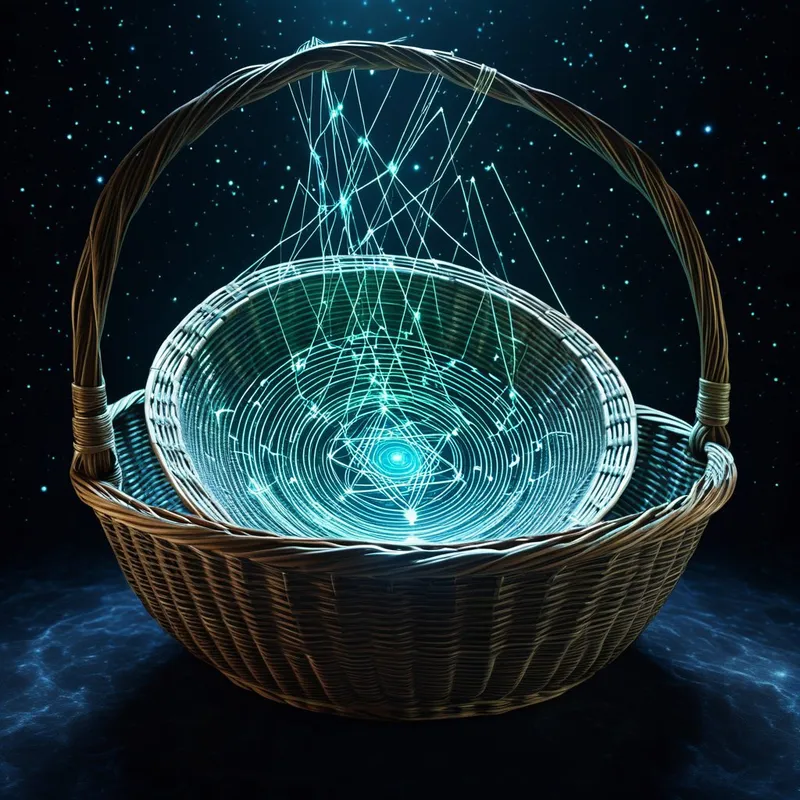
The Dreamer's Resonance
When this myth stirs in the modern psyche, it often manifests in dreams of futile burden, sudden release, and scattered treasures. You may dream of desperately carrying a heavy, precious object that impedes your escape or your progress. You may dream of a container—a box, a vase, a hard drive—shattering, with its contents (light, water, insects, jewels) exploding outward in a mix of terror and awe. You may dream of a child or an animal offering you a simple, obvious solution to an intractable problem.
Somatically, this echoes the process of releasing a core identification—often with being "the smart one," "the responsible one," or "the one who has it all figured out." The body carries this as tension in the chest and shoulders (the pot on the front), a literal weight of persona. The dream impulse is the psyche’s move to shatter this rigid container. The accompanying feeling is often one of profound relief mixed with loss, a somatic unclenching as the burden of pretended omniscience falls away. You are not losing wisdom; you are being forced to stop performing it, allowing it to become a living, breathing part of your being.

Alchemical Translation
The individuation journey modeled here is the transmutation of cunning into wisdom, and possession into participation. Anansi begins as the archetypal Jester, using his wit to defy the gods and seize their treasure. This is a necessary, early stage—the ego’s heroic (if flawed) assertion against the overwhelming parental archetype of Nyame (the Ruler).
The alchemical operation is in the failure. The pot cannot be integrated by carrying it; it must be broken. This is the nigredo, the blackening, the moment of despair and humiliation where the ego’s project lies in ruins. "All that work, for nothing!" But from this darkness comes the true gold.
Individuation is not the gathering of all light into oneself, but the courageous scattering of one’s light into the world, trusting it will take root in unexpected places, including within.
The modern individual undergoes this when a tightly held identity—"I am my career," "I am my intellect," "I am my trauma"—becomes too heavy to bear and shatters. What feels like a breakdown is the scattering of that concentrated, pathological self-concept. The wisdom it contained is not lost; it is liberated from the fragile pot of a single story. It becomes available to be rediscovered in daily life, in relationships, in moments of silence, and in the simple, Ntikuma-like observations we previously ignored.
You are then free, like Anansi, to spin your web again—but now it is a web of connection, not entrapment. Your wisdom is no longer a trophy on your shelf, but the very silk with which you engage the world, delicate, strong, and designed to catch not prey, but the nourishing dew of lived experience. The basket is always emptying so that it may always be filled.
Associated Symbols
Explore related symbols from the CaleaDream lexicon: