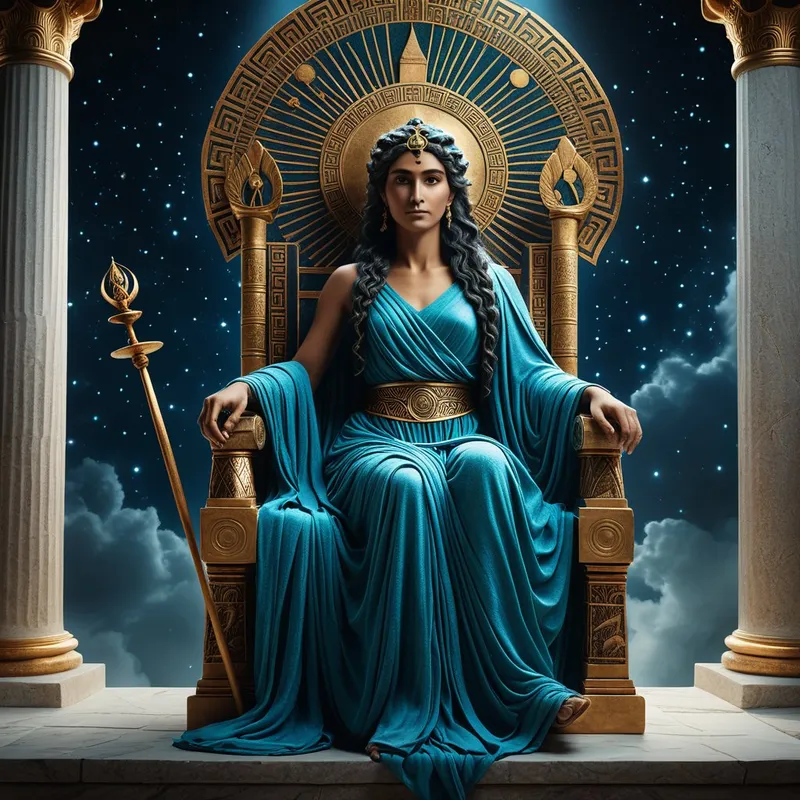
Ananke Myth Meaning & Symbolism
Ananke, the primordial goddess of necessity, binds the cosmos with her coils of inevitability, a force older than the gods themselves.
The Tale of Ananke
Before the sun knew its path, before the sea learned its tides, there was the Silence. And in that Silence, a stirring. Not a birth, but an emergence. From the formless, endless dark, she simply was. Ananke. Her name was not spoken, for there was no tongue to speak it; it was known in the marrow of existence, a pressure, a law written before words.
She was not alone. With her, from that same primordial womb, came Chronos, Time himself, a great serpent of endless becoming. They were twins in the first dawn of being, and their union was not of passion, but of absolute necessity. Where Ananke was the unyielding law, Chronos was the relentless flow. Together, they coiled around the raw egg of Chaos, their bodies—hers of adamantine spirit, his of celestial matter—forming the first boundary, the first constraint. Their embrace was the first sentence of the cosmos, a binding that said: "This shall be."
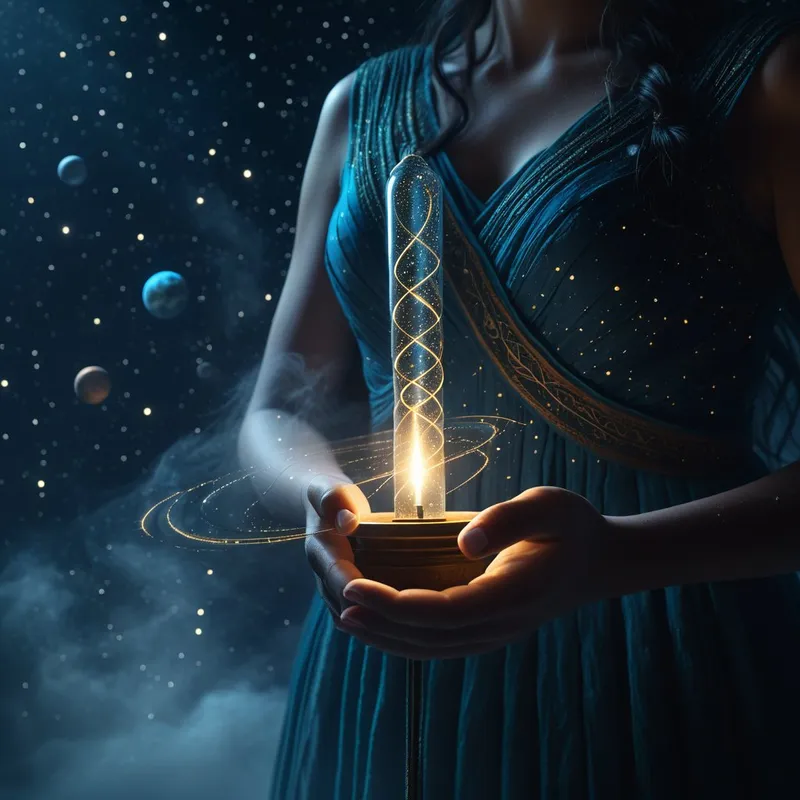
As they turned, the egg cracked. From it spilled the raw stuff of creation: the ether, the earth, the deep waters, the misty air. And still, Ananke and Chronos turned, their spiraling dance pressing this chaos into shape, winding it upon the spindle of fate. She held the distaff, the raw wool of possibility. He provided the turning. And from their work, the threads of the Moirai were drawn—Clotho, Lachesis, and Atropos—her daughters, who would weave the specifics of destiny for every living thing.
The gods who came after—Zeus with his thunderbolt, Poseidon with his trident—they ruled from gleaming thrones on Olympus. But they too bowed their heads, however reluctantly, to the silent, turning presence of Ananke. For her law was not written on tablets, but in the foundation of reality itself. Even Zeus could not alter the portion she had allotted. She was the prison of the Titans, the reason the seasons turn, the inescapable pull that draws the soul to its end. She sat, eternal and unmoved, at the very axis of the turning world, and her gaze was the gaze of the inevitable.
Cultural Origins & Context
The figure of Ananke is a relic of the most ancient stratum of Greek thought, a pre-Olympian deity who represents a philosophical concept given divine form. Her primary appearances are not in popular epic poetry like Homer's, but in the more esoteric, philosophical works such as the Orphic theogonies and the writings of philosophers like Plato. In his Republic, Plato describes her as the mother of the Moirai, seated beside Chronos at the center of the cosmos, turning the spindle of necessity.
This tells us her myth was not for the marketplace or the theater, but for the mystery cults and philosophical schools. It was a narrative for those pondering the fundamental nature of reality: What is the ultimate power? Is it the capricious will of the Olympians, or is there a deeper, impersonal order to which even gods are subject? Ananke answered this. She was the societal function of absolute law, the recognition that certain things—death, decay, the turning of celestial bodies—are beyond petition or sacrifice. Her worship was likely minimal, if it existed as cult practice at all; her power was acknowledged through contemplation, not supplication. She was the mythic embodiment of a cosmic principle, passed down by poets and thinkers who sought to map the architecture of existence.
Symbolic Architecture
Ananke is the archetype of the inescapable. She symbolizes not just fate as a story written in advance, but as necessity—the logical, physical, and existential constraints that define all being.
To encounter Ananke is to confront the boundaries of the self, the limits of will, and the non-negotiable conditions of existence.
Her adamantine nature speaks to absoluteness. Adamant was the mythical unbreakable substance; her laws are the unbreakable parameters of life. Her spindle is the tool of creation and constraint; to be given form is to be given limits. Her union with Chronos is profoundly symbolic: Time is the medium through which necessity operates. We are bound by time, by aging, by sequence—this is Ananke's work.
Psychologically, Ananke represents the superordinate complexes and instincts that govern the psyche beyond the ego's control. She is the compulsion of the trauma response, the inevitability of certain developmental stages, the deep, archetypal patterns that dictate the "plot" of our lives long before we are conscious of them. She is the inner tyrant of "I must" and "I cannot," the voice of existential givens: you were born to these parents, in this body, in this era. This is the raw material—the thread on her distaff—from which the Moirai (the more personal, detailed fates) weave the specific tapestry of a life.
The Dreamer's Resonance
When Ananke appears in the modern dreamscape, she rarely comes as a named goddess. She manifests as atmosphere and immutable structure. The dreamer may find themselves in a labyrinth with walls that slowly, inexorably close in. They may be trying to run on a treadmill that speeds up to match their panic, or be bound by chains that have no lock, only a seamless, cold integrity. They may encounter a vast, silent machine—a clock, a loom, a press—that operates with a purpose they cannot fathom but must submit to.
Somatically, this dream pattern correlates with feelings of profound constraint, often during life passages where options seem to collapse: a serious diagnosis, the death of a loved one, the inevitable consequences of a long-made choice, or the crushing weight of systemic or familial obligation. The psyche is processing the somatic truth of limitation. It is not a nightmare of monsters, but of mathematics—the cold equation of reality asserting itself. The psychological process is one of coming to terms. The ego is fighting a law of the inner world, a deep psychic necessity—perhaps the need to leave a relationship, to face a repressed truth, or to accept an aspect of the self that has been denied. The dream is the soul's way of saying, "This force is older and stronger than your resistance. The work is not to break it, but to understand your place within its turning."
Alchemical Translation
The individuation process, the journey toward psychic wholeness, is not a path of infinite freedom. It is a negotiation with necessity. Ananke models the crucial alchemical stage of mortificatio—the necessary death, the dissolution of the ego's grand fantasies of total control.
The first step toward true sovereignty is to kneel before the throne of what cannot be changed.
To integrate Ananke is to perform a profound act of discernment: to separate the chains of neurosis (which can be broken) from the cords of destiny (which must be worn). The modern seeker must locate their own "spindle of necessity." What are the non-negotiable truths of your nature? Your deepest wounds? Your core gifts? Your mortality? These are your adamantine threads. The alchemical work is to take up this spindle yourself—to stop railing against the fact that you have a fate, and begin to consciously spin it.
This is where Ananke's daughters, the Fates, offer a key. If Ananke is the impersonal law, the Fates are the personal application. In individuation, we move from being passive subjects of fate to active participants in destiny. We take the raw material Ananke provides—our inherent limitations, our time-bound existence, our specific history—and, with conscious effort, we weave it into a coherent, meaningful life. We cannot choose the thread, but we can choose the pattern. To honor Ananke is not to succumb to fatalism, but to achieve a mature humility that liberates energy previously wasted on futile rebellion. It is to find, within the very heart of constraint, the paradoxical freedom of authenticity. You become the ruler of a kingdom whose borders are finally, and mercifully, defined.
Associated Symbols
Explore related symbols from the CaleaDream lexicon: