Amrita Kumbha Myth Meaning & Symbolism
A celestial pot of immortality, churned from the cosmic ocean, becomes the ultimate prize in a divine war between gods and demons.
The Tale of Amrita Kumbha
In the beginning, before time was measured in years, the universe was a sea of potential, a milky ocean of unmanifest dreams. The Devas and the Asuras, locked in an eternal dance of order and chaos, found themselves weary, their power waning. A great malaise had fallen upon all beings. Mortality was a shadow that touched even the divine.
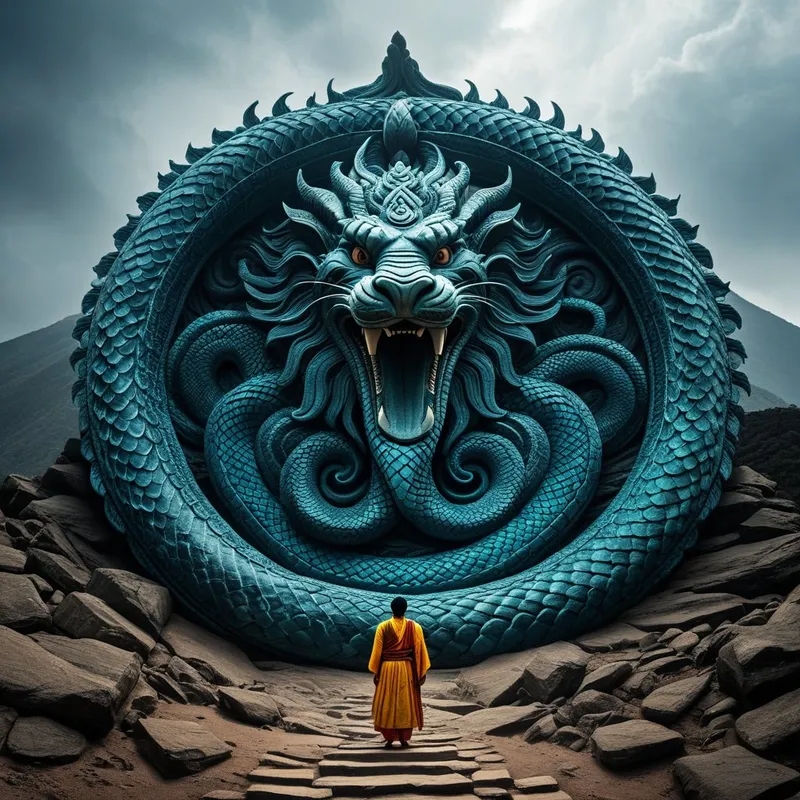
From the depths of this collective longing, a plan was forged—a plan of impossible ambition. They would churn the cosmic ocean, the Kshirasagara, to extract its deepest secret: the Amrita. But to stir the infinite, one needs a mighty rod and a titanic rope. The mountain Mandara was uprooted to be the churn. The great serpent-king Vasuki offered himself as the cord. The Vishnu, in his form as the great tortoise Kurma, plunged to the bottom of the abyss to bear the mountain on his immortal shell.
And so the churning began. The Devas took the head of the serpent, the Asuras his tail. They pulled. The mountain spun. The ocean heaved and frothed. First came terrible poisons, a dark, seething Halahala that threatened to consume all creation. The god Shiva, in an act of supreme containment, drank the poison, holding it in his throat, which turned blue—a permanent testament to the cost of creation.
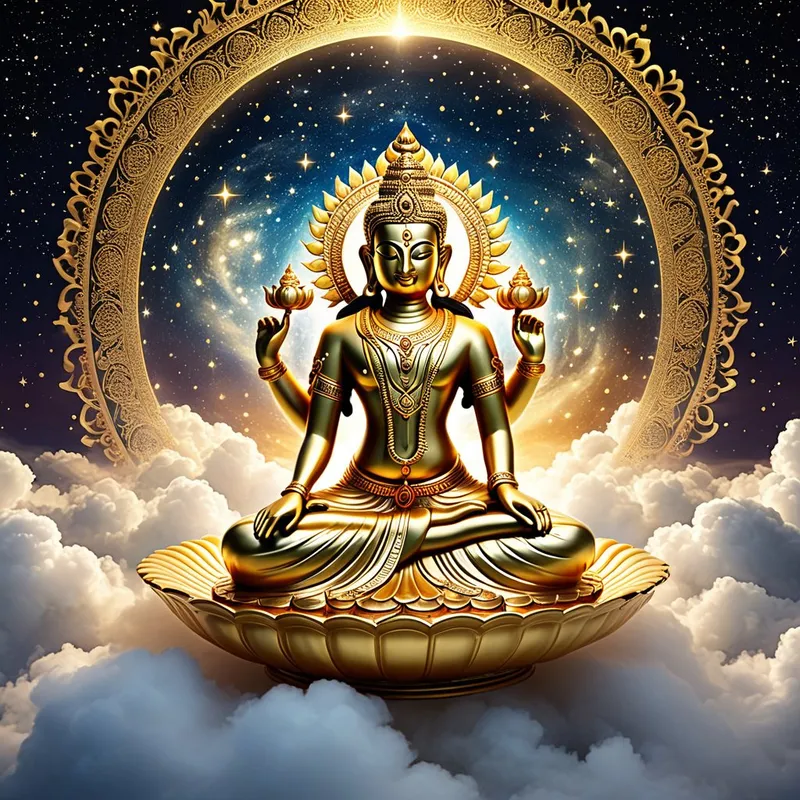
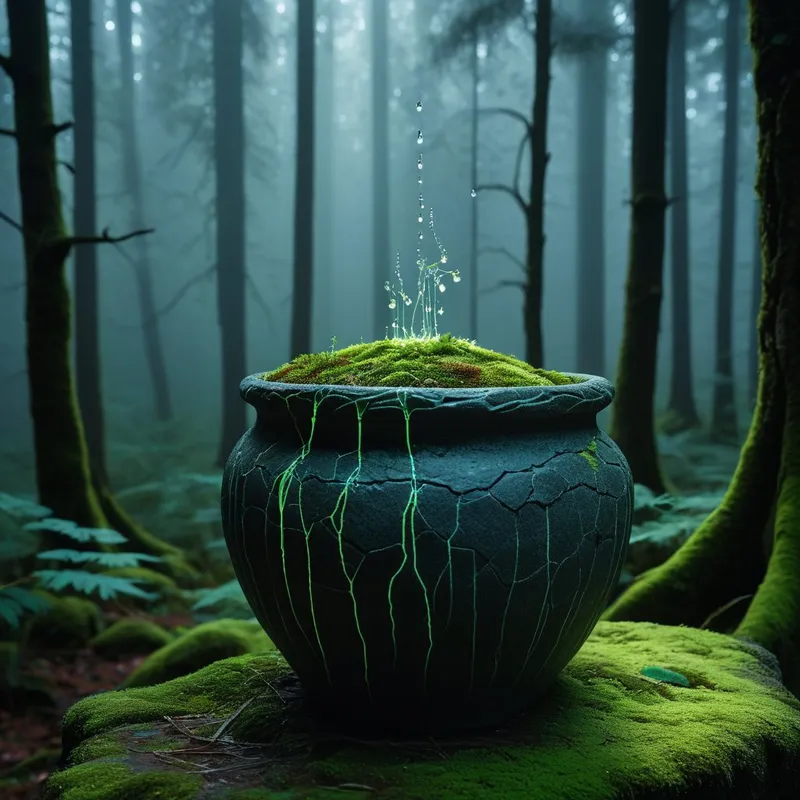
Then, wonders emerged from the depths: the celestial cow, the wish-fulfilling tree, the goddess of wine. Finally, rising with a radiance that dimmed the stars, came Dhanvantari, holding aloft the Amrita Kumbha. It was a vessel of blinding splendor, containing the essence of eternal life.
A silence fell, thick and hungry. Then, chaos erupted. The Asuras, driven by primal desire, snatched the pot. A titanic struggle ensued across the skies. To protect the nectar, the great god Vishnu took the form of Mohini, a being of mesmerizing beauty. Enthralled, the Asuras handed her the pot. With divine grace, she served the Devas, granting them the sip of immortality. But a few drops fell—to Prayag, to Haridwar, to Ujjain, and to Nashik—sanctifying the earth forever. The Kumbha was secured, the cosmic balance preserved, but the memory of that struggle, and the promise of that nectar, was etched into the soul of the world.
Cultural Origins & Context
The myth of the Amrita Kumbha is not a single story but a foundational episode within the grand narrative of the Puranas, particularly the Vishnu Purana and the Bhagavata Purana. It is the cosmological explanation for the Kumbh Mela, the immense pilgrimage that draws tens of millions to the four drop-sites every twelve years. For millennia, this myth was transmitted orally by storytellers and priests, performed in temple dramas, and illustrated in vibrant miniature paintings. Its societal function was multifaceted: it explained the origin of divine beings and earthly sacred sites, it reinforced the concept of dharma through the ultimate triumph of the Devas (order) over the Asuras (chaos), and most importantly, it provided a tangible symbol—the Kumbha—for humanity’s most profound yearning: to transcend suffering and death. It framed immortality not as a given, but as a prize won through immense collective effort, sacrifice, and divine intervention.
Symbolic Architecture
The Amrita Kumbha is the ultimate symbol of wholeness, the Self achieved. The churning of the ocean represents the arduous process of psychological and spiritual integration. The ocean itself is the unconscious, vast and containing all possibilities—both luminous wonders and deadly poisons.
The nectar of immortality is not found on the tranquil surface of the psyche, but in its deepest, most churned depths, where light and shadow are inextricably mixed.
The Devas and Asuras are not merely external forces of good and evil. They are the internal polarities of the psyche: the conscious striving for order (Devas) and the unconscious, instinctual, often “demonic” drives for power and possession (Asuras). The myth insists that both are necessary for the alchemical work; one cannot churn the ocean with one force alone. The poison (Halahala) that emerges first is the shadow material, the repressed trauma, rage, and fear that must be acknowledged and contained (as Shiva does) before any healing nectar can appear. The Kumbha, the vessel, is the cohesive structure of the individuated psyche—the strong, sacred container that can hold the transformative, life-giving essence without being shattered by its power.
The Dreamer’s Resonance
When this myth stirs in the modern dreamer, it often signals a profound period of inner churning. One may dream of tumultuous oceans, of being caught in a great tug-of-war, or of finding a simple yet radiant vessel in an unexpected place. The somatic experience is one of deep agitation and subsequent potential release—a feeling of being pulled apart by conflicting desires (the career versus the soul, security versus freedom) or of processing a backlog of emotional “poison.”
The dream of the Kumbha asks: What in your life is being churned? What opposing forces within you are locked in a stalemate, and what mountain of your identity are they using as a tool? The appearance of the vessel suggests the nascent formation of a new psychological container—a stronger ego-structure or a spiritual practice—capable of holding the transformative insights beginning to surface. It is the dream of the crucible, where the base metals of everyday experience are being subjected to immense pressure to yield their gold.
Alchemical Translation
The journey of the Amrita Kumbha is a perfect map for the Jungian process of individuation. The first step is the descent—the recognition of lack, the divine discontent that forces us to engage with our own depths (the ocean). We then must enlist all parts of ourselves, both the “good” and the “bad,” to begin the work (the churning). This inevitably brings the shadow to the surface in toxic forms: old wounds, destructive patterns, deep-seated anger. The alchemical task here is not to expel this poison, but to transmute it through conscious suffering and containment (Shiva’s act).
Individuation is the slow, painful, and glorious churning of one’s own experience until the personal elixir—the unique meaning and vitality of one’s life—distills.
Only after this can the true treasures emerge: creative powers, inner nourishments, and finally, the integrated Self (the Dhanvantari figure) bearing the Kumbha. Yet the work is not done. The “demonic” aspect, the ego that wants to possess this wholeness for its own aggrandizement, will try to claim it. The final, crucial transmutation is the development of Mohini-consciousness—the ability to step outside the binary struggle, to wield discernment and graceful intelligence to ensure the nectar serves the soul’s life, not the ego’s inflation. The drops that fall to earth signify that this ultimate achievement is not for the individual alone; true immortality is found in how our personal transformation sanctifies the ground we walk on and nourishes the world around us.
Associated Symbols
Explore related symbols from the CaleaDream lexicon: