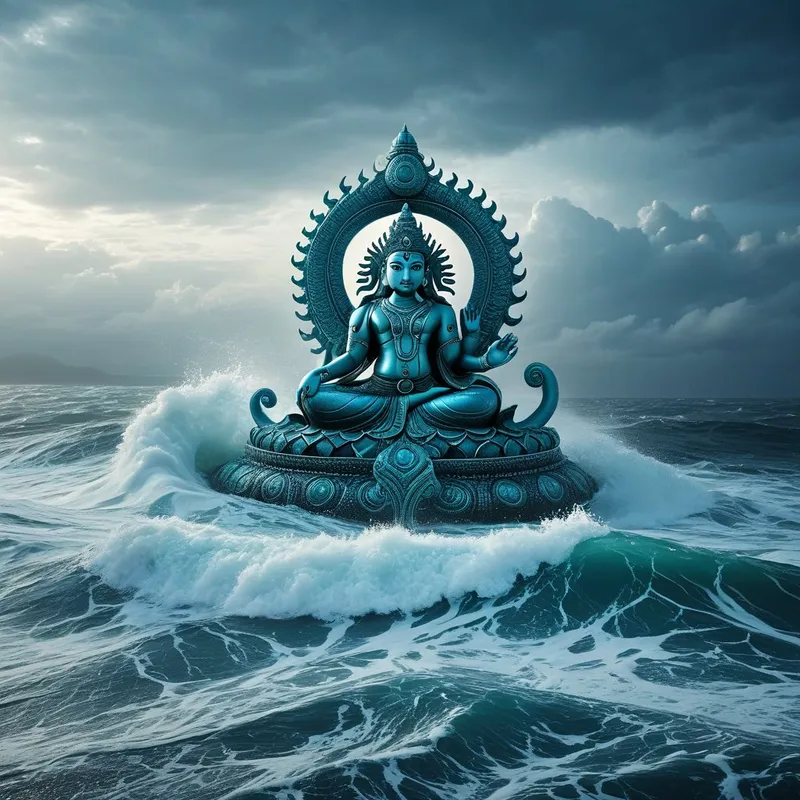
Amrita Myth Meaning & Symbolism
The churning of the cosmic ocean for the nectar of immortality, a tale of divine collaboration, cosmic struggle, and the ultimate prize of eternal life.
The Tale of Amrita
In the age when the world was young and the boundaries between realms were thin, a great weariness fell upon the cosmos. The devas, lords of light and order, found their vitality waning, their radiance dimming under the shadow of mortality. Their ancient foes, the asuras, lords of might and passion, too felt the same creeping decay. A shared desperation, a singular hunger, echoed in the hollows of both their heavens and their underworlds: the hunger for immortality.
Thus, a fragile truce was forged upon the shore of the Kshirasagara. Their goal was Amrita, the essence of deathlessness, lost in the ocean’s infinite depths. For a churn, they uprooted the cosmic mountain, Mandara. For a rope, they persuaded the king of serpents, the mighty Vasuki, to coil himself around the mountain’s peak. The devas took the serpent’s tail, the asuras his head, and with a collective roar that shook the foundations of time, they began to pull.
Back and forth, in a rhythm as old as creation itself, they churned. The ocean frothed and boiled. But the mountain began to sink, threatening to plunge into the abyss. From the depths of his cosmic slumber, Vishnu awoke. Taking the form of a colossal turtle, Kurma, he dove beneath the waves, offering his indestructible shell as the pivot for the churning rod.
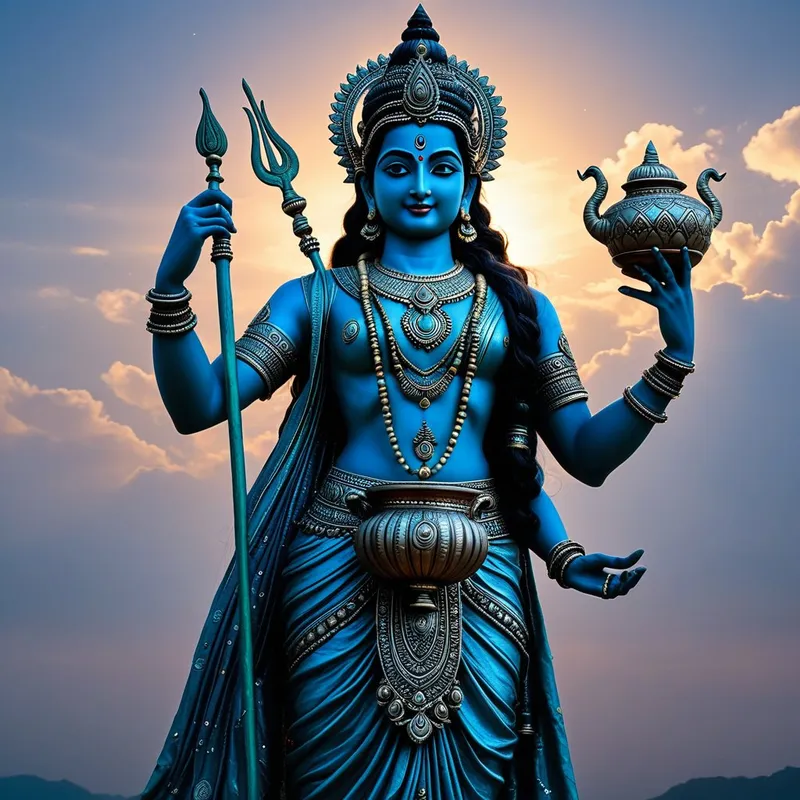
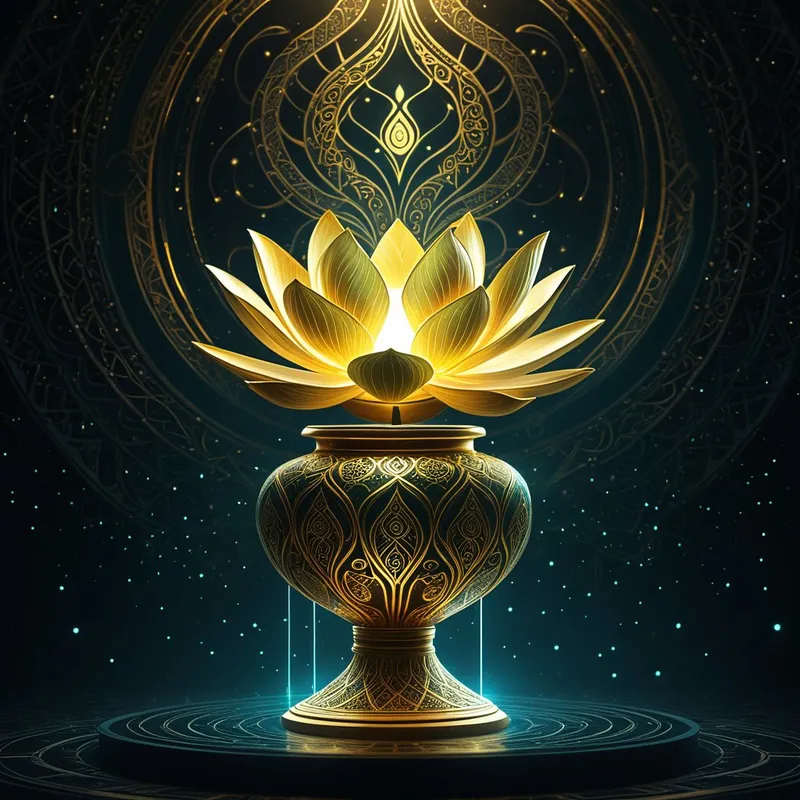
And then, the ocean gave birth. Not first to nectar, but to wonders and terrors both. A deadly poison, Halahala, erupted, threatening to consume all creation. The world held its breath until the great ascetic, Shiva, gathered the venom in his palms and drank it, holding it in his throat, which turned blue—a sacrifice that saved existence. Then came the celestial cow, the wish-fulfilling tree, the moon, the goddess of wine, until finally, radiant as a thousand suns, the physician of the gods, Dhanvantari, emerged from the foam. In his hands, he held the pot, the Kumbha, brimming with the luminous, liquid gold of Amrita.
The truce shattered. A fierce battle erupted over the prize. Seeing the chaos, Vishnu again intervened, this time in the form of Mohini, an enchantress of unparalleled beauty. Mesmerized, the asuras agreed to let her distribute the nectar. She sat the devas and asuras in separate rows. To the devas, she gave the Amrita. But to the asuras, she gave only illusion. One asura, Rahu, disguised himself among the devas and took a sip. The sun and moon gods saw him and cried out. Vishnu, discarding the Mohini form, swung his celestial discus, Sudarshana Chakra, severing Rahu’s head. But the nectar had reached his throat—his head became immortal, forever chasing the sun and moon across the sky in an eternal eclipse. The devas, fortified with Amrita, regained their sovereignty, and the cosmic order was restored, forever changed by the struggle at the ocean’s heart.
Cultural Origins & Context
The myth of Amrita, central to the episode known as Samudra Manthan, is not a singular story but a vast, resonant motif woven into the fabric of Hindu thought. Its most famous renditions are found in epics like the Mahabharata and in Puranic literature, such as the Vishnu Purana and the Shiva Purana. For millennia, it has been transmitted through oral storytelling by village bards, elaborated upon in temple sculptures that cover entire gopurams, and ritually re-enacted in festivals. Its societal function is multifaceted: it is a cosmological map explaining the origin of celestial bodies and natural phenomena, a theological narrative illustrating the dynamic interplay between preservation (Vishnu), transformation (Shiva), and order (devas), and a moral allegory on cooperation, sacrifice, and the perils of unchecked desire. It serves as a foundational metaphor for the cyclical nature of creation, where any great gain is preceded by immense effort and potential destruction.
Symbolic Architecture
The myth is a grand allegory for the process of psychological and spiritual refinement. The Kshirasagara represents the unconscious mind—the vast, undifferentiated source of all potential, both luminous and shadowy. The churning is the disciplined effort of introspection, meditation, or any profound inner work.
The nectar is never found in calm waters; it is born only in the violent, creative friction between opposing forces of the self.
The devas and asuras symbolize the eternal polarities within the psyche: conscious and unconscious, spirit and matter, order and chaos, altruism and selfishness. Their forced collaboration is essential; the light cannot refine itself without engaging the power of the shadow. Halahala, the first product, is the toxic shadow material—the repressed trauma, shame, and aggression—that must surface and be consciously “held” (like Shiva holding the poison) without being dispersed destructively. This act of containment is itself a sacred transformation. Dhanvantari emerging with the Kumbha signifies the arrival of inner healing and wholeness after the ordeal. The final deception by Mohini illustrates that the ultimate prize of Self-realization cannot be grasped by the ego’s greedy, divisive consciousness (the asuras); it is bestowed only when the ego is enchanted, disarmed, and transcended.
The Dreamer's Resonance
When this myth stirs in the modern dreamer, it often signals a profound somatic and psychological process of integration. One might dream of being on a vast, dark sea, engaged in a exhausting, repetitive task like turning a giant wheel or pulling a heavy rope with an unseen “other side.” This is the somatic echo of the churning—the felt sense of deep, often frustrating, inner work. Dreams of being poisoned, or of finding a beautiful but dangerous substance, mirror the emergence of Halahala: the painful yet necessary surfacing of what has been buried. A dream figure of immense calm swallowing a dark energy (a Shiva-like act) points to the psyche’s capacity to transform poison into power. To dream of finally discovering a radiant, liquid light in a simple pot is to touch, however briefly, the experience of Amrita—a moment of profound inner peace, healing, or Self-recognition that feels timeless. The dream may leave a residue not of fatigue, but of awe.
Alchemical Translation
For the individual on the path of individuation—the process of becoming a coherent, whole Self—the Amrita myth is a master blueprint for psychic transmutation. It models the alchemical opus: the solve et coagula (dissolve and coagulate). First, one must enter the chaotic waters of the unconscious (the Ocean). Then, one must engage in the hard, sustained work of “churning”—confronting contradictions, holding tensions between opposites (our inner deva and asura), and enduring the discomfort of bringing hidden contents to light.
Immortality, in the psychological sense, is not the avoidance of death, but the achievement of a consciousness that participates in the eternal—the Self that exists beyond the ego’s temporal identifications.
The critical stage is the handling of the poison. In our personal alchemy, this is the shadow work. We cannot skip it or wish it away. Like Shiva, we must have the courage to take it in, to contain its corrosive power without letting it destroy us or spill onto others. This act alone transmutes the poison into a source of transformative power (symbolized by Shiva’s blue throat). Only after this purification can the “physician within”—our innate healing intelligence—emerge to offer the nectar. The final lesson is that this wholeness (Amrita) cannot be possessed by the grasping ego. The ego must be enchanted, tricked into submission by a greater wisdom (the Mohini principle—the allure of the Self), so that the immortal essence can be integrated into the fabric of our being. The reward is not eternal physical life, but the deathless quality of living from the center of the Self, having reconciled the warring factions of the soul.
Associated Symbols
Explore related symbols from the CaleaDream lexicon: