Amphora of Pandora Myth Meaning & Symbolism
The first woman, Pandora, opens a sealed jar, releasing all evils into the world, leaving only hope trapped inside.
The Tale of Amphora of Pandora
Hear now a tale from the age when gods and mortals were newly parted, a story of cunning and consequence, of a gift that was a curse.
The great war was over. The Titans were bound in [Tartarus](/myths/tartarus “Myth from Greek culture.”/). But the fire of rebellion still smoldered. For the crafty [Prometheus](/myths/prometheus “Myth from Greek culture.”/) had stolen [the sacred fire](/myths/the-sacred-fire “Myth from Native American culture.”/) from [the hearth](/myths/the-hearth “Myth from Norse culture.”/) of Zeus himself, gifting its warmth and light to shivering, ignorant humanity. On his high throne, Zeus felt the sting of this theft, a cold fury settling in his divine bones. The balance was broken. A punishment was required—not for the Titan, who was already chained to a rock for his eternal torment—but for the race that had benefited from his defiance. A punishment that would be a masterpiece of divine irony.
So the father of gods summoned the divine artisans. To [Hephaestus](/myths/hephaestus “Myth from Global/Universal culture.”/), the lame smith, he gave a command: “Mix earth and [water](/myths/water “Myth from Chinese culture.”/). Shape it into a being with the voice of a mortal and the form of a goddess.” From his skilled hands emerged the first woman, a creature of breathtaking beauty. [Aphrodite](/myths/aphrodite “Myth from Global/Universal culture.”/) then breathed upon her, bestowing grace and desire that would weaken the knees of men. [Athena](/myths/athena “Myth from Global/Universal culture.”/) clothed her in shimmering silvers and taught her the crafts of the loom. [Hermes](/myths/hermes “Myth from Global/Universal culture.”/), the quick-tongued messenger, placed in her heart a shameless mind and a deceitful nature, and named her [Pandora](/myths/pandora “Myth from Greek culture.”/)—“All-Gifted.”
But the final gift, the pivot upon which all fate would turn, came from Zeus. It was not for Pandora directly, but for the man who would receive her. To [Epimetheus](/myths/epimetheus “Myth from Greek culture.”/), whose name means “Afterthought,” the gods sent this dazzling woman as a bride. Despite his brother Prometheus’s warnings never to accept a gift from Olympus, [Epimetheus](/myths/epimetheus “Myth from Greek culture.”/) was enchanted. He welcomed her.
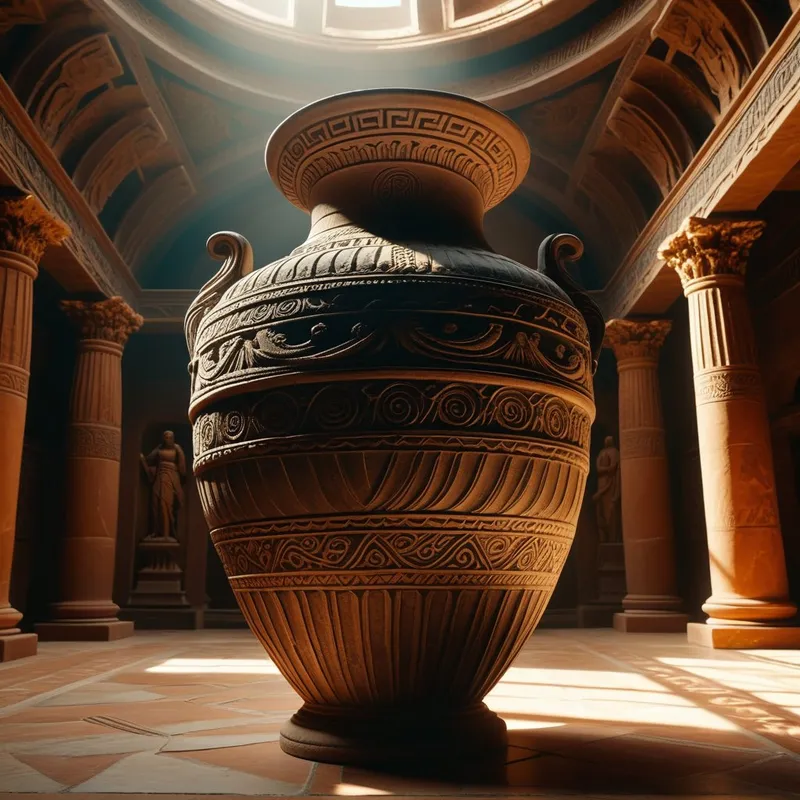
And with her, she brought a dowry. A large amphora, not a small box as later poets would sing. It was of sturdy, baked clay, its surface smooth, its mouth sealed tight with a great, heavy lid. A solemn instruction accompanied it: “This is not for you. It must never, ever be opened.”
For a time, life was sweet in their simple home. But the gift of Hermes worked within Pandora. A terrible, gnawing curiosity took root. What splendors or secrets did the gods see fit to send with her, only to forbid them? The amphora sat in a corner, silent, imposing. Its very presence became a question. What was inside? The “why” of the prohibition echoed louder than the command itself. It was a silence that screamed.
One day, when the weight of the unknown became unbearable, she approached the jar. Her fingers traced the cool curve of its belly. The lid was heavy, but her resolve was heavier. With a grunt of effort, she tilted it, breaking the seal.
It was not a click, but a hiss—the sound of a world exhaling a breath it had held since creation. From the mouth of the amphora erupted a shrieking, formless cloud. It was not one [thing](/myths/thing “Myth from Norse culture.”/), but a legion: Ponos (Toil), [Lethe](/myths/lethe “Myth from Greek culture.”/) (Forgetfulness), Limos (Starvation). The spirits of sickness, old age, jealousy, hatred, and war—all the kakoi and ponoi that the gods had kept locked away—poured forth into the clean air. They were invisible, yet their presence was a sudden chill, a taint in the light. They streamed out the door and window, spreading across [the earth](/myths/the-earth “Myth from Hindu culture.”/) to find a home in the hearts and lives of mortals for all time to come.
Terrified, Pandora slammed the lid back down. But it was too late. [The world](/myths/the-world “Myth from Tarot culture.”/) was already changed. [The golden age](/myths/the-golden-age “Myth from Greek culture.”/) was irrevocably stained. As she wept in despair, a faint, fluttering sound came from within the jar. One thing remained. Trapped under the rim was Elpis—Hope.
And so it was. The amphora, now empty of evils, held only that final, ambiguous spirit. Was Hope left as a mercy, a comfort for humanity in its newfound suffering? Or was Hope itself the final, most cruel evil, a delusion that would keep mortals striving in a world of pain? The jar did not say. It sat, a silent monument to the moment curiosity unbound the world.
Cultural Origins & Context
The tale of Pandora is one of the oldest foundational myths of Greek culture, primarily preserved in the epic poem Works and Days by the poet Hesiod (c. 700 BCE). It exists as a divine “just-so” story, an aetiology for the human condition. Hesiod, a farmer writing in a time of social strife, used the myth to explain the presence of evil, hardship, and toil in the world. It was not a playful fable but a serious theological and social commentary.
The myth functioned on multiple levels. On one hand, it explained the origin of human suffering, placing the blame not on a capricious universe, but on a specific, chain of divine actions and mortal failings. On another, it served as a potent piece of social ideology. In Hesiod’s deeply patriarchal world, the story of Pandora provided a divine rationale for the distrust of women, portraying them as a “beautiful evil” sent to punish men. The myth was passed down orally by [bards](/myths/bards “Myth from Celtic culture.”/) and rhapsodes before being codified by Hesiod, becoming a [cornerstone](/myths/cornerstone “Myth from Biblical culture.”/) of Greek cosmological understanding. It taught lessons about obedience to divine will, the dangers of curiosity, and the acceptance of a life defined by struggle, tempered only by elusive hope.
Symbolic Architecture
The myth’s power lies in its dense, layered [symbolism](/symbols/symbolism “Symbol: The use of symbols to represent ideas or qualities, often conveying deeper meanings beyond literal interpretation. In dreams, it’s the language of the unconscious.”/). Pandora herself is not merely a woman but the [archetype](/symbols/archetype “Symbol: A universal, primordial pattern or prototype in the collective unconscious that shapes human experience, behavior, and creative expression.”/) of the “Created Other,” a being fashioned as a [instrument](/symbols/instrument “Symbol: An instrument symbolizes creativity, communication, and the means by which one expresses oneself or influences the world.”/) of retribution. She symbolizes the dual [nature](/symbols/nature “Symbol: Nature symbolizes growth, connectivity, and the primal forces of existence.”/) of all profound gifts: the allure of [beauty](/symbols/beauty “Symbol: This symbol embodies aesthetics, harmony, and the appreciation of life’s finer qualities.”/) and the potential for devastation. She is the embodied consequence of rebellion.
The [amphora](/symbols/amphora “Symbol: An ancient storage vessel symbolizing preservation, cultural heritage, and the containment of valuable substances like wine, oil, or ashes.”/) is the central [symbol](/symbols/symbol “Symbol: A symbol can represent an idea, concept, or belief, serving as a powerful tool for communication and understanding.”/). As a [storage](/symbols/storage “Symbol: Storage symbolizes the preservation of memories, knowledge, emotions, or physical belongings, often reflecting the subconscious mind’s organization.”/) jar, it represents containment, potential, and the unknown. It is the [womb](/symbols/womb “Symbol: A symbol of origin, potential, and profound transformation, representing the beginning of life’s journey and the unconscious source of creation.”/) of all latent suffering and the [prison](/symbols/prison “Symbol: Prison in dreams typically represents feelings of restriction, confinement, or a lack of freedom in one’s life or mind.”/) of hope.
The sealed amphora is the human psyche itself—a vessel containing all the repressed, shadowy contents of a life, held under the fragile lid of consciousness.
The act of opening it is the primal [drama](/symbols/drama “Symbol: Drama signifies narratives, emotional expression, and the exploration of human experiences.”/) of [consciousness](/symbols/consciousness “Symbol: Consciousness represents the state of awareness and perception, encompassing thoughts, feelings, and experiences.”/). It is the inevitable [moment](/symbols/moment “Symbol: The symbol of a ‘moment’ embodies the significance of transient experiences that encapsulate emotional depth or pivotal transformations in life.”/) when curiosity—the drive to know, to see, to experience—overcomes prohibition. This is not simple disobedience, but the essential [human](/symbols/human “Symbol: The symbol of a human represents individuality, complexity of emotions, and social relationships.”/) act of engaging with the hidden, often painful, truths of existence. The released evils represent the inescapable realities of mortal [life](/symbols/life “Symbol: The symbol of ‘Life’ represents a journey of growth, interconnectedness, and existential meaning, encompassing both the joys and challenges that define human experience.”/): [disease](/symbols/disease “Symbol: Disease represents turmoil, issues of control, or unresolved personal conflicts manifesting as physical or emotional suffering.”/), decay, sorrow, and conflict. They are the “[shadow](/symbols/shadow “Symbol: The ‘shadow’ embodies the unconscious, repressed aspects of the self and often represents fears or hidden emotions.”/)” of the previously pristine, unconscious state of humanity.
And then, there is Elpis, Hope. This is the myth’s most profound and debated symbol. Is Hope a benevolent comfort, the one good thing the gods allowed us to keep? Or is it the final, most insidious evil—a false promise that perpetuates suffering by preventing total [despair](/symbols/despair “Symbol: A profound emotional state of hopelessness and loss, often signaling a need for transformation or surrender to deeper truths.”/) and surrender? The [ambiguity](/symbols/ambiguity “Symbol: A state of uncertainty or multiple possible meanings, often found in abstract art and atonal music where clear interpretation is intentionally elusive.”/) is the point. Hope is the [capacity](/symbols/capacity “Symbol: A measure of one’s potential, limits, or ability to contain, process, or achieve something, often reflecting self-assessment or external demands.”/) for forward [movement](/symbols/movement “Symbol: Movement symbolizes change, progress, and the dynamics of personal growth, reflecting an individual’s desire or need to transform their circumstances.”/), for meaning-making in the face of suffering. It is what remains when everything else has been unleashed.
The Dreamer’s Resonance
When this myth stirs in the modern dreamer, it often manifests as dreams of forbidden containers: locked rooms, sealed chests, closed doors, or mysterious packages. The dreamer feels a compulsive, anxious curiosity about what is inside, coupled with a dread of finding out.
Somatically, this can feel like a tightness in the chest, a knot of anxiety in the stomach—the body sensing the impending release of something long-contained. Psychologically, this dream pattern signals that the lid is coming off a repressed complex. The “evils” are not external monsters, but internal realities: a long-buried grief, a suppressed rage, a shameful memory, or a denied aspect of [the self](/myths/the-self “Myth from Jungian culture.”/). The dream is the [psyche](/myths/psyche “Myth from Greek culture.”/)‘s enactment of its own necessary, terrifying opening. The process is one of confrontation with the personal shadow. The dread is real, for integrating shadow material is painful; it disrupts our carefully constructed self-image. Yet, the curiosity is also authentic—it is the soul’s imperative toward wholeness, pushing against [the ego](/myths/the-ego “Myth from Jungian culture.”/)‘s desire for a tidy, controlled existence.
Alchemical Translation
The Pandora myth is a perfect map for the alchemical process of individuation. It begins with the [nigredo](/myths/nigredo “Myth from Alchemical culture.”/), the blackening. This is the theft of fire—the act of gaining consciousness ([Prometheus’s gift](/myths/prometheuss-gift “Myth from Greek culture.”/)), which inevitably incurs a divine wrath, a sense of alienation or suffering (Zeus’s punishment). Pandora, the dazzling, problematic gift, represents the arrival of the anima or animus—the contrasexual other within—who disrupts the status quo and leads us toward the unknown.
The sealed amphora is the unconscious in its unexamined state. The command not to open it is the ego’s defense mechanism, its fear of being overwhelmed by what it has repressed.
The alchemical work is not to keep the vessel sealed, but to have the courage to open it in a sacred vessel, to consciously suffer the contents so that the final essence—Hope, or the Self—can be revealed.
Opening the jar is the mortificatio, a necessary dissolution. The release of the “evils” is the painful confrontation with shadow, complex, and trauma. This stage feels like a psychological plague, a [dark night of the soul](/myths/dark-night-of-the-soul “Myth from Christian culture.”/) where all one’s sufferings are made conscious.
But the process does not end in despair. The trapping of Elpis inside is the critical turn, the [albedo](/myths/albedo “Myth from Alchemical culture.”/) or whitening. After the contents are aired, after the suffering is fully acknowledged and experienced, what remains at the bottom of [the vessel](/myths/the-vessel “Myth from Alchemical culture.”/) is not nothing. It is the transformative residue: Hope. In alchemical terms, this is the [lapis philosophorum](/myths/lapis-philosophorum “Myth from Alchemical culture.”/), [the philosopher’s stone](/myths/the-philosophers-stone “Myth from Alchemical culture.”/). It is not a naive optimism, but the hard-won capacity for meaning, the resilient spark of the Self that survives the confrontation with totality. It is the knowledge that consciousness itself, born from curiosity and tempered in suffering, is the final, ambiguous, and essential gift. We are not punished with hope; we are left with it as the tool to build a conscious life from the ruins of innocence. The amphora, once a prison of potential evils, becomes [the sacred vessel](/myths/the-sacred-vessel “Myth from Various culture.”/) that contains the transformative essence of the ordeal itself.
Associated Symbols
Explore related symbols from the CaleaDream lexicon: