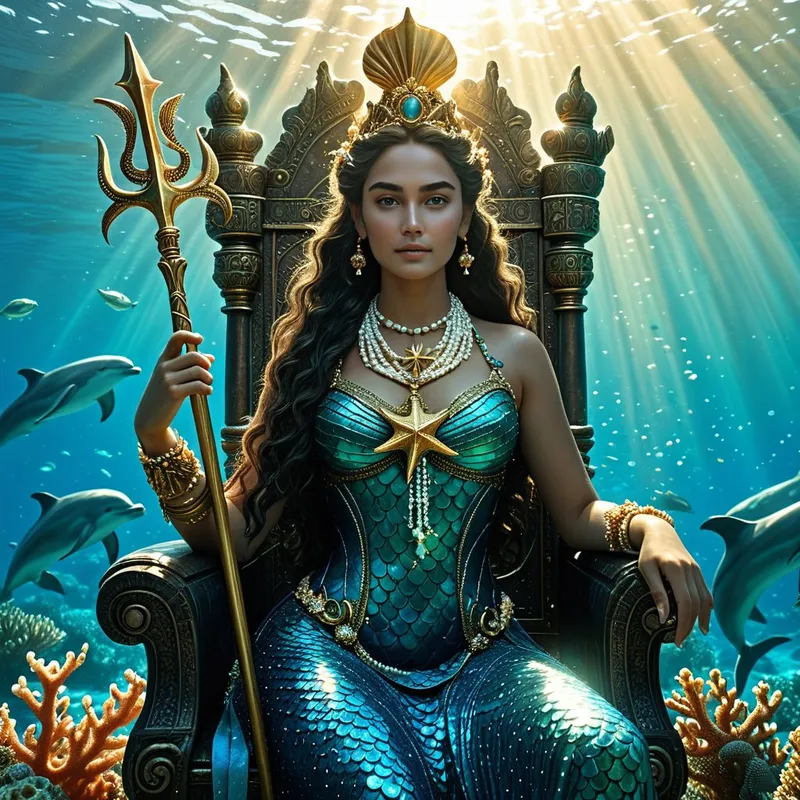
Amphitrite Myth Meaning & Symbolism
The myth of the Nereid Amphitrite, who fled the god Poseidon's courtship, was persuaded to return, and became the revered Queen of the boundless Sea.
The Tale of Amphitrite
Listen, and let the salt-spray carry you back. Before the names of cities, before the first ship’s keel, there was only the deep, blue, singing wildness of the sea. And within that wildness danced the Nereids, daughters of the Old Man of the Sea. Among them, one was not merely beautiful—she was the very essence of the untamed brine, the shimmer on a wave’s crest, the hidden current that guides lost things. Her name was Amphitrite.
She dwelt in the sun-flecked deeps near her father Nereus, dancing in choruses with her sisters. Her world was one of fluid grace, of freedom without boundary. But the gaze of the Earth-Shaker fell upon her. Poseidon, lord of the roaring waves and the stallions that crash upon the shore, saw in her not just a nymph, but the missing piece of his vast, turbulent domain. He desired her as his queen.
He approached with the force of a tidal surge, expecting her to be swept up in his divine power. But Amphitrite was not of the earth or the sky; she was of the deep’s own heart. To be claimed, to be bound even to a throne, felt like a cage. A profound terror, colder than the abyssal trenches, seized her. So, she fled. She vanished into the furthest, most forgotten reaches of the ocean, a place not even the god’s trident could easily churn, melting into the anonymity of the endless water.
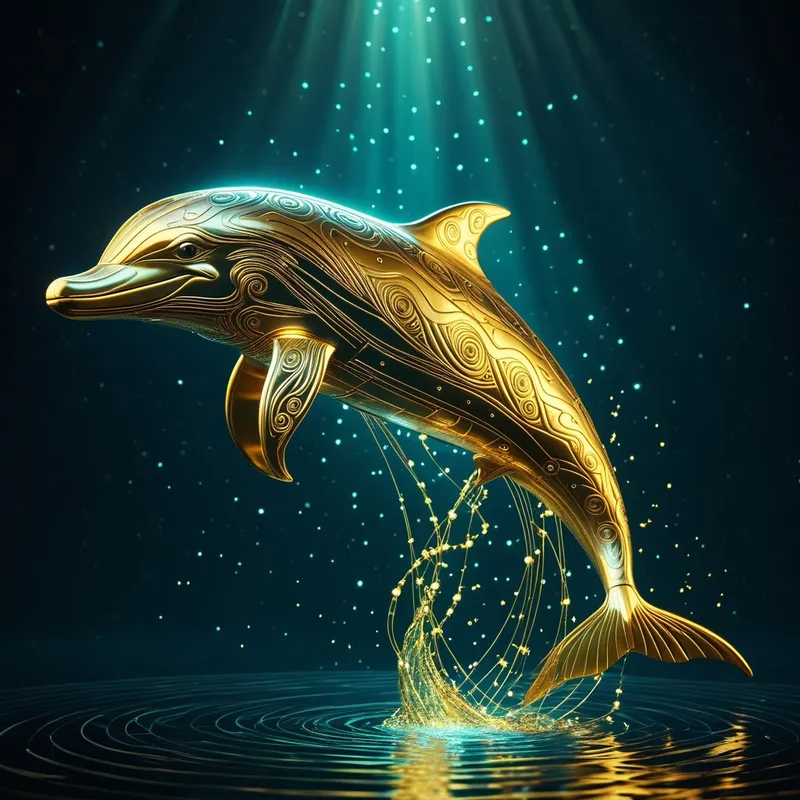
Poseidon, enraged and bewildered by this refusal that echoed like a silent tide, scoured the world’s waters. But the sea keeps its secrets. Desperate, he summoned all the creatures of the deep. It was the dolphin, creature of playful intelligence and boundless travel, who volunteered. The dolphin swam beyond the known currents, through silent forests of kelp and over plains of bleached coral, its song a gentle, persistent inquiry. And in a hidden, sunless grotto, it found her.
The dolphin did not command or capture. It spoke—of glory, yes, but also of completion. It spoke of a union that would not diminish but magnify; that her sovereignty over the quiet, generative depths would balance his rule over the stormy surface. She would not be a consort in shadow, but the Queen whose name would be whispered by sailors seeking calm passage. Moved by this diplomacy, this recognition of her essence, Amphitrite’s resistance softened. She consented.
The dolphin carried her back on its arched back, a living bridge between retreat and return. A wedding of cosmic scale was held. Poseidon, in boundless gratitude, placed the dolphin among the stars, forever circling the heavens. And Amphitrite ascended not as a prize, but as a power. She became the revered Queen of the Sea, mother of Triton, and of the seals, and the great sea monsters. When she rose in her chariot drawn by hippocampi, the waves grew calm and the sea smiled. Her initial flight was not forgotten; it was the very reason her ‘yes’ held weight, making the wild deep itself a partner to the throne.

Cultural Origins & Context
The myth of Amphitrite is ancient, woven into the earliest layers of Greek cosmogony. She appears in the poetry of Hesiod's Theogony, which catalogues the birth of the gods, establishing her as a foundational figure in the divine order. Unlike the more localized and personalized Olympian myths, her story is elemental, belonging to the sea itself. It was a tale told by coastal communities, fishermen, and far-traveling sailors for whom the sea was both provider and perpetual threat.
Her narrative functioned as a sacred map of the sea’s dual nature. Poseidon represented its terrifying, uncontrollable power—the storm, the earthquake, the ship-shattering wave. Amphitrite came to embody its benevolent, fertile, and stable aspect—the calm harbor, the teeming schools of fish, the reliable deep-water current. By making their union a story of courtship and earned sovereignty, the Greeks anthropomorphized a fundamental truth: the sea is not monolithic. It is a marriage of chaotic force and nurturing depth, and respect must be paid to both rulers for safe passage and bounty. Her myth ritualized this respect, making the mysterious, feminine depth of the ocean a conscious, addressable divinity.
Symbolic Architecture
At its core, the myth of Amphitrite is a profound allegory of the encounter between the differentiated Self and the overwhelming, seeking force of the Other—be it love, power, vocation, or an archetypal energy.
The initial flight is not cowardice, but the instinct of an unviolated essence seeking to preserve its own unique nature against assimilation.
Amphitrite symbolizes the pure, unconstellated feminine principle—not in a gendered sense, but as the deep, receptive, fluid, and autonomous psyche. She is the anima in its natural state, the soul’s own depth before it is confronted by the ego’s (Poseidon’s) demand for possession and order. Poseidon represents the potent, structuring, and often domineering masculine principle—the conscious will that seeks to claim and organize the contents of the unconscious into a kingdom.
The central conflict is not good versus evil, but the necessary tension between autonomy and relationship, between remaining in undifferentiated potential and entering into defining, creative union. The dolphin is the critical symbol of mediation. It is the psychopomp (soul-guide), the function of intelligence, playfulness, and persuasive communication that can navigate between conscious and unconscious realms. It does not force, but translates, making the value of union comprehensible to the part that wishes to remain hidden.
The dolphin’s persuasion succeeds because it speaks the language of the deep; it honors the retreat before facilitating the return.
Her return and coronation symbolize the integration of this deep, autonomous psychic material into the ruling structure of the personality. She does not disappear; she is enthroned. The psyche is no longer ruled solely by turbulent, impulsive force (Poseidon alone), but by a conscious partnership where depth and surface communicate. The result is not a tame sea, but a complete one—capable of both nurturing life and terrifying power, now under a unified, conscious sovereignty.
The Dreamer's Resonance
When the pattern of Amphitrite stirs in the modern dreamer, it often signals a profound interior process related to the call of relationship or vocation that feels simultaneously attractive and threatening to the core self.
One might dream of fleeing into a vast, featureless ocean or a labyrinthine cave system, feeling a primal need to hide from a pursuing presence that is not necessarily evil, but feels overwhelmingly demanding. This is the somatic echo of Amphitrite’s retreat. The body knows the threat of being “claimed” before the soul is ready, of losing its essential fluidity to a rigid identity.
Conversely, dreams featuring dolphins, seals, or other intelligent, guiding aquatic mammals often appear at critical junctures, suggesting the emergence of the mediating function. The dolphin in the dream does not give answers but offers a new perspective, creating a bridge between a place of isolated safety and a possibility of empowered connection.
The culmination of this process might be symbolized by dreams of wearing a crown of coral or pearl, or calmly directing the movements of sea creatures. These are images of achieved sovereignty—the once-fugitive part of the self has now been recognized, integrated, and vested with legitimate authority within the dreamer’s inner kingdom. The anxiety of being consumed is replaced by the calm authority of co-creation.

Alchemical Translation
For the individual on the path of individuation, Amphitrite’s myth models the alchemical stage of coniunctio—the sacred marriage. This is not a simple fusion, but a difficult, glorious union of opposites that creates a third, transcendent thing: the integrated Self.
The process begins with the nigredo, the blackening. This is Amphitrite’s flight into the dark, unknown abyss. Psychologically, it is the necessary withdrawal when the ego is faced with a demand from the unconscious that is too large to incorporate. It feels like depression, stagnation, or a loss of purpose. The soul goes underground, into the “sea,” to protect its nascent integrity. To bypass this retreat is to risk a hollow, false union where the deep self is enslaved, not wedded.
The alchemical vessel is sealed in the darkness of the ocean deep; here, the prima materia of the soul rests, gathering its essence away from the fire of the will.
The dolphin represents the albedo, the whitening, the enlightening insight. It is the therapeutic intervention, the synchronistic event, the piece of art or poetry that suddenly reframes the struggle. It is the function that communicates: “Your depth is not meant to be erased by this union, but to be its crown. Your return will mean power, not annihilation.” This is the moment of understanding that makes integration possible.
Finally, the rubedo, the reddening, is the royal wedding and coronation. The conscious mind (Poseidon) and the unconscious depth (Amphitrite) are joined in a sacred bond. The ego relinquishes its fantasy of total, solitary control. The unconscious agrees to participate in form and structure. The result is psychic sovereignty—the individual who can access both the creative, stormy power of passion and the profound, calm wisdom of the deep self. They rule the inner world not as a tyrant, but as a sacred dyarchy, where the dolphin’s mediating intelligence is forever memorialized in the starlight of consciousness. The once-hidden essence becomes the source of the ruler’s deepest authority and peace.
Associated Symbols
Explore related symbols from the CaleaDream lexicon: