
Amanohashidate Myth Meaning & Symbolism
A myth of divine ambition and earthly grace, where a fallen celestial bridge becomes a landscape of breathtaking beauty, teaching the alchemy of imperfection.
The Tale of Amanohashidate
In the age when the world was still soft, when the mists of creation clung to the raw face of the deep, the heavens and the earth were not so distant. It was a time of grand gestures, of deities whose thoughts shaped the very clay of existence. Among them stood Izanagi-no-Mikoto, his gaze fixed not on the fledgling lands below, but on the unreachable vault above.
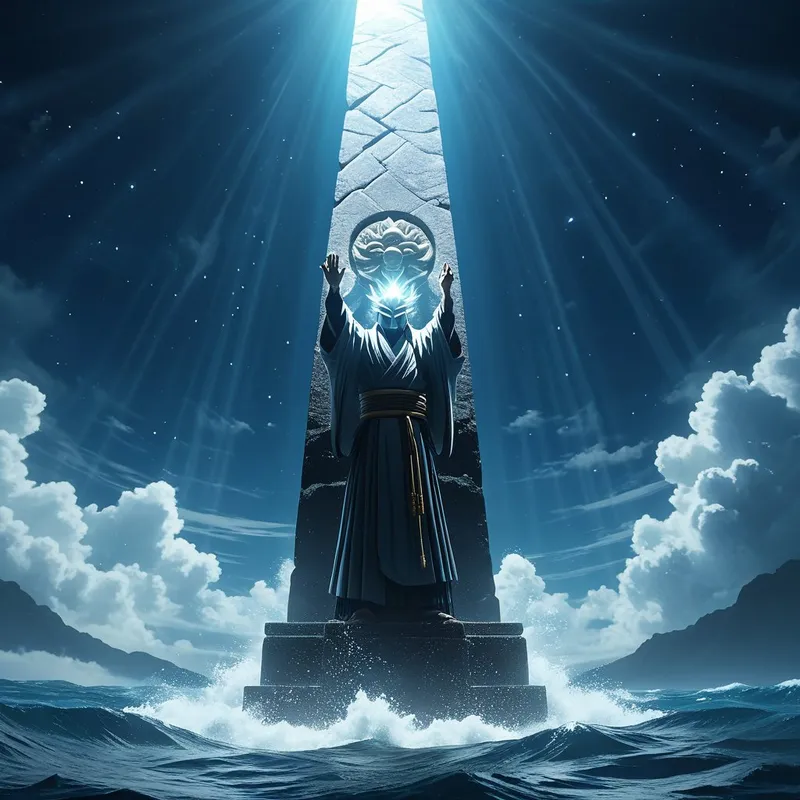
A longing stirred in his divine heart—a desire to walk the corridors of the High Plain of Heaven, to bridge the unbridgeable gap between the celestial and the terrestrial. He would build a stairway for the gods, a passage so magnificent it would forever unite the realms. With a will that could move mountains, he descended to the swirling, grey waters of the Onogoro sea. From its very bed, he wrenched forth a pillar of stone, a spine of the earth itself, colossal and unyielding. The waters roared in protest, and the new-born islands trembled.
Izanagi set the pillar upon his shoulder, a god bearing the weight of his own ambition. He began his ascent, each step a seismic event, his divine form straining against the gravity of creation. Higher he climbed, the stone groaning, the air thinning into the ether of the heavenly realm. He could almost see it—the shimmering gates, the plains of eternal light. But ambition is a heavier burden than stone. At the very precipice of success, at the moment the pillar’s peak should have touched the heavenly shore, his strength—or perhaps the very law of the cosmos—failed him.
The pillar slipped. It did not fall with a mere crash; it fell with a world-ending sigh, a descent that seemed to last an eternity. It plunged through the layers of sky, trailing streamers of cloud and dying light, and struck the earthly sea with a cataclysm that echoed in the bones of the world. But the sea did not reject it. The waters cradled the broken ambition, softening its edges, weaving sands around its form. Where a bridge to heaven was meant to be, a new shape emerged: a long, graceful sandbar, arcing across the bay like the spine of a resting dragon. Ame-no-Kami looked down, and instead of a stairway, they saw a landscape. Kunitsu-Kami looked up, and instead of a pillar, they saw a sheltering curve. The fallen bridge had become "Amanohashidate"—the Bridge to Heaven, laid not across the void, but upon the face of the beloved earth.
Cultural Origins & Context
The myth of Amanohashidate is a Kuni-umi story, a subset of Shinto creation narratives that specifically explain the origins of Japan's distinctive topography. It is deeply rooted in the animistic heart of Shinto, where natural landmarks are not mere scenery but the manifested bodies (shintai) of kami. This tale transforms a specific, breathtaking location in modern-day Kyoto Prefecture from a scenic wonder into a sacred relic of a divine event.
Passed down orally and later recorded in early chronicles like the Kojiki and Nihon Shoki, its function was twofold. Firstly, it was an etiological myth, answering the profound human question: "Why is this here? Why is it so beautiful?" The answer rooted the landscape in a divine drama, making it a place of power and narrative. Secondly, it served a societal function of humility and reverence. By framing one of Japan's "Three Scenic Views" as a divine failure transformed, it encoded a cultural value: that perfection is not a prerequisite for the sacred. The most revered beauty can emerge from broken plans, teaching people to venerate not just flawless creation, but graceful transformation and the genius of the unintended.
Symbolic Architecture
At its core, Amanohashidate is a myth about the creative act and its inherent relationship with "failure." The pillar is the symbol of pure, vertical intention—the human (or divine) urge to build straight towards an ideal, to transcend earthly limitations and reach a perfect, heavenly state of being. Its fall represents the inevitable collision of idealistic vision with the resistant, gravitational pull of reality.
The bridge to heaven is not built by reaching upward, but by learning to see the sacred pattern in where you have fallen.
The resulting sandbar is the symbol of horizontal integration. It is no longer a tool for escape but a feature that belongs, that cradles life (the iconic pine trees), that guides the waters and offers a path for mortals to walk within the world. Psychologically, the pillar is the ego's monolithic project: the perfect career, the ideal relationship, the flawless self-image. Its fracture is the crisis that shatters this ego-ideal. The sandbar is the new psychic structure that forms from the pieces—a more complex, resilient, and authentically beautiful sense of self, integrated with the "earth" of one's unconscious and embodied existence.

The Dreamer's Resonance
When this myth stirs in the modern unconscious, it often manifests in dreams of architectural collapse or sublime, unexpected landscapes. A dreamer may find themselves building a tower that crumbles as it nears completion, or fleeing a collapsing bridge, only to wake on a serene, unfamiliar shore. Somatically, this can correlate with a release of tension in the shoulders and spine (the burden of the pillar) and a grounding sensation in the feet.
Psychologically, this dream pattern signals a profound process of ego-reorientation. The individual is undergoing what James Hillman might call a "deflation of the heroic." The conscious, striving identity is being compelled to surrender its vertical, heaven-oriented project. The emotional tone is not merely one of failure, but often of awe and melancholic beauty upon discovering the resulting "landscape." The dreamer is processing the death of an old ambition and the simultaneous, often surprising, birth of a new form of value and identity from its ruins. It is the psyche working to alchemize disappointment into depth.

Alchemical Translation
The individuation process modeled here is not one of triumphant ascent, but of sacred grounding. The alchemical stages are clear: Nigredo is the wrenching effort and ultimate failure—the darkening, the crushing weight of the fallen pillar in the murky sea. Albedo is the washing of the waters, the clarifying moment when the raw material of the broken dream is seen for what it is, stripped of its original purpose. Citrinitas is the dawning realization of a new form, the glint of sunlight on the newly formed sand and the first green of the pines—the emergence of value from the void.
The true transmutation occurs when we stop trying to rebuild the bridge and instead learn to inhabit the island it has become.
The final Rubedo, the reddening, is the full embodiment of the sandbar. It is the individual who has stopped lamenting the lost heaven and has instead committed to walking the curved, earthly path. They have integrated the "failure" into their core identity, finding that their greatest offering to the world is not a monument to what they intended to be, but a living, breathing landscape shaped by what they authentically are. The struggle is transmuted from "How do I reach perfection?" to "How do I cherish and protect the uniquely beautiful, imperfect creation that my life has, in fact, become?" The Bridge to Heaven is found not in the sky, but in the daily, mindful traversal of one's own, perfectly imperfect existence.
Associated Symbols
Explore related symbols from the CaleaDream lexicon: