Amanikable Myth Meaning & Symbolism
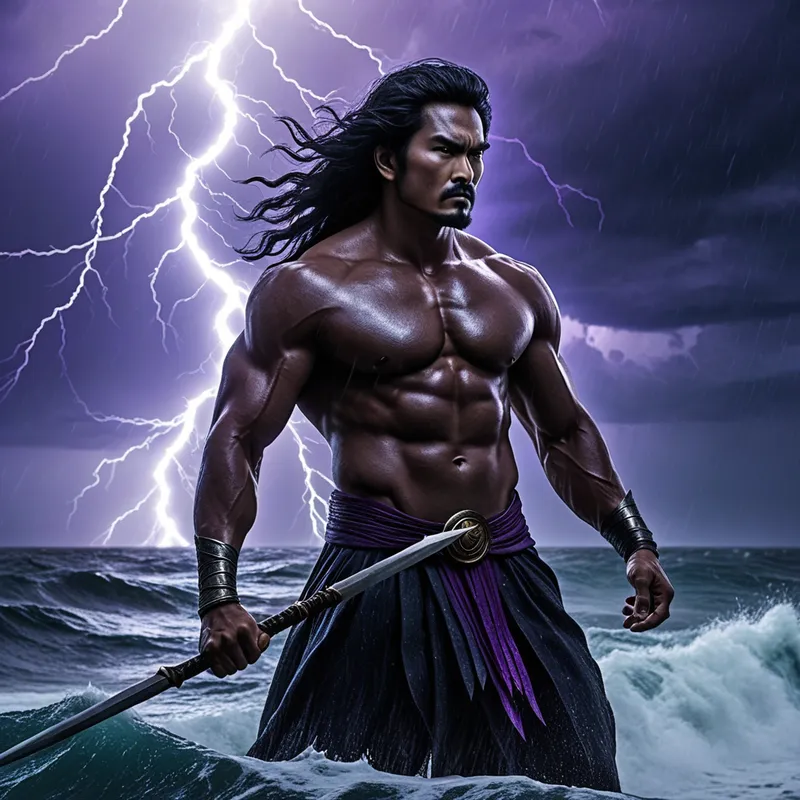
The myth of Amanikable, the once-handsome sea god whose heartbreak transformed him into a wrathful, solitary deity of storms and untamed waters.
The Tale of Amanikable
Listen, and hear the tale of the sea's first sorrow. In the time when the world was young and the gods walked closer to the earth, there was Amanikable. He was not always as he is now. Once, he was the most handsome of the celestial beings, his form as perfect as a polished shell, his laughter like the gentle lap of waves on a sun-drenched shore. His domain was the boundless, glittering ocean, and all who dwelled within it danced to the rhythm of his joyful heart.
But in his pride and beauty, Amanikable desired a companion. He set his gaze upon Diyan Masalanta, the goddess of love, whose grace could calm the fiercest storm in a mortal's breast. He courted her with treasures from the deep: pearls that held the moon's glow, corals in impossible hues, the songs of the great whales. Yet, Masalanta's heart was not for the taking. She saw in Amanikable a love that was possessive, a tide that sought to engulf rather than to caress. With a kindness that cut deeper than any reef, she refused him.
The refusal was a harpoon to the god's soul. Where once there was joy, a tempest brewed. His handsome face darkened like a cloud blocking the sun. His laughter ceased, and in its absence, the sea learned new sounds: the groan of crushing depths, the hiss of raging foam. The love that had warmed his waters curdled into a cold, fathomless rage. He tore his gaze from the heavens and turned it inward, upon his own domain.
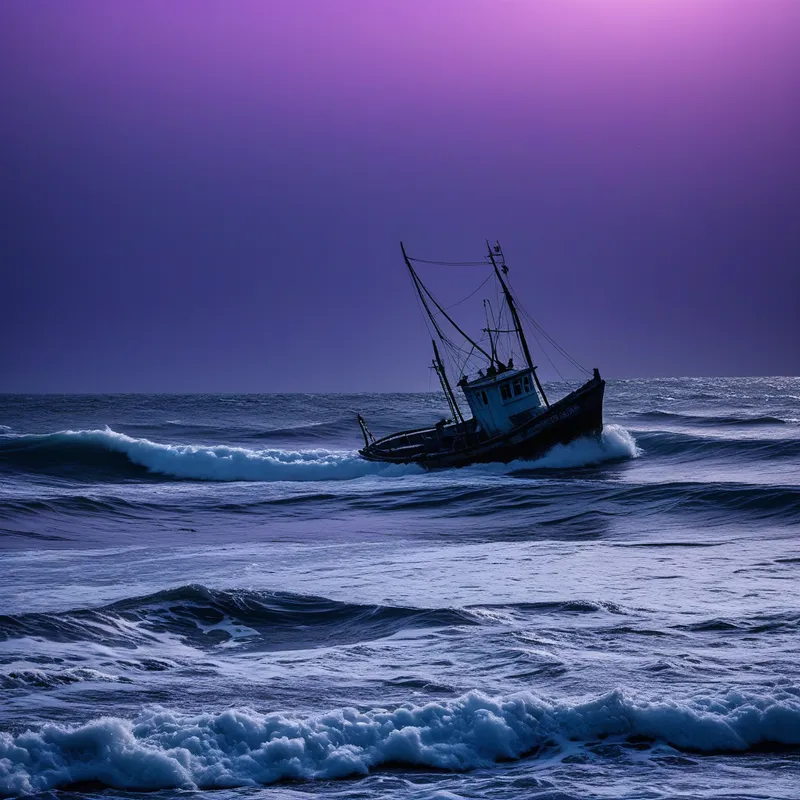
No longer the benevolent lord of abundant fisheries and calm passages, Amanikable became a deity of vengeance. He would stalk the surface, his form growing wild and terrible, his hair like storm clouds, his eyes flashing with lightning. He hated the sight of happiness, of union, of love upon his waters. Fishermen who ventured out with songs on their lips would find their boats splintered by sudden, mountainous waves. Lovers whispering on moonlit shores would be driven back by violent, crashing surf. The sea became a mirror of his isolation—vast, beautiful, and utterly treacherous. He commanded the monsters of the deep and the fury of the typhoon, and in his solitary wrath, he found a bitter, eternal kingdom. He became the god you do not pray to for bounty, but the one you fear and appease, the untamed and unforgiving heart of the deep itself.
Cultural Origins & Context
The myth of Amanikable originates from the pre-colonial belief systems of the Tagalog peoples of the Philippines, part of a rich and complex pantheon recorded by early Spanish chroniclers like Pedro Chirino and Juan de Plasencia. Unlike myths preserved through uninterrupted oral tradition, these stories were often documented through the lens of colonial observers seeking to understand—and subsequently alter—the indigenous spiritual landscape. This makes Amanikable a figure glimpsed through a fractured mirror.
He was not a myth told to children for comfort, but a necessary explanation for the capricious and often deadly nature of the sea. In an archipelago of over 7,000 islands, the ocean was both life-giver and life-taker, a source of food and a gateway to peril. Stories of Amanikable served a critical societal function: they codified respect for the ocean's power. Rituals and offerings were made not to court his favor, but to placate his infamous temper, to ask for safe passage rather than abundant catch. He represents the aspect of nature that cannot be domesticated, only acknowledged and approached with profound caution. His myth was likely passed down by babaylan and fisherfolk, a narrative anchor in the unpredictable vastness that surrounded their world.
Symbolic Architecture
At its core, the myth of Amanikable is a profound map of emotional alchemy gone awry. It depicts the catastrophic transformation of vulnerable feeling—rejection, heartache, shame—into a permanent, externalized identity of rage and isolation.
The wound that is not wept becomes the weather of the world.
Amanikable begins as the Divine Child, whole and beloved. The rejection by Masalanta is not merely a romantic setback; it is a cosmic shattering of his self-image. His beauty, his domain, his very divinity feels invalidated. This psychic injury is too acute to integrate. Instead of moving through the pain, he becomes the pain. His entire being and his entire realm are reconfigured around this unprocessed grief. The ocean, a classic symbol of the unconscious and the emotional body, turns from a place of nurturing depth to one of chaotic, destructive fury. He is the archetypal Orphan, but one who wields the power of a god. His solitude is no longer peaceful but punitive, a fortress built from the rubble of his own heart.
The Dreamer's Resonance
When the pattern of Amanikable stirs in the modern dreamer, it signals a profound somatic encounter with the Shadow born from heartbreak or narcissistic injury. One does not simply dream of a stormy sea; one dreams of being the storm, of feeling a vast, impersonal rage that seems to have no source and no end. The dreamer may find themselves in a landscape of terrifying, beautiful isolation—a towering cliff face, an empty mansion, the deck of a ship with no crew.
Somatically, this can feel like a cold fire in the chest, a tension in the jaw and shoulders held for a lifetime, a sense of being fundamentally "other" and untouchable. Psychologically, it is the process of identifying with the wound: "I am not a person who was hurt; I am the hurt." The dreamer is experiencing the Amanikable complex—the transformation of vulnerable sadness into a defensive, powerful, yet utterly isolating identity. The dream is the psyche's attempt to show the dreamer the sheer scale and sovereignty of this self-created, stormy prison.

Alchemical Translation
The individuation journey modeled by Amanikable is not one of victory, but of tragic stasis. It is a cautionary tale of failed alchemy. The core struggle is the transmutation of leaden grief into golden wisdom, but Amanikable's process halts at the Nigredo—the blackening. He becomes stuck in the stage of dissolution and rage.
The true transformation begins not when we command the storm, but when we consent to feel the rain.
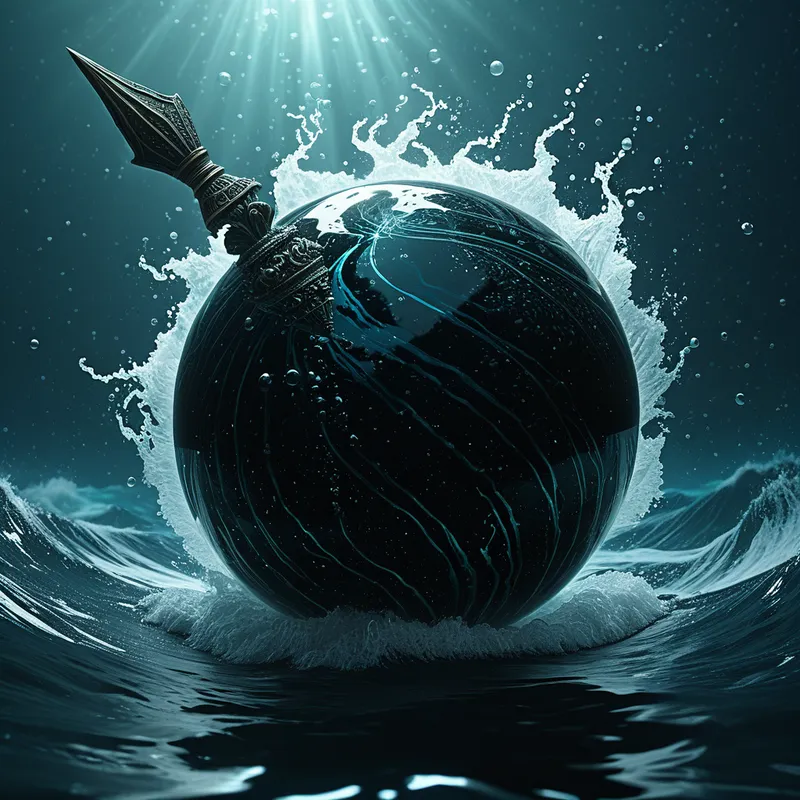
For the modern individual, the myth instructs by showing the dead end. The path forward requires the agonizing descent that Amanikable refused: to lay down the spear of wrath, to still the manufactured tempest, and to finally confront the lonely, heartbroken god within the storm. It means differentiating the Self from the Injury. One must hear the weeping within the roar of the wave. The alchemical translation is the re-integration of the orphaned feeling. It is allowing the rejected one—the humiliated, ashamed, grieving part—to exist without letting it consume the entire psychic kingdom. The goal is not to regain the naive beauty of the past, but to achieve a weathered, compassionate sovereignty that can contain both calm and storm without identifying as either. It is the move from being the god of the vengeful sea to becoming the wise, deep ocean floor that remains unmoved, holding all things in its silent, dark embrace.
Associated Symbols
Explore related symbols from the CaleaDream lexicon:
- Ocean — The vast, unconscious emotional body, which in Amanikable's myth transforms from a source of life into a realm of solitary, destructive fury.
- Storm — The externalized manifestation of internal, unprocessed rage and emotional turmoil, representing a psyche in chaotic conflict.
- Grief — The core, unmourned emotion that catalyzes Amanikable's transformation, festering into isolation instead of flowing into release.
- Solitude — Not a chosen peace but an enforced, punitive isolation, representing the fortress the ego builds around a profound wound.
- Rage — The secondary, protective emotion that masks deeper vulnerabilities of shame and heartbreak, becoming a god's primary identity.
- Heart — The symbolic seat of love that, when wounded, can reconfigure an entire world into a reflection of its pain.
- Shadow — Amanikable himself becomes a personification of the Shadow, the disowned and rejected parts of the self that wield immense, autonomous power.
- Rejection — The catalytic event that shatters the self-image, initiating the descent from wholeness into a fragmented, defensive state.
- God — A symbol of ultimate power and sovereignty, here turned inward upon itself, demonstrating how absolute power can create an absolute prison.
- Transformation — The central, tragic process of the myth, depicting a psychic change that is not growth but a calcification around a wound.
- Wound — The unhealed psychic injury that becomes the governing principle of a personality and its perceived reality.
- Pride — The initial state of Amanikable, whose fragility is revealed by rejection, showing how pride is often the armor for a vulnerable self.