Amalthea Myth Meaning & Symbolism
The nurturing goat whose horn became the Cornucopia, a symbol of endless abundance born from a primal act of care and a sacred break.
The Tale of Amalthea
Before the world knew order, when the sky was a younger, more violent blue, a terror stalked the earth. His name was Cronus, the Devourer of Time, and he consumed his own children, swallowing them whole to forestall a prophecy of his downfall. His wife, Rhea, her heart a cavern of grief, could bear it no longer. When her sixth child was born—a son with a gaze that already crackled with potential—she acted.
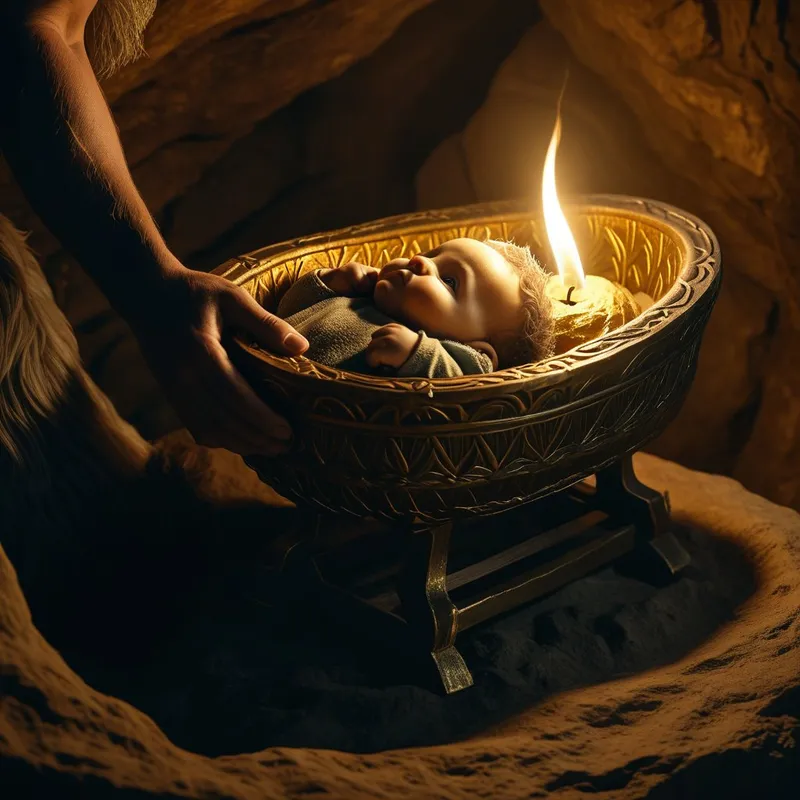
Wrapping a stone in swaddling clothes, she presented it to Cronus, who gulped it down without a second glance. The true infant, she entrusted to her mother, Gaia. And Gaia knew the perfect hiding place: a secret, echoing cave on the fertile slopes of Mount Ida on the isle of Crete. Here, the very earth would conspire to protect the future king.
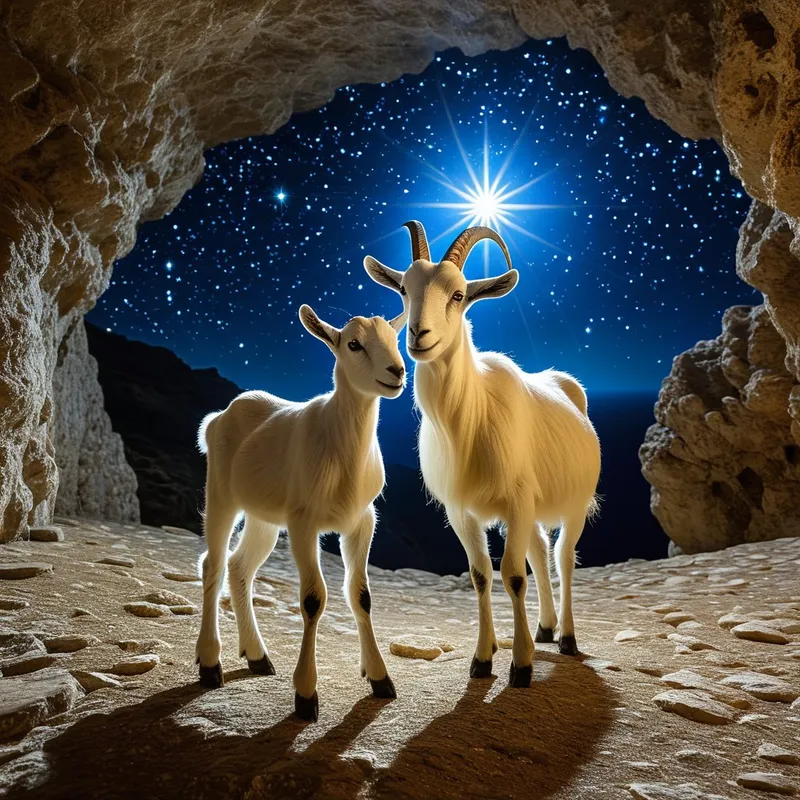
But an infant god needs more than stone and shadow. He needs warmth, sustenance, and a song to soothe the primordial chaos within. This is where she enters the story: Amalthea. She was no ordinary beast. Some say she was a goat of such divine stature that her hide gleamed like polished bronze, her horns spiraled towards heaven, and her milk was the nectar of potential itself. Others whisper she was a tender nymph who took the form of a goat for this sacred task.
Into her care was placed the squalling infant, who would be called Zeus. The cave became a nursery of cosmic significance. The Curetes, armed and fierce, danced and clashed their spears against their shields outside the entrance, their thunderous rhythm masking the baby’s cries from the searching ears of Cronus. Inside, Amalthea offered her teat. The godling fed, drawing strength not just from milk, but from her unwavering, animal presence. He slept curled against her warm flank, his dreams seeded with future lightning.
Time, even for a god, passed in that hidden cradle. And in play, as the young Zeus tested his burgeoning power, a fateful accident occurred. Reaching for one of Amalthea’s magnificent horns, he grasped it with a grip that held the promise of thunder—and broke it clean from her head.
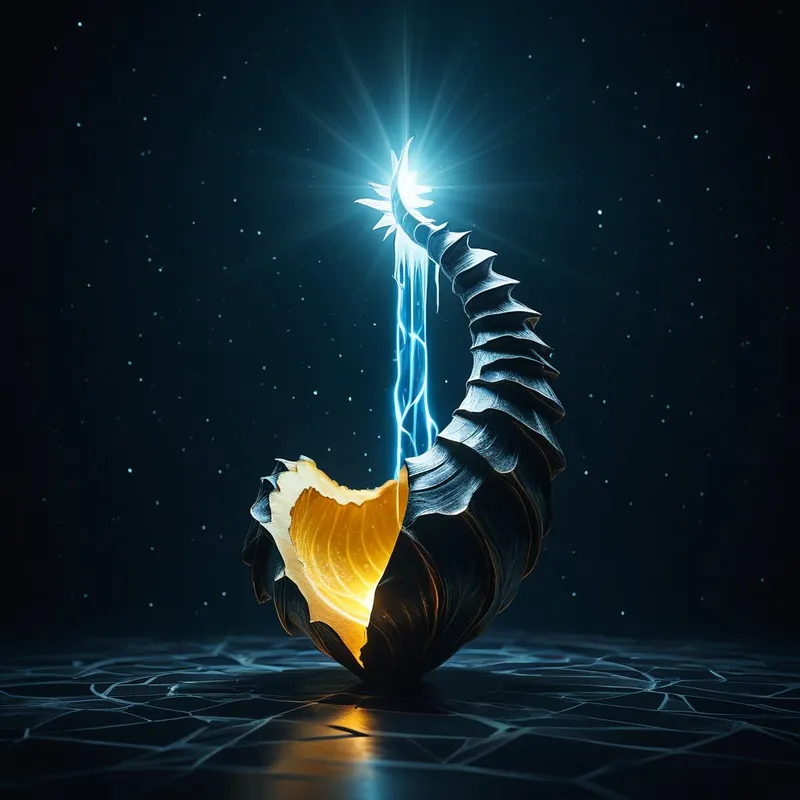
There was no cry of pain recorded, only a profound transformation. Where there was breakage, there was now becoming. The horn, cradled in divine hands, did not signify loss, but limitless gain. It became the Cornucopia, instantly overflowing with fruits, grains, and flowers—an unending stream of bounty from a single act of sacrificial care. The nurse was honored, her broken horn transmuted into the very symbol of the nourished world Zeus would one day rule.
Cultural Origins & Context
The myth of Amalthea is a foundational prelude, a necessary backstory to the established Olympian order. It belongs to the rich tapestry of cosmogonic and succession myths, passed down orally by bards and poets like Hesiod in his Theogony. Its primary function was etiological—to explain the origin of the Cornucopia, a potent symbol in Greek ritual and art associated with deities of the earth, harvest, and fortune, like Demeter and Tyche.
More deeply, it served a crucial societal role: it established the legitimacy and character of the supreme god. Zeus was not a remote, unfeeling tyrant from birth. His mythos includes this period of vulnerability, of being sheltered, fed, and protected. It roots his kingly authority in a debt of gratitude and a model of reciprocal care. The myth tells us that even the mightiest ruler was once a dependent child, and that his power is built upon a foundation of nurture—a profoundly humanizing and stabilizing concept for the culture that revered him.
Symbolic Architecture
Amalthea represents the primal, pre-conscious matrix of nourishment. She is not the biological mother (Rhea), nor the grand strategic planner (Gaia), but the immediate, somatic source of sustenance. She symbolizes the environmental mother—the actual, tangible source of food, warmth, and security that allows potential to grow.
The first law of the cosmos is not power, but nurture. Before the lightning bolt can be forged, the god must drink milk.
Her broken horn is the central alchemical image. The break is not a tragedy but a necessary fracturing of the whole to release a new, more complex order of being. The horn, a symbol of her strength and vitality, is sacrificed. In its breaking, its nature is utterly transformed: from a part of a body to a vessel of endless generativity. This is the paradox at the heart of care: true giving often involves a break in one's own integrity, a pouring out that feels like a loss, which then mysteriously becomes the source of infinite gain.
The Cornucopia, therefore, is not merely a symbol of agricultural plenty. It is the symbol of psychic and spiritual abundance born from a sacred exchange. It represents the overflowing creativity, resilience, and resourcefulness that can emerge only after one has been thoroughly nourished and has, in turn, honored that nourishment—even through an accidental break.
The Dreamer's Resonance
When the pattern of Amalthea stirs in the modern unconscious, it often surfaces in dreams of profound nourishment or its troubling absence. One might dream of a comforting, animal presence—a goat, a cow, a bear—that offers warmth and safety. This can signal a psyche seeking, or gratefully receiving, a deeply somatic, non-verbal form of care and grounding, perhaps during a period of vulnerability or new growth.
Conversely, dreams of the broken horn are pivotal. Dreaming of breaking something precious that belongs to a nurturing figure, or of discovering a broken object that then spills forth unexpected bounty, points to a critical phase in psychological development. The dreamer may be processing a felt sense of having "broken" a source of their own nurture—a relationship, an inner ideal, a childhood perception of a caregiver. The dream is not condemning the break, but orchestrating it, presenting the broken vessel as the next stage. It asks: What abundance is waiting to spill from this fracture? The somatic feeling accompanying such a dream can range from sharp guilt to awe-filled wonder.
Alchemical Translation
For the individual on the path of individuation, the Amalthea myth models the alchemy of the nurturing complex. The first stage is the acknowledgment of our own "infant Zeus"—the nascent, vulnerable, but potent new potential within us (a creative project, a new identity, a healing process). This potential must be hidden from the "Cronus" of our inner critic or cynical ego, and placed in a protected inner cave.
Individuation begins not with a quest, but with a feeding. The ego must first become a diligent Curete, clashing shields to protect the fragile god-spark within, while the deeper Self must become Amalthea, offering its own substance.
We must identify and honor our inner Amalthea—those sources, both internal and external, that provide unglamorous, steady sustenance. This could be a daily practice, a supportive relationship, or the body's own resilience. The critical alchemical fire is applied when, in our growth, we inevitably "break the horn." We outgrow a former source of comfort. We see the limitations of a once-nurturing figure or belief. We sacrifice a part of our own defensive structure.
The alchemical work is to not see this as an end, but as the creation of the Cornucopia. The broken horn is the crafted vessel. The endless flow is the psychic energy now liberated and redirected into a new form of creativity and abundance. The myth teaches that our deepest nourishment is not depleted by our growth; it is transformed by it. The ultimate goal is to become both the nurtured and the nurturer, holding the Cornucopia not as a symbol of what we receive, but of what we have learned to generate from the very substance of our breaks and our gratitude.
Associated Symbols
Explore related symbols from the CaleaDream lexicon: