Ama divers Myth Meaning & Symbolism
The myth of the Ama, women who dive into the ocean's abyss to retrieve pearls, embodies the soul's descent into the unconscious to bring forth life-giving treasure.
The Tale of Ama divers
Listen. Before the world was loud with machines, there was only the rhythm of the sea and the breath of the women who knew her secrets. They were called the Ama. They did not conquer the ocean; they courted her. They did not battle her depths; they entered into a sacred pact.
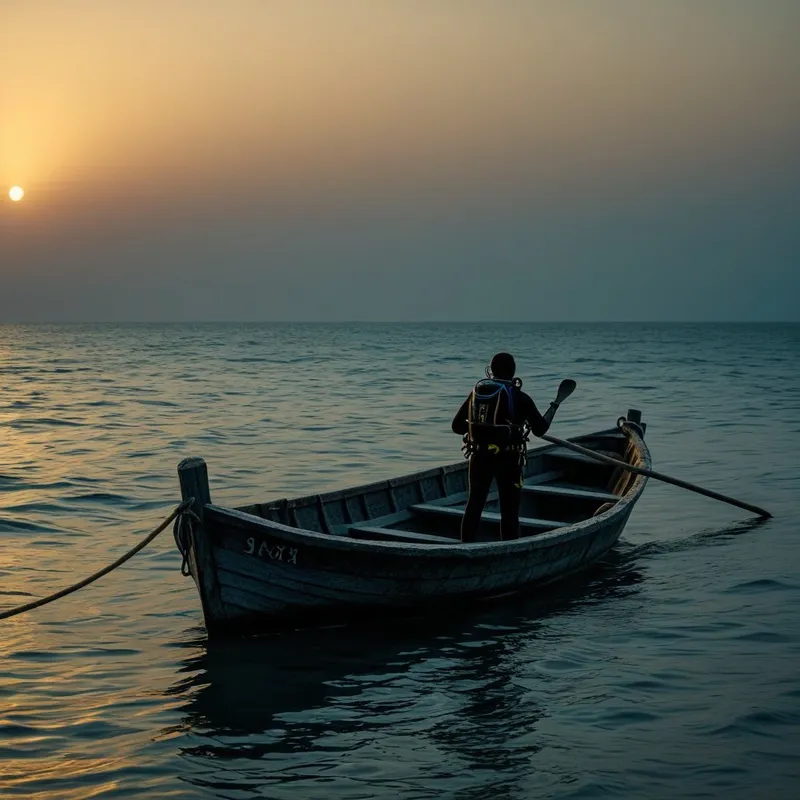
In the grey hour before dawn, when the world is neither night nor day, they would gather on the shore. Their bodies, wrapped in simple white cotton, were prayers against the dark water. They would sit by small fires, their skin drinking in the heat, their minds turning inward, away from the world of air and speech. Then, with a ritual slowness, they would approach the water's edge. No grand speeches, no clamorous gods. Just a woman, the intake of a long, deep breath—a sound like the world being born—and then the silent plunge.
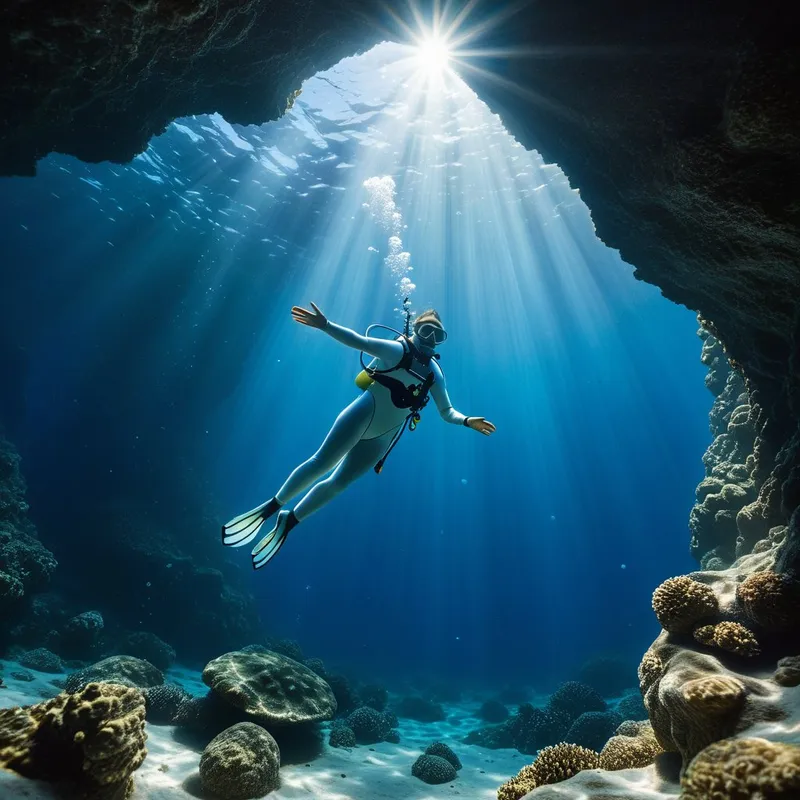
Down she would go, a pale arrow into the blue-green gloom. The pressure would embrace her, a cold, insistent lover. The light from above would fray into trembling threads, then vanish, leaving only the phosphorescent glow of life in the abyss. Her world shrank to the burning in her lungs, the beat of her own heart echoing in her ears, and the feel of the rocky floor beneath her searching hands. Here, in the kingdom of kami that dwell in dark places, she sought her treasure: the oyster, clamped tight around its secret.
Her fingers, skilled and gentle, would pry the shell from its stone cradle. This was the moment of truth, a silent conversation in the dark. To take too greedily was to offend the spirit of the place. To hesitate was to drown. With the prize secured, she would kick upward, following the silver trail of her own bubbles, her chest a forge of fire, her vision tunneling to that distant, shimmering coin of light—the sun seen through a veil of water.
Breaking the surface, the gasp was not just for air. It was a rebirth. The exhalation was a song returned to the world. In her hand, the rough, unassuming shell. Only later, by the fire, would it be opened. And there, gleaming with a wet, inner moonlight, would be the pearl: a perfect sphere born of irritation, of a grain of sand embraced by the living flesh of the deep. The sea’s secret, bought with breath and courage, now held in a human palm.
Cultural Origins & Context
The Ama are not a myth in the sense of a single, codified story with named deities. They are a living mythos, a practice that became legend. For over two thousand years, primarily in the coastal regions of Mie Prefecture and Jeju Island, women have free-dived to harvest wakame, awabi, and, most symbolically, pearls. This was not merely an occupation; it was a socio-spiritual role.
These communities were often matrifocal, with the Ama as primary breadwinners, their earnings literally hauled up from the deep. The knowledge was passed from mother to daughter, a lineage of breath and pressure. Their rituals—the pre-dive meditation, the votive offerings to the sea kami, the specific whistling breath (iso-ebuki) upon surfacing to expel carbon dioxide—framed the dive as a sacred transaction. They functioned as intermediaries between the human community and the fertile, dangerous unconscious of the ocean, providing both physical sustenance and a powerful cultural narrative of feminine strength, resilience, and direct communion with nature’s raw, generative power.
Symbolic Architecture
The Ama diver’s journey is a masterful map of the psyche. The surface world represents the conscious ego—the realm of air, speech, and social life. The dive is a voluntary descent into the unconscious, specifically the collective unconscious symbolized by the primordial sea.
The pearl is the Self, formed not in spite of the wound, but because of it. The grit of experience, embraced by the soul’s substance, becomes luminous unity.
The white diving garment is a shroud, signifying the death of the ego’s petty concerns. The single, held breath is the focused life-force, the concentrated libido necessary to navigate the depths. The burning lungs are the tension of the transformative process, the nigredo or blackening of alchemy. The oyster on the dark seafloor is the hidden, protected core of the psyche, where transformation occurs in darkness. The retrieval is not a raid, but a respectful extraction, acknowledging that the treasure belongs to the depths until it is consciously integrated.
The Dreamer's Resonance
When this mythic pattern stirs in modern dreams, it signals a call to dive. You may dream of holding your breath underwater, exploring sunken ruins, or searching for a lost, glowing object in the dark. Somatically, this can correlate with feelings of constriction in the chest, a sense of pressure, or conversely, a surprising ease in deep water.
Psychologically, this is the process of engaging with what has been submerged: repressed memories, unlived potentials, or deep-seated grief. The dream-ego is undergoing the Ama’s ordeal—learning to tolerate the pressure of psychic truth, to navigate without the familiar light of conscious rationality, and to operate on the limited breath of courage. The anxiety of drowning is the fear of being overwhelmed by the contents of the unconscious. The triumphant return to the surface with a treasure signifies the successful retrieval of a vital, life-enhancing insight or quality, ready to be “breathed into” waking life.
Alchemical Translation
The Ama’s work is a perfect model for individuation. The entire cycle is an alchemical opus. The descensus (descent) is the initial confrontation with the shadow and the anima/animus realms in the personal unconscious. The seafloor work is the coniunctio, the engagement with the deep archetypal opposites—life and death, pressure and treasure, time and eternity.
One must become the oyster to make the pearl; the diver and the deep are not two, but one organism in the act of self-creation.
The modern individual translates this by consciously entering periods of introspection, therapy, or creative incubation—the voluntary “dive.” We learn the Ama’s art: to take that one deep breath of intention, to endure the burning discomfort of self-confrontation without fleeing prematurely to the surface of distraction, and to search with respectful hands in the dark sediments of our history and soul. The prize is never what the ego thinks it wants (fame, validation); it is always the pearl of the Self—a hard-won, authentic wholeness formed around the irreducible grit of our lived experience. We surface, gasping, forever changed, bearing an inner luminosity that was forged in the very pressure we feared.
Associated Symbols
Explore related symbols from the CaleaDream lexicon: