Altar of Incense Myth Meaning & Symbolism
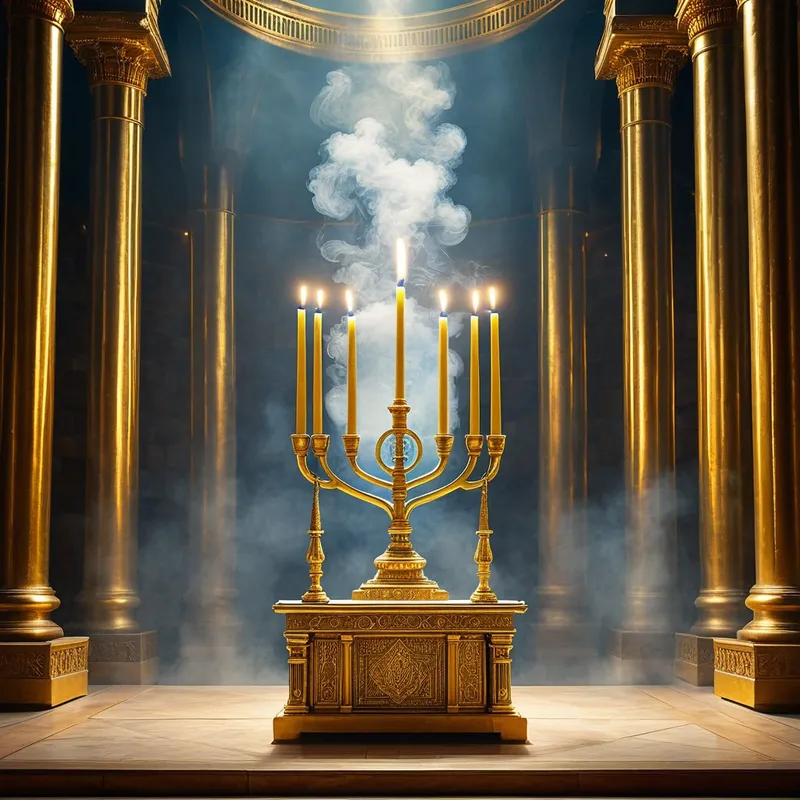
A sacred golden altar where fragrant smoke ascends, weaving human prayer into the divine presence within the holy sanctuary.
The Tale of the Altar of Incense
Hear now of the place where breath becomes bridge, where the scent of earth meets the silence of heaven. It stands not under the open sky, but in the inner chamber, the Holy Place. Here, the air is thick with the memory of oil and the sheen of hammered gold. To one side, the Menorah casts a restless, living light. To the other, the Table of Presence offers the quiet sustenance of the tribes. And before the veil—the woven boundary beyond which only the holiest may pass—rests the heart of this fragrant mystery: the Altar of Incense.
It is a small cube of acacia wood, sheathed entirely in pure gold, as if a cinder from the sun itself had been placed gently upon the earth. Upon its crown, a ridge of gold forms a border, a horizon for the sacred work. No blood is spilled here; no flesh is consumed. This is an altar for fire of a different order.
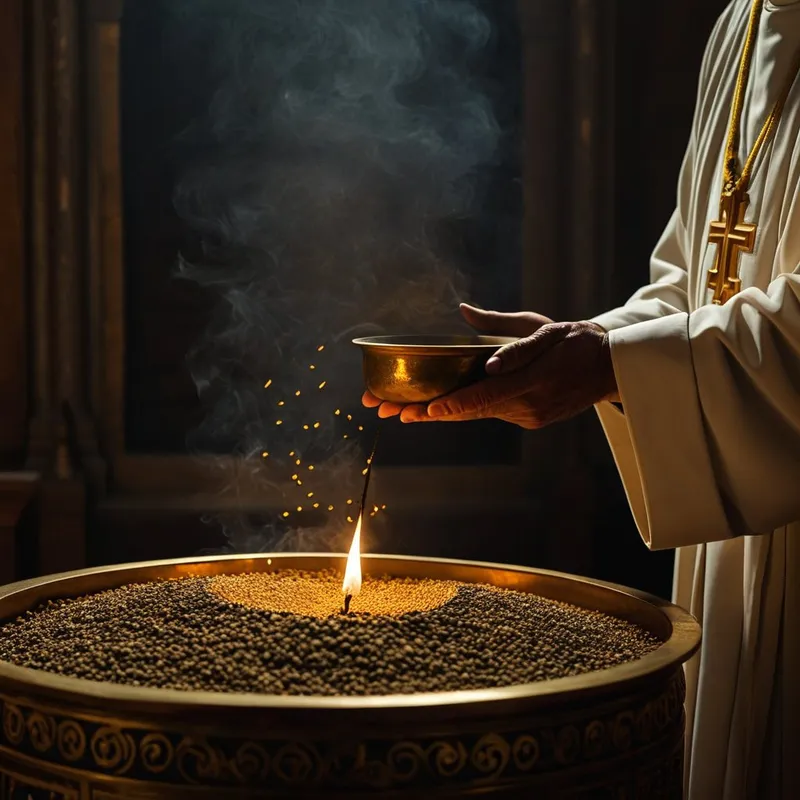
Twice each day, as the sun touches the world’s rim, the appointed priest enters. He carries not a sacrifice, but a censer. In one hand, a golden shovel holds coals taken from the great Bronze Altar in the courtyard—fire that has already accepted the people’s surrender. In the other, a vessel holds the sacred compound: stacte, onycha, galbanum, and frankincense, ground fine, a mixture ordained, never to be used for common pleasure.
The ritual is one of exquisite tension. The priest approaches the golden cube. The coals are poured onto its surface. Then, with a motion that is both offering and release, he places the incense upon the fire.
A silence falls, deeper than the absence of sound. Then, a crackle, a sigh. And from the altar, smoke begins to rise. Not a wild, dissipating cloud, but a column—a solid, unbroken pillar of fragrant grey. It ascends in a perfect, unwavering line, a vertical path through the still air. It climbs past the glow of the Menorah, past the loaves on the table, until its head meets the woven threads of the veil that separates the Holy Place from the Holy of Holies. There, the smoke seems to press against the fabric, to seep into its very threads, carrying with it the essence of the prayer it has become. It is the breath of the community, transformed by sacred fire into a scent pleasing to the Divine Nose. For a moment, the veil is not a barrier, but a permeable membrane. The human and the holy breathe in the same fragrant air.
Cultural Origins & Context
This is not a myth of a single heroic act, but a prescribed, eternal rhythm embedded within the priestly law of the Torah. Its origin is architectural and liturgical, given as divine instruction to Moses during the wilderness sojourn. The Altar of Incense was a central fixture of the portable Tabernacle and, later, the stationary Temple in Jerusalem.
The story was passed down not by bards around a fire, but by priests and scribes, through meticulous ritual repetition and textual transmission. Its primary tellers were the Kohanim, who performed the rite generation after generation. Its societal function was manifold: it regulated the approach to the divine, it symbolized the constant, daily intercession for the people, and it created a sensory anchor for communal identity. The rising smoke was a public, visible sign that the covenant relationship was being actively tended—that prayer was as essential and scheduled as the morning and evening sacrifices outside.
Symbolic Architecture
The symbolism of the altar is a multi-layered architecture of the soul. The gold sheathing represents the highest aspiration, the divine nature, and incorruptible value. The acacia wood core signifies the human, the earthly, the mortal frame that supports this aspiration.
The altar is where the human core, clothed in divine intent, becomes a vessel for transmuting the raw material of longing into an acceptable form.
The incense itself is a profound symbol. Its specific, exclusive formula represents a prayer that is both unique and set apart—a dedicated communication. The act of placing it on coals taken from the outer altar is critical: it signifies that personal prayer or intercession must be founded upon the prior act of surrender and atonement (the sacrifices of the bronze altar). One cannot bypass the work of reconciliation to engage in communion.
Most powerfully, the rising smoke represents the ascent of prayer from the earthly to the heavenly. It is breath made visible, intention given form. It does not explode or scatter; it coalesces and rises directly, symbolizing focused, undistracted devotion that seeks to penetrate the ultimate boundary—the veil separating the known from the utterly mysterious.
The Dreamer's Resonance
When this myth stirs in the modern unconscious, it rarely appears as a literal golden altar. Instead, one might dream of a quiet, focused place in a cluttered house from which something essential ascends. Or of tending a small, precise flame that transforms a substance—words, tears, memories—into a vapor that changes the quality of the air.
To dream of this pattern is to undergo a somatic process of gathering and releasing. Psychologically, it indicates a movement from fragmented, chaotic inner dialogue (the raw spices) towards a synthesized, intentional offering (the compounded incense). The dreamer is often in a state of seeking clarity or connection, feeling the need to formalize their hopes, fears, or gratitude into a coherent "prayer" that moves beyond the self. The altar in the dream represents the disciplined, sacred space one must create within one's own psyche to perform this alchemy. The rising smoke is the feeling of release and connection that follows a genuine, integrated expression of the soul's depth.
Alchemical Translation
For the individual on the path of individuation, the myth of the Altar of Incense models the stage of sublimation and conscious relationship with the Self.
The outer courtyard of sacrifice represents the necessary, often painful, work of confronting the shadow and surrendering egoic claims (the "burnt offerings"). This work provides the "coals"—the transformed energy, the heat of conscious suffering and insight. One cannot approach the golden altar with cold, self-generated sparks.
The inner altar represents the sacred, inner sanctum of the psyche where this refined energy is applied. Here, the "incense" is the totality of one's experiences, emotions, and thoughts, not rejected, but compounded—brought together into a unique, personal essence.
Individuation is not the destruction of the human material, but its compounding upon the sacred fire of consciousness, creating a unique fragrance that did not exist before.
The daily ritual mirrors the necessity of consistent, devoted inner work. The rising smoke is the symbol of the transcendent function at work: the creation of a new, third thing (the connecting column) that bridges the conscious ego and the unconscious Self (the Holy of Holies). The veil remains—the Self is ultimately unknowable in its totality—but it becomes permeable. Communication is established. The individual no longer shouts into a void, but learns to send up a focused, fragrant signal, and in the stillness, senses a response in the changed atmosphere of their own being. The goal is not to tear down the veil, but to learn the art of the fragrant ascent that makes the veil a site of meeting, not of separation.
Associated Symbols
Explore related symbols from the CaleaDream lexicon: