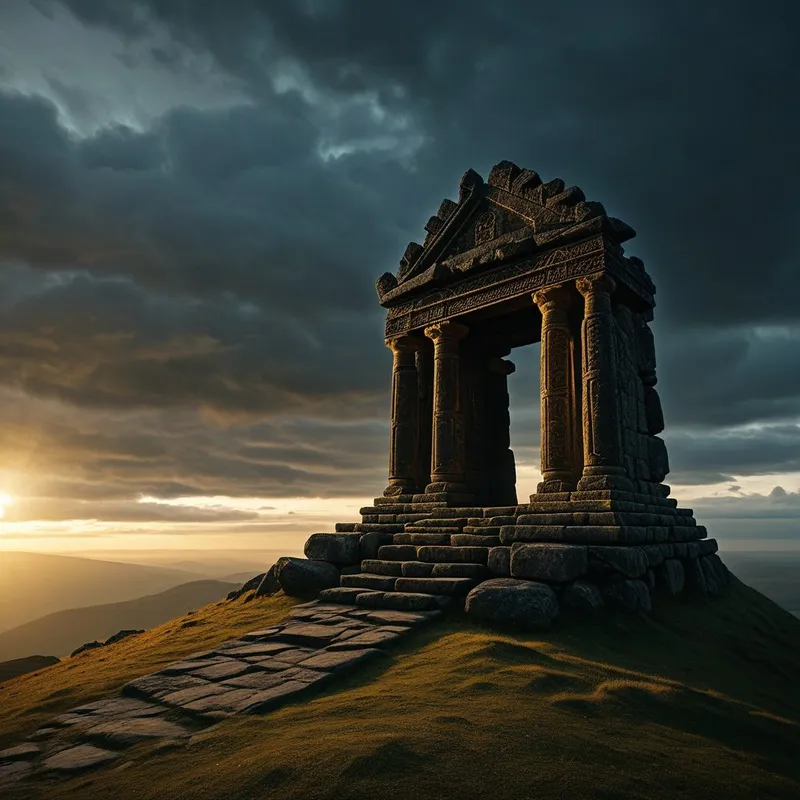
Altar Myth Meaning & Symbolism
The myth of the altar is the story of a sacred table where the human and divine meet, sealed by sacrifice and transformed by grace.
The Tale of Altar
Listen. In the beginning, there was a chasm, a terrible silence between the heavens and the dust. The divine breath moved upon the waters, and life stirred, but the connection was a memory, a fading echo. Humanity walked, built, and dreamed, yet their words seemed to fall back to earth, unheard. They felt the absence like a hollow in the chest.
Then came the whisper, not in the wind, but in the heart of a wanderer named Abraham. "Go to the land I will show you," it said. "Build an altar there." And so he did. With uncut stones, heavy with the weight of the earth itself, he piled them high on a mountain called Moriah. It was a rude and simple thing, a bridge of rock. Upon it, he laid wood. The air grew thick with the scent of resin and impending storm. His hand trembled, not with fear, but with the awful gravity of the meeting place. Here, at this pile of stone, the unseeable would draw near. The knife was raised—a flash against a dark sky—and in that moment of ultimate offering, the chasm was bridged not by the death, but by the surrender. A ram, caught in a thicket, became the substitute. The altar smoked, and the covenant was sealed in fire and smoke, a pillar connecting earth to heaven.
Generations later, the whisper became a cloud and a fire, leading a people through a desert. Their lawgiver, Moses, was given a vision: a mobile altar of acacia wood overlaid with bronze. It traveled with them, this holy hearth. Where they camped, it was the center of the camp; its fire never went out. The scent of fine flour, oil, and frankincense—a grain offering—would rise each morning and evening. It was the heartbeat of the community, a rhythmic pulse of acknowledgment and dependence. To approach it was to approach the consuming fire of Presence itself.
Then came the age of temples. Solomon built a house of cedar and gold, and within its innermost court stood the great Altar of Burnt Offering. Here, the drama of reconciliation reached a crescendo. The high priest, in garments of blue, purple, and scarlet, would lay his hands upon the head of a flawless bull, transferring the weight of a nation’s brokenness onto the beast. The knife would flash, the blood would be collected in basins, and the life—for the life is in the blood—would be poured out at the base of the altar. The flesh would be placed upon the bronze grate, and the fire would descend, not from human hands, but from heaven itself. The roar of the flame, the crackle of fat, the dense, greasy smoke coiling upward—this was the language spoken at the altar. It was a terrible, beautiful, and necessary conversation.
But the stones themselves wept, for the conversation was never complete. The blood of bulls and goats could only point, not perfect. Until a final, silent night, in a shadowed garden, another was bound. Not on Moriah, but on Golgotha. Here, the wood was a cross, the offering a man. And in that moment, the myth of the altar reached its shocking, silent resolution. The divine breath itself was poured out. The temple veil, shielding the holy of holies, tore from top to bottom. The mobile altar had found its final, still point. The fire of heaven had been quenched in a deeper, darker sacrifice, and from it, a new covenant was born, not of stone and blood, but of spirit and grace.
Cultural Origins & Context
The myth of the altar is not a single story but a deep, evolving pattern woven through the entire tapestry of the Biblical narrative. Its origins are nomadic, emerging from the pastoral and early agricultural societies of the ancient Near East. An altar was, first and foremost, a place of encounter, a "beth-el" (house of God). For patriarchs like Abraham, Isaac, and Jacob, it was a spontaneous response to a theophany—a pile of stones marking where God had spoken.
This personal memorial evolved into a central, prescribed element of communal Israelite worship, codified in the books of Exodus, Leviticus, and Deuteronomy. The altar became the sociological and theological center of the community. Its maintenance—the continual offerings—was the people's shared ritual of atonement, thanksgiving, and communion. It functioned as the nation's anchor, the tangible point where their corporate identity as a covenant people was reaffirmed daily. The myth was passed down through priestly lineages, recorded by scribes, and re-enacted in the solemn, sensory-rich rituals of the Temple. It was a story told in smoke and scent, in the feel of rough stone and the sight of flowing blood, impressing itself not just on the mind, but on the very senses of the culture.
Symbolic Architecture
Psychologically, the altar represents the constructed space within the psyche where consciousness engages with the transcendent, the numinous, or the contents of the deep Self. It is the temenos, the sacred precinct where the profane business of the ego is temporarily suspended for an encounter with something greater.
The altar is the psyche’s negotiation table with the infinite, where the currency is not reason, but sacrifice.
The materials are symbolic: uncut stones signify the raw, unadorned aspects of our nature being used in their natural state for a sacred purpose—no polishing by the ego is permitted. Bronze, an alloy, represents the strength and durability required to contain the fire of transformation. The fire itself is the archetypal symbol of purification, divine presence, and the transformative energy that consumes the offered form to release its essence. The blood, universally seen as life-force, symbolizes the ultimate cost, the pouring out of one’s vital energy or cherished attachments. Finally, the smoke represents the prayer or the essence of the sacrifice ascending, the point of contact between the earthly offering and the heavenly response.
The Dreamer's Resonance
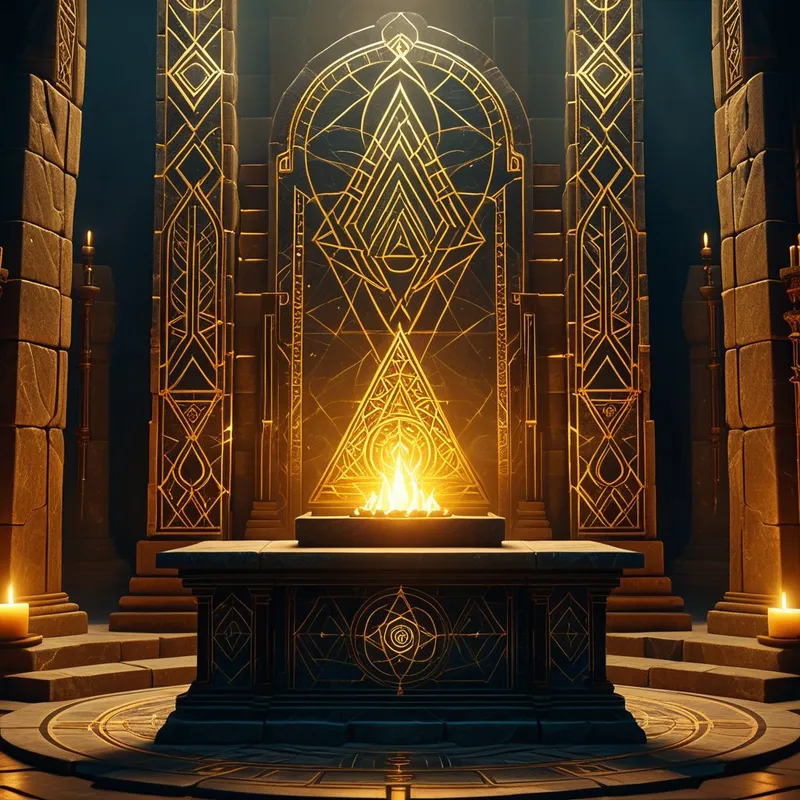
When the altar appears in modern dreams, it rarely manifests as a church furnishing. It appears as any raised platform, a stone table in a forest clearing, a simple slab in a basement, or even a cleared space on a desk. Dreaming of building an altar signifies the dreamer’s unconscious preparation for a significant inner offering—perhaps letting go of an old identity, a cherished grievance, or a compulsive pattern. It is the somatic signal of the psyche readying itself for a rite of passage.
To dream of approaching an altar with nothing to offer speaks of a feeling of spiritual or creative poverty. To dream of an altar on fire can indicate a process of intense, perhaps painful, purification underway. A broken or desecrated altar often mirrors a profound sense of broken covenant in the dreamer’s life—with themselves, their values, or a relationship they held as sacred. The altar in dreams marks the spot where the personal psyche intersects with the archetypal realm, and the dream ego’s actions there—whether in fear, reverence, or avoidance—chart the course of an imminent transformation.
Alchemical Translation
In the alchemy of individuation, the myth of the altar models the entire process of psychic transmutation. The first step, nigredo (the blackening), is found in the choice of the sacrifice—the confronting of what must die. This is the bull, the ram, the grain—the valued possession, the familiar comfort, the inflated aspect of the personality that must be laid upon the stone.
Individuation demands a sacrifice of the partial self to make room for the whole Self. The altar is the crucible where this transaction occurs.
The albedo (whitening) is the moment of surrender, the flash of the knife, the release of control. This is the critical dissolution. The rubedo (reddening) is the application of the sacred fire—not the ego’s willpower, but the descent of a transformative energy from the Self (the "fire from heaven"). This fire does not destroy arbitrarily; it transmutes. It consumes the literal, identified form (the ego-attachment) to release its symbolic, spiritual essence (its value for the whole psyche).
Finally, the rising smoke is the sublimatio—the integration. The essence of the sacrifice, now freed from its literal constraints, ascends and is integrated into a higher order of being. The modern individual performs this alchemy not with physical offerings, but by consciously sacrificing attitudes: pride for humility, certainty for openness, resentment for forgiveness, isolation for connection. Each time we do this work consciously, we build an inner altar, and at that sacred space, the ego and the Self renew their covenant, forging a more complete and authentic human being.
Associated Symbols
Explore related symbols from the CaleaDream lexicon: