Allegory of the Cave Myth Meaning & Symbolism
A tale of prisoners chained in darkness, mistaking shadows for reality, and the harrowing ascent into the blinding light of true knowledge.
The Tale of the Allegory of the Cave
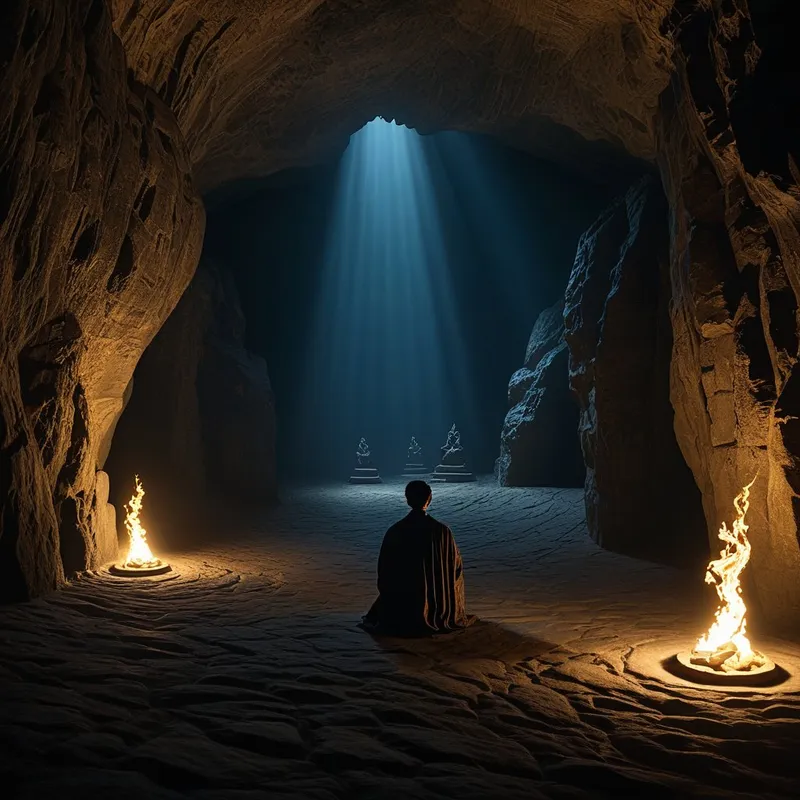
Imagine, if you will, a place deep beneath the world of men. Not a place of earth and root, but of stone and echo. Here lies a cavernous den, its mouth open to a world it does not know. Within, from childhood, men and women are bound. Not by malice, but by custom. Their legs and necks are fettered so they cannot turn their heads; they can see only what is before them, the blank wall of the cave.
Behind them, at a distance and higher up, a fire blazes. Between the fire and the prisoners runs a low wall, like the screen at a puppet show. And along this wall walk bearers, carrying all sorts of vessels, statues, and figures of animals and men, which appear over the wall. Some of the bearers speak, others are silent.
The prisoners see only the shadows of these objects, cast by the firelight onto the wall they perpetually face. The echoes of the voices from the bearers bounce off the stone, seeming to come from the shadows themselves. For these captives, the shadows are the whole of reality. They name them, discuss their sequences, honor the cleverest who can best predict which shadow will come next. Their world is a play of phantoms, and they are its devoted, if unwitting, audience.
Now, picture one among them. His bonds are loosened, perhaps by chance or a force unseen. He is compelled to stand up, to turn his neck, to walk and to look towards the light of the fire. The action is agony. The movement is alien, the light painful to eyes accustomed only to dim reflections. The objects carried along the wall seem less real than their shadows, for they are confusing, crude, and dazzling. He would prefer to return to his familiar chains, to the comforting certainty of the shadow-play.
But he is not permitted to retreat. He is dragged, struggling and lamenting, up the steep and rugged ascent, out of the cave and into the light of the sun itself. The pain is blinding, unbearable. He can see nothing of the realities of which he is now told—the trees, the water, the stars. He can only suffer the radiance.
Slowly, painfully, his eyes adjust. He first looks at the shadows of things, then at their reflections in water, then at the things themselves. He gazes upon the light of the moon and the stars by night. Finally, he can behold the sun itself, not as a mere image in water, but in its own proper place, and contemplate its nature. He understands it as the source of the seasons and the years, the guardian of all in the visible world, and in a way, the cause of all that he and his fellows had seen in the cave.
Then, remembrance of his old habitation, and the wisdom of the cave-dwellers, comes to him. He pities them. He knows their prizes and honors—for predicting shadows—are empty. Filled with this new understanding, he descends back into the cavern.
His eyes, now full of the sun, are blind in the world of darkness. He stumbles, clumsy and sightless, before the seated prisoners. They laugh at him. They say his journey upwards has ruined his sight. They declare it is not worth even to attempt to ascend. And if they could lay hands on the man who tried to free them and lead them up, they would kill him.
Cultural Origins & Context
This is no myth of gods and heroes, but a philosophical parable crafted by the Athenian thinker Plato, written around 380 BCE in the seventh book of his monumental dialogue, The Republic. It was told by the character of Socrates to his interlocutor, Glaucon. Its function was not entertainment, but profound instruction on the nature of reality, knowledge, and governance.
In the context of Platonic culture, the “myth” served as the cornerstone of a radical metaphysical system. It illustrated the distinction between the visible world of shifting appearances (the cave) and the intelligible world of eternal Forms (the world outside, culminating in the Sun, the Form of the Good). It was passed down not by bards, but by philosophers and students in the Academy, a living model for the arduous path of education (paideia) and the philosopher’s duty to return to the political “cave,” however hostile, to guide others. Its societal function was to justify the rule of philosopher-kings—those few who had seen the truth and must, however reluctantly, administer the state.
Symbolic Architecture
The Allegory is a perfect symbolic architecture of the human condition. The Cave represents the phenomenal world of sensory experience, the world as it appears to us, mediated by our bodily senses and cultural conditioning. The Shackles are our own cognitive limitations, biases, and unexamined assumptions—the inherited “software” of perception that keeps us facing one direction. The Shadow-Play is the constructed reality of society, media, ideology, and personal narrative that we mistake for ultimate truth.
The journey from darkness to light is not an acquisition of information, but a transformation of the entire faculty of seeing.
The Fire is the imitative light of conventional wisdom, the second-hand sources that illuminate but also distort. The Ascent is the painful process of dialectic and philosophical inquiry, which feels like a loss of reality before it becomes a gain. The Sun is the Form of the Good, the source of all intelligibility and being, which can only be apprehended by the intellect after long preparation. The Return is the philosopher’s tragic and necessary obligation, the descent of wisdom into the marketplace, which often meets with ridicule or violence.
Psychologically, the prisoner who escapes is the emerging ego-consciousness beginning to differentiate from the collective unconscious (the cave). The shadows are the autonomous complexes and archetypal images that parade before the undifferentiated psyche, which it takes to be the whole self.
The Dreamer’s Resonance
When this myth stirs in the modern dreamer, it often manifests as dreams of imprisonment in familiar yet confining spaces—old basements, endless hallways, or theaters where one is forced to watch a nonsensical play. The dreamer may feel chained to a desk, a role, or a relationship, watching a repetitive “shadow-play” of their own life narrative. The somatic experience is one of profound frustration, claustrophobia, and a nagging sense of falsity.
The turning point comes in the dream when a door previously unseen is noticed, a light shines from a crack, or the dreamer finds they can, after all, turn their head. This is the psyche signaling a readiness to question fundamental assumptions. The subsequent dream imagery—a blinding light, a difficult climb, emerging into an overwhelming landscape—maps the disorientation and psychic growing pains of confronting a deeper truth. The dream may end in the painful return to the “cave,” symbolizing the difficulty of integrating new awareness into an old life structure, often feeling misunderstood by those still “asleep.”
Alchemical Translation
The allegory is a precise map of the alchemical and Jungian process of individuation. The initial state (nigredo) is the prisoner in the dark cave, identified with the shadowy contents of the personal and collective unconscious. The breaking of the chains is the first stirring of the Self, initiating the crisis that forces a confrontation with the psyche’s own defensive structures (the pain of the fire).
The arduous ascent is the albedo, the whitening, the rigorous work of analysis, introspection, and confronting painful truths—it is a purification. Reaching the sunlight and gradually comprehending the Forms is the citrinitas, the yellowing or solar illumination, where one perceives the archetypal patterns behind personal experiences.
The true philosopher does not flee the cave of human suffering, but carries the sun within them as they descend.
The culmination, gazing at the Sun itself, is the rubedo, the reddening, the full integration of the Self, achieving a paradoxical connection to the transcendent source. But the work is not complete. The alchemical opus requires the return, the projection of this newfound gold back into the lead of the world. This is the most challenging transmutation: to live the truth in a world of shadows without succumbing to bitterness or inflation, to suffer the blindness of the cave-dwellers not as a curse, but as a condition to be met with compassion. The myth thus models the ultimate psychic triumph: not escape from the human condition, but the transformation of one’s entire mode of being within it, becoming a vessel through which a glimmer of the sun might, however faintly, illuminate the dark.
Associated Symbols
Explore related symbols from the CaleaDream lexicon: