Ali Baba and the Forty Thieves Myth Meaning & Symbolism
A poor woodcutter discovers a thieves' treasure cave, unlocking a world of fortune, danger, and cunning that tests his family's loyalty and wit.
The Tale of Ali Baba and the Forty Thieves
Listen, and let the desert wind carry you to a time of hidden wonders. In a dusty Persian town, there lived two brothers. Kasim had all the luck of the merchant, his coffers full. But Ali Baba, the younger, knew only the honest ache of the woodcutter’s labor, his axe biting into the trunks of the sparse forest to feed his family.
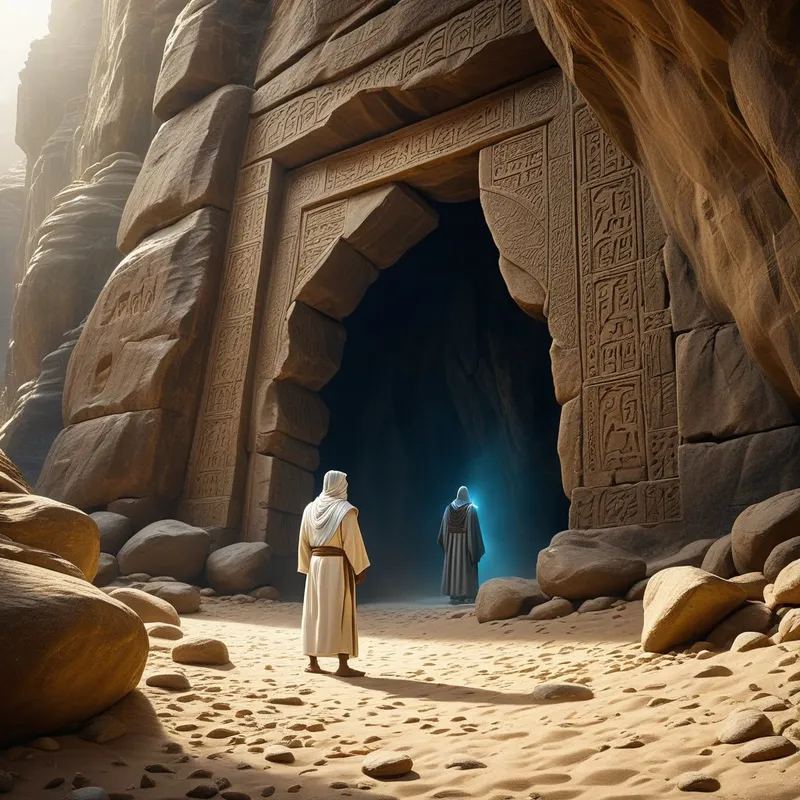
One day, deep in the hills, Ali Baba’s work was interrupted by a thunder of hooves. He scrambled into the safety of an ancient, gnarled tree and held his breath. Forty riders, faces hard as the canyon rock and dressed for violence, approached a sheer cliff face. Their leader, a man with eyes like black flint, dismounted and cried out to the stone itself: “Open, Sesame!”
And the mountain obeyed. With a groan of ancient rock, a hidden door swung inward. The men filed inside, emerging later with heavy sacks, their leader sealing the cave with the words, “Close, Sesame!”. When the dust of their departure had settled, Ali Baba’s heart hammered against his ribs. He approached the blank rock and whispered the secret. “Open, Sesame.”
The cave yawned before him, not a den of earth, but a chamber of dreams. Piles of gold coins shimmered like water. Silks spilled from chests. Jewels glinted in the dim light, a treasure beyond the imagination of kings, gathered by thieves from the corners of the world. Fearing the men’s return, Ali Baba took only what his donkeys could carry—a few modest sacks of gold—and sealed the mountain’s mouth.
But fortune is a flame, and it draws moths. Kasim, discovering his brother’s sudden wealth, wormed the secret from him. Greed blinded Kasim to caution. He rushed to the cave, uttered the words, and was swallowed by gold. In his avarice, he forgot the command to leave. When the thieves returned, they found him trapped. Their justice was swift and final.
Ali Baba, fearing the worst, went searching. He found his brother’s body, a grim warning. He brought Kasim home, and the family’s grief was compounded by a terrible secret: how to explain his death without revealing the treasure? Here, the true hero of the tale emerged: Morgiana, a slave gifted with a mind sharper than any scimitar. She found a clever tailor who, working blindfolded, sewed Kasim’s body back together, allowing for a discreet burial.
The thieves, however, were not fools. They discovered a body was missing. Their leader, in disguise, traced Ali Baba. He came to the house, posing as an oil merchant, his mules carrying thirty-eight jars—one with oil, and thirty-seven hiding his murderous men, waiting for a signal to spring forth and slaughter the household.
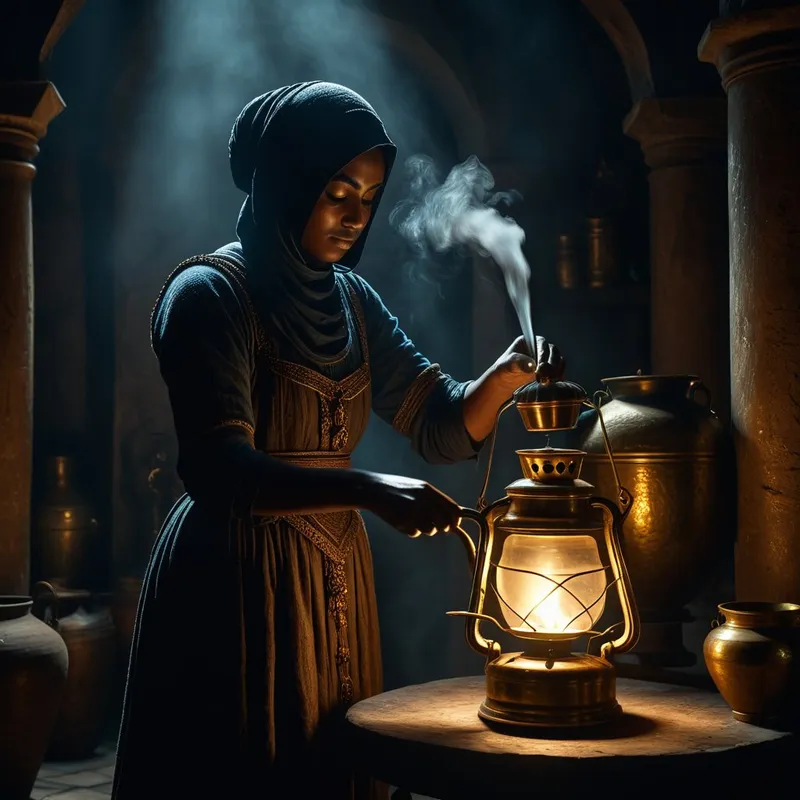
Once more, Morgiana’s wisdom shone. Needing oil for the lamps, she found the first jar strangely heavy. A whisper from within met her ear. In a flash of understanding, she took a great cauldron of boiling oil and poured a lethal measure into each sealed jar, silencing the hidden threat. When the thief captain came to give the signal, he met only the grim silence of his dead crew. Later, as he dined with Ali Baba, pretending friendship, Morgiana recognized him. She performed a mesmerizing dagger dance, and at its climax, plunged the blade into his heart.
The shadow was lifted. The treasure, and its secret, passed to Ali Baba and his descendants, guarded forever by the loyalty and cunning of the remarkable Morgiana.
Cultural Origins & Context
The tale of Ali Baba is one of the most famous stories from the One Thousand and One Nights, also known as the Arabian Nights. Unlike some core tales believed to be of ancient Persian or Indian origin, scholars suggest Ali Baba may be a later addition, possibly from a Syrian storyteller in the 18th century, first recorded by the French orientalist Antoine Galland. Its “Arabian” cultural setting is that of the Islamic Golden Age—a world of bustling bazaars, caravanserais, and stark desert frontiers where fortune could change in a moment.
It was a story told in coffee houses and royal courts, a folk narrative that functioned as both entertainment and moral instruction. It reflects a societal fascination with sudden reversals of fate, the hidden dangers of the road, and the immense value placed on cleverness and loyalty within the closed unit of the household. The hero is not a prince, but a common man; the savior is not a warrior, but an enslaved woman. This subversion speaks to the folk wisdom of the culture, acknowledging that true power often lies in wit and perception, not just in birth or brute force.
Symbolic Architecture
At its heart, this is a myth of the shadow and its integration. The treasure cave is not just a physical location; it is the vault of the unconscious, filled with the repressed wealth and potential of a life unlived.
The secret cave is the psyche itself. The password is the act of consciousness required to access its depths.
Ali Baba stumbles upon it not through questing, but through attention—he is in the right place, observing, not striving. The thieves represent the shadow in its raw, undifferentiated, and dangerous form: a legion of repressed desires, instincts, and capacities that operate outside the law of the conscious self. They have amassed the “wealth,” but they cannot integrate it into civilized life; they can only hoard it.
The gold is symbolic potential—libidinal energy, creativity, and power. Kasim’s fate is a stark warning of the ego’s fate when it attempts to possess the shadow’s contents through greed and identification; it is destroyed by them. Ali Baba’s approach is different. He takes only what he can consciously carry and integrate (“what his donkeys can bear”).
Morgiana is the crucial psychological function: the animating intelligence of the unconscious. She is the personified cunning, the transformative insight that works within the household (the conscious personality) to neutralize the threat. She doesn’t fight the shadow head-on in the open; she meets its covert threat with superior covert action (the boiling oil), and its final, disguised manifestation with direct, conscious integration (the dagger dance becoming an act of liberation).
The Dreamer's Resonance
When this myth stirs in modern dreams, it signals a confrontation with a trove of hidden personal potential and the defensive structures that guard it. Dreaming of a hidden door or cave suggests an intuition of undiscovered aspects of the self. The feeling of stumbling upon a secret, of overhearing a magical phrase, points to a moment of psychological readiness.
Dreams of being pursued by a faceless gang, or of hiding while dangerous figures pass by, mirror Ali Baba’s initial fear. This is the somatic anxiety of the ego sensing the shadow’s approach. The dreamer may be on the verge of acknowledging a powerful but long-ignored drive, talent, or trauma.
Conversely, to dream in the role of Morgiana—of cleverly solving an impossible domestic threat, of pouring liquid to neutralize a hidden danger—suggests the dreamer’s psyche is actively engaged in a process of integration. It is the intelligence of the unconscious itself working to protect the conscious personality from being overwhelmed by the very forces it is trying to assimilate.
Alchemical Translation
The psychic transmutation modeled here is the alchemy of turning hidden, outlawed potential (the thieves’ gold) into legitimate, generational wealth (Ali Baba’s legacy). The process begins with the nigredo: the blackening. This is Ali Baba’s poverty, his marginalized state—the “orphan” archetype feeling cut off from life’s abundance.
The discovery is the albedo: the whitening, the revelation. The magical phrase “Open, Sesame” is the key of consciousness that unlocks the unconscious. But revelation alone is not integration. The citrinitas—the yellowing, the arduous work—is embodied by the long middle act: the death of Kasim (the greedy ego), the cunning of Morgiana (the mediating intelligence), and the repeated assaults of the thief captain (the shadow’s resistance to being assimilated).
Individuation is not a single opening of the cave, but a series of negotiations with its guardians.
The final rubedo—the reddening, the culmination—is not merely possessing the treasure. It is the restoration of order. The shadow (the thieves) is not destroyed in battle abroad but is integrated at home, its energy neutralized and its leader consciously recognized and dealt with. The treasure loses its curse. Morgiana is freed and married to Ali Baba’s son, symbolizing the permanent union of conscious discernment (the household) with the transformative cunning of the unconscious. The wealth is no longer stolen, hidden, or dangerous; it becomes a sustainable inheritance. The psyche has successfully brought a legion of its own outlaws in from the desert and made them citizens of the self.
Associated Symbols
Explore related symbols from the CaleaDream lexicon: