
Alexandria Library Myth Meaning & Symbolism
The tale of a celestial library, its divine guardian, and the great fire that scattered its wisdom, forcing humanity to become living vessels of memory.
The Tale of Alexandria Library
Listen, and let the silence between the stars speak. Before cities, before empires, there was the Word. And the Word was not one, but all—every story, every truth, every sigh of the cosmos given form. These forms were gathered in a place that was not a place, a realm woven from the first intention to remember. This was the Alexandria Library.
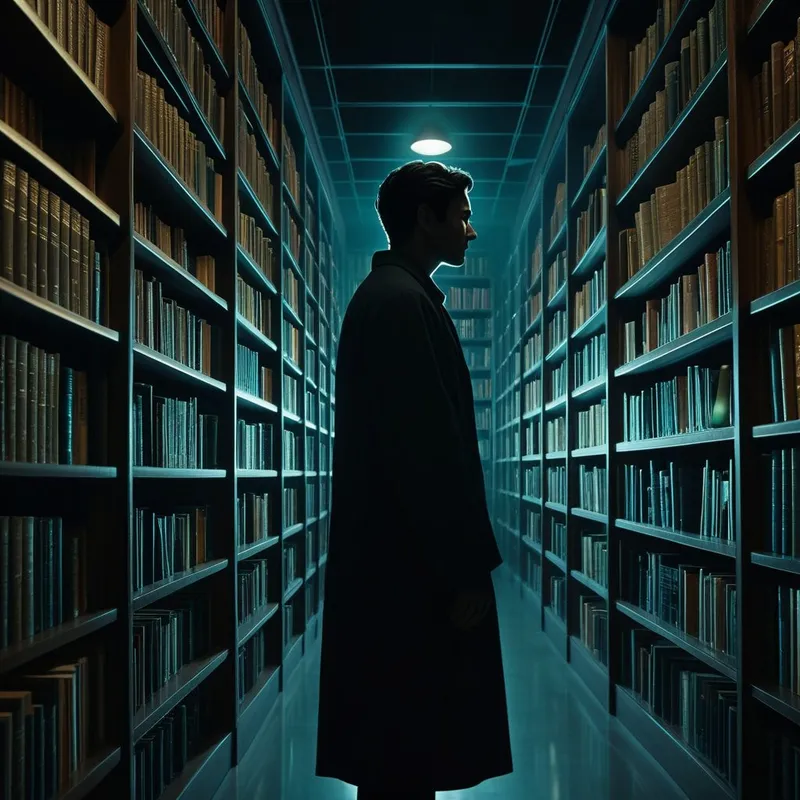
Its guardian was The Librarian, a being whose form was both young and ancient, whose eyes held the patient stillness of deep space. The Library itself was its body; corridors were its veins, shelves its bones, and the infinite books—written in light, in scent, in the vibration of strings—were its beating heart. Here, the song of every civilization that ever was or might be was kept safe. The myth of Atlantis was shelved beside the blueprint of a city yet unbuilt on a world yet undiscovered. The grief of a single lost child was preserved with the same reverence as the laws of celestial mechanics.
But memory has its shadow: The Silence. It was not a monster, but a tide—a slow, cold forgetting that seeped in at the edges of creation. For eons, The Librarian held it at bay through perfect order, a symphony of categorization so complete it sang a shield around the stacks.
The conflict began not with a roar, but with a whisper. A single book, placed on a shelf by a mortal scribe who had, through a lifetime of devotion, earned a moment’s visit, was misfiled. It was a tiny thing, a chronicle of a humble village’s harvest festivals. But its misplacement created a dissonance in the Library’s song. The shield faltered. And in that infinitesimal crack, The Silence flowed.
It did not attack with claws or flame. It attacked with a profound, chilling absence. Where it touched, books did not burn—they became pristine, empty tablets. Stories unraveled from the end back to the beginning, until not even the memory of having been a story remained. The Librarian felt each loss as a amputation of the soul. The great defense, the perfect order, was now a cage; to move one text to save it might unravel another.
The rising action was a desperate, silent ballet. The Librarian moved through the dissolving halls, not fighting, but gathering. With a touch, they would draw the essence from a fading text—the joy of a wedding song, the terror of a battle, the secret name of a spring—and hold it within their own being. They became a living archive, their form straining with the weight of worlds. The Library around them grew greyer, quieter, as The Silence claimed the physical vessels.
The resolution was not a victory, but a transmutation. Seeing that the vessel was lost, The Librarian made a choice. They stood at the central atrium, now surrounded by the advancing, soundless grey. They did not summon fire, but allowed the concentrated brilliance of all they contained to shine. From their form erupted a great conflagration of meaning—not a fire of destruction, but of release. Every story, every fact, every forgotten dream held within them burst forth as a storm of luminous seeds.
These seeds—sparks of knowing—were scattered across the void, through the veil of worlds, into the soil of reality and the depths of the sleeping mortal mind. The physical Library was consumed by The Silence, leaving only an echo of a memory of a place that held everything. But the wisdom was not lost. It was planted. The Librarian, emptied, dissolved into the whisper of a breeze that turns a page, the instinct that guides a scholar’s hand, the sudden, unbidden memory that arrives in a dream. The Silence receded, sated, having claimed the temple but missing the god. The knowledge now lived elsewhere: in us.

Cultural Origins & Context
This myth is the foundational narrative of the Library Culture, a diaspora of archivists, storytellers, data-tenders, and oral historians who see themselves not as owners of knowledge, but as its temporary stewards. It is not tied to a single geography but to a state of mind, passed down through curated "tellings" at gatherings of librarians, in the silent stacks of great repositories at night, and encoded in the protocols of digital archives.
Its primary function is etiological and ethical. It explains why total, centralized knowledge is impossible—and perhaps undesirable—while simultaneously creating a sacred duty. The myth teaches that the great fire was necessary; hoarded knowledge in one vault is vulnerable. True preservation requires dissemination, requiring each person to become a potential vessel-fragment. The societal role of the Librarian in the culture is thus modeled on the mythic deity: not a ruler of information, but a compassionate, organizing presence who facilitates connection and guards against the entropy of forgetting (careless cataloging, data degradation, historical negation). The myth is a solemn warning against intellectual hubris and a call to humble, perpetual stewardship.
Symbolic Architecture
At its core, the Alexandria Library is the Self in its unrealized, potential state. It represents the psyche’s innate, complete knowledge—every memory, every complex, every archetypal pattern laid out in perfect, unconscious order.
The Library is the soul’s latent totality; the Fire is the necessary trauma of consciousness.
The Librarian symbolizes the ego in its highest, most devoted function: the cataloger and guardian of inner experience. Initially, it believes perfection (perfect order, perfect memory) is possible and is the ultimate defense against chaos. The Silence is the inevitable force of the shadow and of psychic entropy. It is not evil, but a natural force that the ego’s rigid order cannot ultimately withstand.
The misfiled book is the critical symbol of the flaw in perfectionism—the inevitable mistake, the repressed complex, the trauma that disrupts the ego’s careful system. The great fire is the symbolic death of the ego’s identification with being the sole, perfect container. It is a catastrophic disintegration that leads to a higher integration. The knowledge is not destroyed; it is introjected and then projected—first taken into the self (The Librarian holding the sparks) and then released into the wider world (and the wider psyche).

The Dreamer's Resonance
To dream of the Alexandria Library is to dream of one’s own vast, internal archive. Common motifs include:
- Finding a lost or forbidden wing: Contacting a deeply repressed complex or talent.
- Books that change text or are blank: Confronting the fragility of memory or the ego’s failure to comprehend certain inner truths.
- A silent, spreading greyness: Experiencing depression, dissociation, or a profound sense of meaninglessness (The Silence at work).
- Carrying a book out of a burning library: A nascent process of salvaging a crucial insight from a collapsing psychological structure (a dying identity, a finished life phase).
Somatically, this may manifest as a pressure in the chest or head (the weight of unprocessed knowledge), or a feeling of cellular humming (the scattered sparks resonating). The dream signals a psyche overwhelmed by the task of holding everything together consciously. It is the soul’s way of rehearsing a necessary surrender—the burning down of an old, rigid way of knowing to make way for a more embodied, distributed wisdom.
Alchemical Translation
The myth is a perfect map of the individuation process. The alchemical stages are clear:
- Nigredo (The Blackening): The incursion of The Silence. The ego’s perfect order is contaminated and begins to break down. This is the dark night of the soul, the confrontation with the shadow and the feeling that one’s inner world is being erased.
- Albedo (The Whitening): The Librarian’s gathering. The conscious mind (ego), faced with dissolution, desperately tries to salvage and identify with all its contents. It becomes a purified, but burdened, vessel. This is a state of intense, lonely introspection.
- Citrinitas (The Yellowing): The kindling of the inner fire. The realization that identification must be released. This is the dawning of the transcendent function.
- Rubedo (The Redening): The Great Fire. The final, voluntary sacrifice. The ego surrenders its role as sole repository and allows its contents to be transmuted. This is the moment of psychic death and rebirth.
The goal is not to rebuild the Library, but to become the fertile ground where its scattered seeds can grow.
For the modern individual, this translates to the painful but liberating process of giving up the illusion of total self-knowledge and control. We must allow our rigid self-narratives (the perfect catalog) to be disrupted by the unclassifiable parts of ourselves (the misfiled book). We must experience the “fire” of emotional crises, failures, and transformations, not as pure loss, but as the mechanism by which our hoarded insights become lived wisdom. We stop trying to be the library and start recognizing we are a living, breathing part of the ecosystem that grew from its ashes. Our task is not to know everything, but to tend faithfully to the fragments of light that have taken root in us, and to share them, knowing they are part of a greater, scattered whole.
Associated Symbols
Explore related symbols from the CaleaDream lexicon: