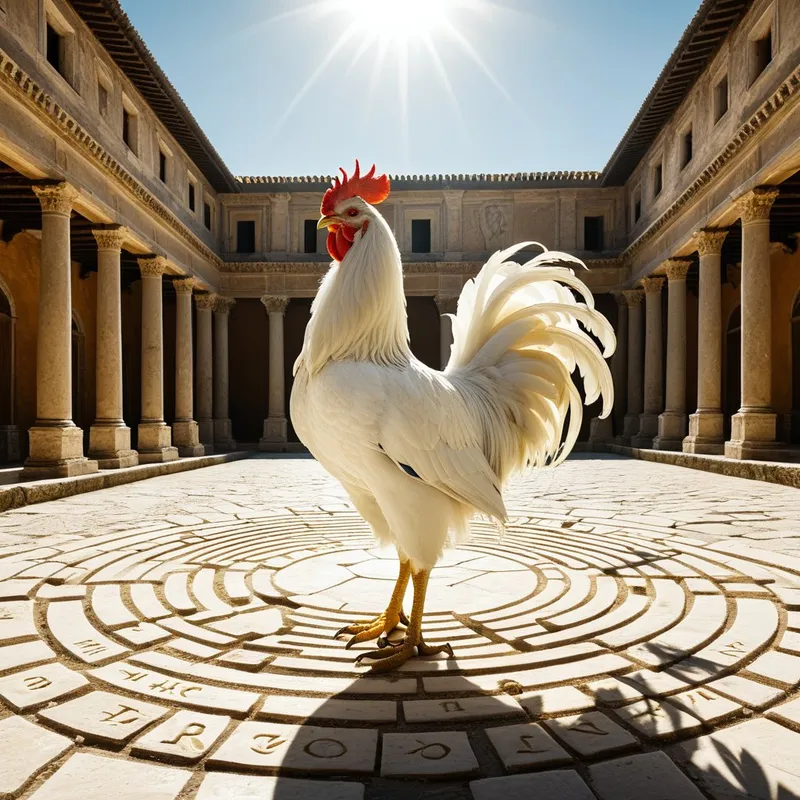
Alectryomancy Myth Meaning & Symbolism
A sacred rooster, a circle of grain, and the silent gods. The ancient Roman art of divination through a bird's path reveals fate in the mundane.
The Tale of Alectryomancy
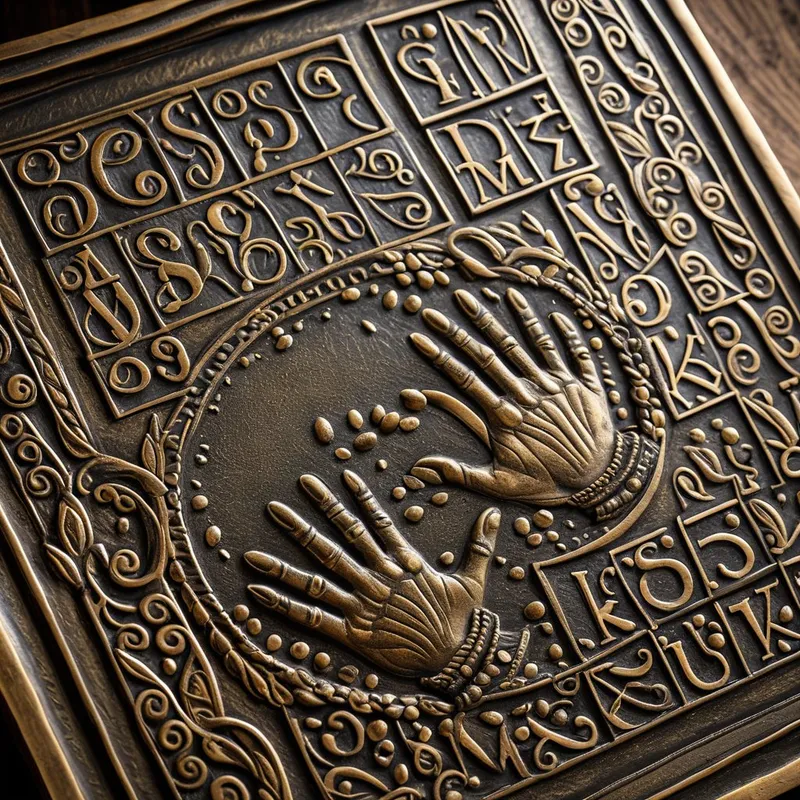
The air in the forum was thick with the scent of incense and animal fear. The sun, a merciless bronze disc, beat upon the heads of the gathered crowd, but they did not feel it. All eyes were fixed on the small, cleared space of packed earth at the center. There, a man in the simple, woolen robe of an augur knelt, his face a mask of solemn concentration. Before him lay a wide, polished tablet of bronze, gleaming dully in the harsh light.
Upon this tablet, he had traced with a steady finger a great circle. Within the circle, he had placed individual grains of spelt at precise intervals, each marking a letter of the sacred alphabet. The circle was a cosmos in miniature, a map of all possible words, all possible fates. The silence was a living thing, pressing in, broken only by the distant cry of a vendor and the anxious rustle of linen.
Then, from a woven basket at his side, the augur drew forth the vessel of the divine. Not a lamb or a bull, but a creature of the dawn: a rooster. Its feathers were pure white, like new snow, and its comb a startling crimson crown. It did not struggle as he set it gently within the circle of grain. It stood, regal and alert, its black eye reflecting the sky and the faces of the silent people.
The question had been whispered to the gods hours before, in the dark of the temple: Will the legion cross the river and prevail? The fate of a thousand men, the security of the city, hung on the path of a bird.
The augur lifted his hands, an invocation without sound. The rooster cocked its head. For a moment that stretched into eternity, it was still, a statue of white and gold. Then, with a purpose that seemed both casual and utterly profound, it dipped its beak. Peck. It took a grain from the letter 'I'. The crowd exhaled as one. Peck. A grain from the 'T'. Peck, peck, scratch. It moved, not in a straight line, but in a wandering, deliberate dance, pausing, considering, consuming.
The augur’s stylus flew across a wax tablet, recording each chosen letter. 'I'... 'T'... 'E'... 'R'... 'V'... 'M'. The bird stepped over some grains, ignored whole quadrants of the circle, and returned to others. It was not spelling a word a man would choose. It was tracing the pattern of the gods' will, a pattern written in hunger and instinct. Finally, sated, the rooster ceased its sacred work and preened a feather, the moment of portent passed.
The augur looked down at the sequence of letters. ITERVM. "Again." The message was not of victory or defeat, but of repetition, of a return, of a path to be trodden once more. The general would not find a prophecy of glory, but a divine injunction to reconsider his strategy, to trace the steps already taken. The mystery was delivered not in thunder, but in the quiet, pecking steps of a sacred bird, turning grain into glyph, and hunger into holy word.
Cultural Origins & Context
Alectryomancy, from the Greek alektryon (rooster) and manteia (divination), was a form of cleromancy—divination by lot—practiced in the ancient Roman world. It existed not as a grand state ritual like the reading of a sacrificed bull's liver, but as a more accessible, though still solemn, practice. Its origins are shadowy, likely borrowed and adapted from earlier Etruscan or Hellenistic traditions, reflecting the Roman propensity for synthesizing useful spiritual technologies.
The practice was grounded in the core Roman religious principle of pax deorum, the "peace of the gods." Maintaining this peace required understanding their will, and the gods were believed to speak through signs (omina) in the natural world. The flight of birds (auspicium) was a premier method, but alectryomancy offered a more controlled, literate variant. The rooster, sacred to Sol and Aurora, was a natural messenger of the liminal space between night and day, ignorance and illumination.
This was divination for the pragmatic yet pious. A general, a merchant embarking on a voyage, or a paterfamilias concerned with a family matter might consult an augur skilled in this art. It democratized portent to a degree, making the cryptic language of the gods legible through the familiar, domestic symbol of the rooster and the fundamental human act of seeking nourishment. The ritual transformed the mundane—feeding a chicken—into a cosmological event, reinforcing the Roman belief that the divine was interwoven with every aspect of daily life.
Symbolic Architecture
At its heart, alectryomancy is a myth of pattern recognition within chaos. The circle of grain letters represents the orbis terrarum, the complete field of possibility, the unordered potential of life. The rooster is the active, seeking consciousness—the human soul or spirit—set loose within this field. It is not an all-knowing oracle, but a creature of instinct and need, guided by invisible forces.
The oracle does not speak in full sentences; it offers letters. The synthesis of meaning is the sacred duty of the observer.
The letters themselves are inert symbols; their power is unlocked only by the bird's selective, non-linear path. This mirrors the psychological truth that meaning is not inherent in the events of our lives, but is created by the path our attention takes through them. We "peck" at certain experiences, memories, and ideas, ignoring others, and from this seemingly random foraging, a personal word, a directive, slowly forms.
The rooster, as a solar symbol, represents the illuminating function of consciousness. Its pecking is a focused beam of awareness, bringing specific elements of the unconscious (the scattered grains of potential) into the light of understanding. The answer "ITERVM" (again) from our tale is profoundly symbolic. It speaks not of external victory, but of an internal process—the necessity of revisiting, re-treading, re-consuming the lessons of a past pattern to truly understand one's fate.
The Dreamer's Resonance
When the pattern of alectryomancy stirs in the modern psyche, it often manifests in dreams of searching within a constrained or ritualized space. A dreamer may find themselves in a round room with objects placed in a circle, compelled to touch them in a specific order. They may dream of following an animal—a bird, a fox, a cat—through a labyrinth, trusting its instinctual path. The somatic feeling is one of tense observation, a held breath waiting for a pattern to emerge from apparent randomness.
Psychologically, this dream motif signals a stage where the conscious mind is preparing to engage with the unconscious not through brute force, but through attentive, ritualized observation. The ego (the augur) has set up the parameters—the circle of a pressing life question or a recurring problem. It has then released a more instinctual, animal part of the psyche (the rooster) to move within it. The anxiety in the dream mirrors the anxiety of surrender: Can I trust this deeper, non-rational part of myself to find the answer?
The dream is an enactment of the psyche's own divinatory process. It confirms that the answers we seek are not "out there," but are encoded in our own instincts and behaviors, if we can but observe their path without premature interpretation. The resolution comes not with a thunderclap, but with the quiet, certain recognition of a sequence that, once seen, feels inevitable.
Alchemical Translation
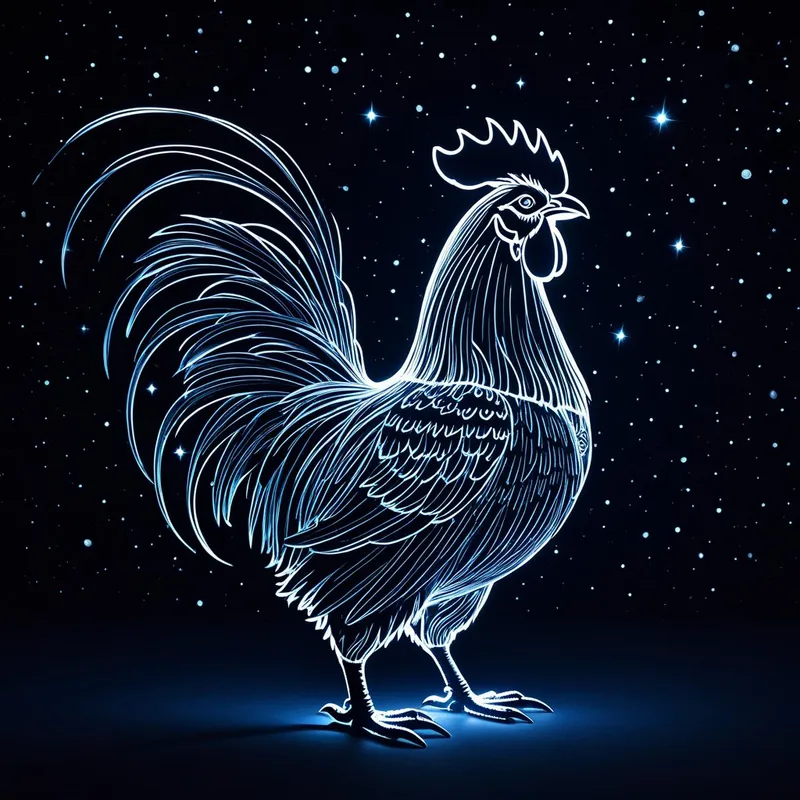
The alchemical process mirrored in alectryomancy is circulatio, the circular distillation. The prima materia—the chaotic stuff of the unexamined life—is the scattered grain. The sacred bird is the mediating spirit, the Mercurius, that moves between the celestial and the earthly. The circle is the vas hermeticum, the sealed vessel of the work, which here is the focused container of the ritual and the attentive self.
For the modern individual seeking individuation, the myth models a critical shift from asking what should I do? to how do I observe what I am already doing? The first step is to create the sacred circle—a period of introspection, journaling, or therapy where the elements of one's life are laid out for examination. The second is to release the rooster: to allow instincts, dreams, synchronicities, and irrational impulses to move freely within this container, without censorship.
The goal is not to force a prophecy, but to become a skilled augur of one's own soul, recording the letters as they are revealed.
The "answer" that emerges, like "ITERVM," will often be a directive to re-engage with a past pattern, a forgotten trauma, or an abandoned talent. It is the psyche's way of saying the raw material for transformation has not been fully consumed; the lesson must be integrated. By faithfully tracing the non-linear, pecking path of our deepest instincts across the field of our experiences, we perform the alchemy. We transmute the base, scattered grains of fate into the golden, coherent word of meaning. We do not command the gods; we learn, humbly, to read their handwriting in the tracks of our own sacred animal.
Associated Symbols
Explore related symbols from the CaleaDream lexicon: