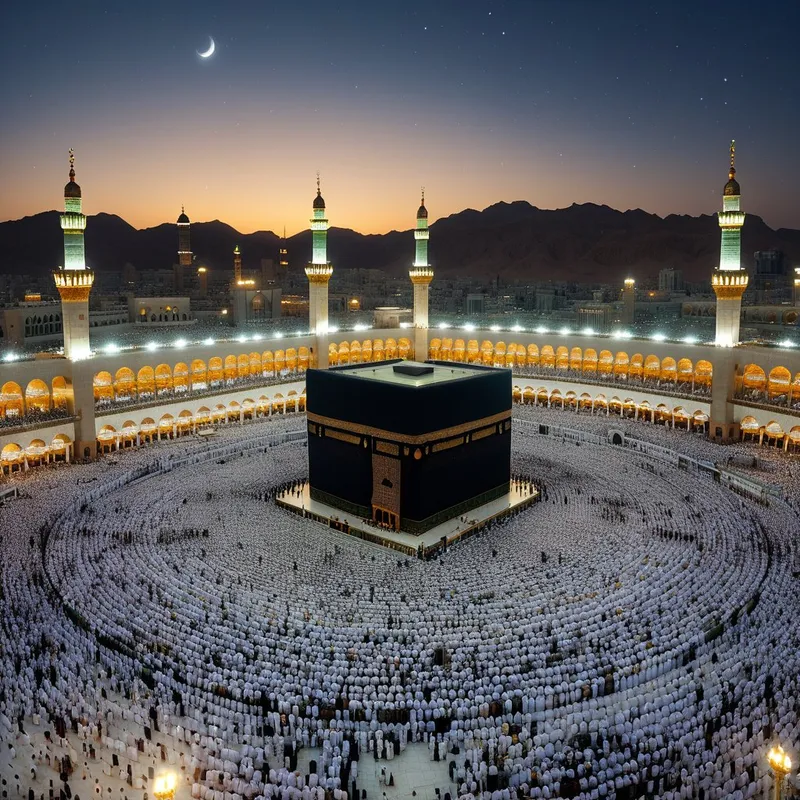
Al-Masjid al-Haram Myth Meaning & Symbolism
The story of the first sanctuary built for humanity, a cosmic axis where heaven and earth meet, and the eternal call to return to one's origin.
The Tale of Al-Masjid al-Haram
In the time before time, when the earth was still soft from the breath of its making, the command echoed through the veils of creation. It was a call to establish a house—not of stone and mortar first, but of light and intention. A place where the weary human heart, adrift in the world of forms, could remember its origin.
The site was chosen from the foundation of the world. It is said the angels themselves circumambulated a celestial prototype, a house of praise, directly beneath the Divine Throne. When Adam, cast onto the earth, wandered in separation and longing, he was guided. He came to a barren valley, a cleft in the wilderness, and there he was instructed to build. He raised the foundations of the first sanctuary, a simple structure of yearning, aligning it with that heavenly original. Here, he and Hawwa performed the rites, turning in a circle of return, enacting the orbit of all creation around its unseen center.
The ages turned. The sands of forgetfulness covered the foundation. The house was lost, a whispered memory in the wind. Then came Ibrahim, the friend of the Divine, tested in fire and exile. With his infant son Isma'il and the boy's mother Hajar, he was led to that same desolate valley. He left them with only a skin of water and a trust that shattered the horizon. When the water was gone and the child cried, Hajar ran between the hills of Al-Safa and Al-Marwah in desperate search, her footsteps etching a path of maternal anguish into the earth. And from the sand where the child's heel struck, water burst forth—the well of Zamzam, a spring of life from the heart of abandonment.
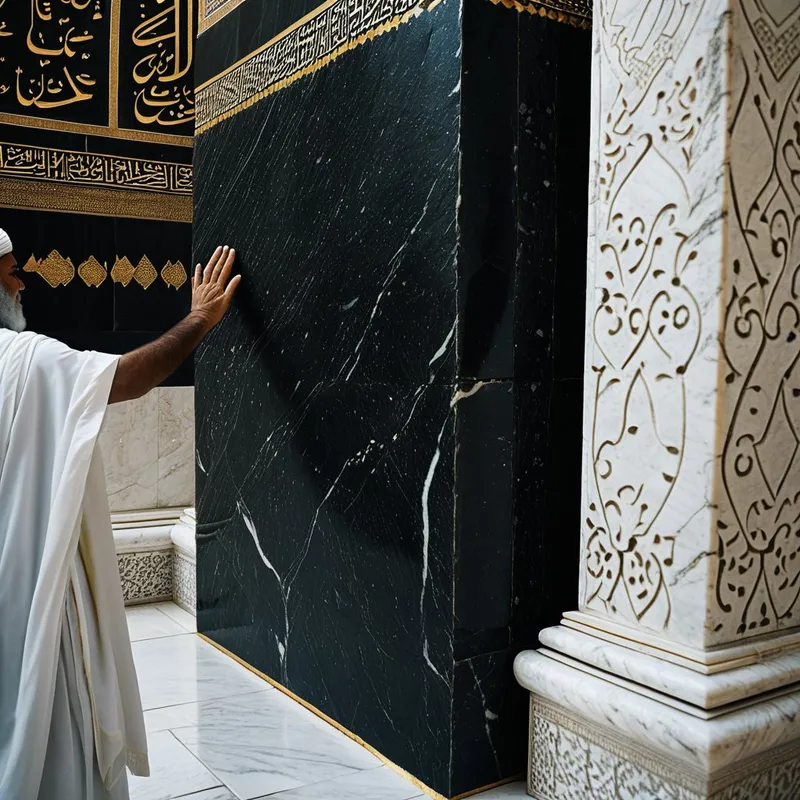
Years later, the command came again to Ibrahim. "Purify My House for those who circumambulate, who stand in devotion, who bow and prostrate." Father and son, now reunited, raised the walls upon the ancient foundations. As they worked, they called out, "Our Lord, accept this from us. You are the Hearing, the Knowing." The stones fit together in a covenant of obedience. Then, from a distant hill, the angel Jibril brought a stone, dark and polished by time and tears. The Black Stone was set in a corner, a celestial benchmark, a touchstone for the beginning and end of every sacred circuit.
And so the House stood—simple, cubic, draped in black—a void at the center of the world. It became the Al-Masjid al-Haram, the Inviolable Sanctuary. A place where all directions collapse into one, where the lion does not hunt, and the human soul finds its qiblah—its orientation. The call of Ibrahim echoed down the centuries: "And proclaim to the people the Hajj; they will come to you on foot and on every lean camel from every distant pass." A call not just to a place, but to a state of being: stripped, equal, revolving around the One.
Cultural Origins & Context
This is not a myth in the sense of a fictional tale, but the foundational sacred narrative of Islam, meticulously preserved in its primary sources: the Qur'an and the authenticated narrations of the Prophet Muhammad (peace be upon him). It is the story of the genesis of the spiritual and geographical center of the Islamic world. Passed down through over 1,400 years of oral tradition, scholarly transmission, and embodied ritual, its primary societal function is to provide the ontological "why" behind the fifth pillar of Islam, the Hajj.
Every ritual act of the Hajj is a re-enactment of this narrative. The circumambulation (Tawaf) mirrors the angels and the work of Ibrahim. The running between Safa and Marwah (Sa'i) is the footsteps of Hajar. The standing at Arafat recalls the finality of Adam's reunion and humanity's standing before its Lord. The story is told by parents to children, by scholars to students, and most powerfully, it is told by the pilgrim's own body and soul as they perform these rites. It functions as a unifying cosmic history, linking every Muslim, regardless of ethnicity or era, to a single origin story and a shared spiritual destination.
Symbolic Architecture
At its core, the myth of Al-Masjid al-Haram is a profound map of the psyche. The Kaaba is not merely a building; it is the symbol of the Self in Jungian terms—the indescribable, central organizing principle of the total personality. It is a cube, the most stable of forms, representing completeness and the earthly manifestation of the divine order.
The center is not a point in space, but a condition of the soul. The Kaaba is the void that gives the circle its meaning.
The Black Stone (Al-Hajar al-Aswad) is the palpable connection to the transcendent, the point where the infinite touches the finite. It is the "right hand of God on earth," a symbol of the covenant (Mithaq) made between the Divine and humanity in pre-existence. To touch it is to physically reaffirm that ancient promise of recognition and return.
The circumambulation represents the ego's orbit around the Self. All worldly concerns, all distractions and identities (represented by the simple, uniform garments of the pilgrim) are shed to engage in this single, focused motion. The running between Safa and Marwah embodies the soul's oscillation between hope and despair, effort and grace, a necessary tension that ultimately leads to the discovery of the inner wellspring—Zamzam—the unconscious source of life and nourishment that emerges precisely at the point of greatest thirst and abandonment.
The Dreamer's Resonance
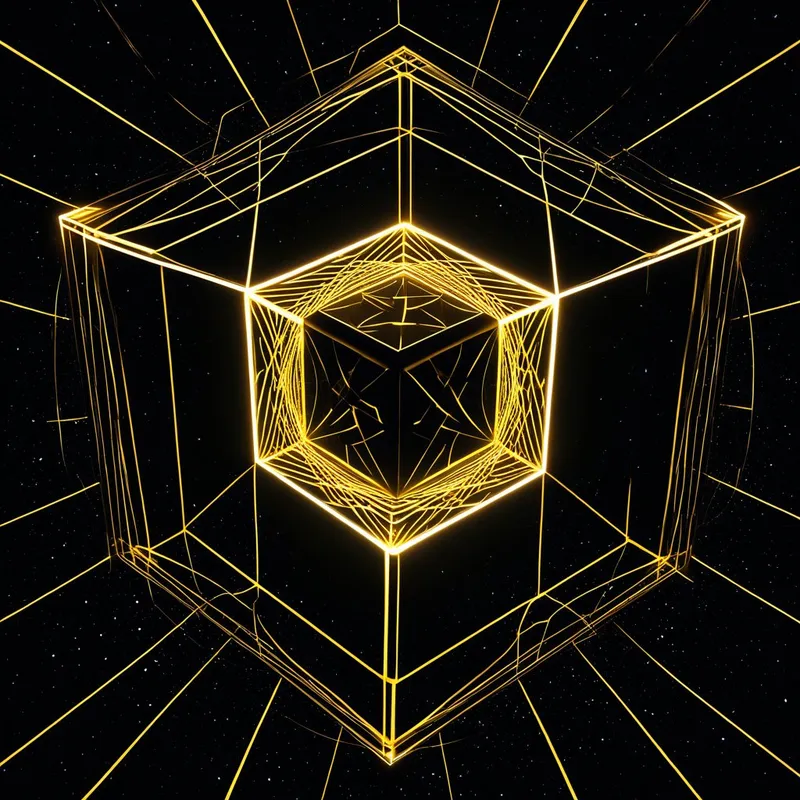
When this myth appears in modern dreams, it rarely manifests as a literal mosque. Instead, the dreamer may find themselves drawn to a stark, geometric center in a vast, empty landscape—a cube, a monolith, a simple house of profound importance. There is often a sense of an imperative journey or a search for orientation. The dreamer might be trying to locate "true north" in a confusing city or feel compelled to walk in circles around a central object.
Somatically, this can correlate with a process of recentering. The psyche is attempting to re-establish order after a period of fragmentation or existential drift. Dreaming of drinking from an unknown, pure spring (Zamzam) can signal the emergence of a new, vital energy from a previously barren or traumatic place within the psyche (Hajar's desperate search). The central structure is often empty, reflecting the experience of the Self as a temenos, a sacred precinct that is paradoxically full precisely because it is void of idols—it has been cleared for its true purpose.

Alchemical Translation
The myth models the alchemical process of psychic transmutation, or individuation, with stunning clarity. The initial state is one of exile and forgetfulness (Adam's descent). The call to Hajj is the stirring of the Self, the first hint of a need for wholeness that disrupts the comfort of a fragmented life.
The journey to Mecca is the nigredo, the arduous, often confusing descent into one's own depths, stripping away status, vanity, and personal history (the donning of the Ihram). The rituals are the albedo and citrinitas—the washing and the illuminating work. Running between the hills integrates the opposites (hope/despair, conscious/unconscious). Standing at Arafat is the supreme confrontation with one's own truth, under the scorching sun of awareness, in a state of utter humility and supplication.
The pilgrim returns home, but the home is no longer the same place, for the pilgrim is no longer the same person.
Finally, the circumambulation of the Kaaba is the rubedo, the reddening, the achievement of the sacred marriage between the individual ego and the cosmic Self. The pilgrim becomes a living axis, centered and grounded. The return from the pilgrimage is not an end, but the beginning of life lived from this new, integrated center. The individual has been transmuted. They have touched the stone of covenant, drunk from the well of the soul, and oriented their entire being around the sacred void that holds all meaning. The outer journey has effected an inner revolution.
Associated Symbols
Explore related symbols from the CaleaDream lexicon: