
Al-Khidr Myth Meaning & Symbolism
A prophet journeys with an immortal sage whose seemingly destructive acts conceal divine wisdom, revealing a path beyond rational understanding.
The Tale of Al-Khidr
The sun was a hammer on the salt-bleached road. Musa, whose tongue was a blade of truth and whose hand held the weight of divine law, walked with a thirst that water could not quench. It was a thirst for knowledge, for the source behind the source. His companions spoke in hushed tones of a servant of God, one who had been given a measure of divine knowledge directly, a knowledge not bound by scroll or tablet. They called him Al-Khidr.
“Where can I find him?” Musa asked. “At the junction of the two seas,” came the reply, a place where the known world frayed into mystery.
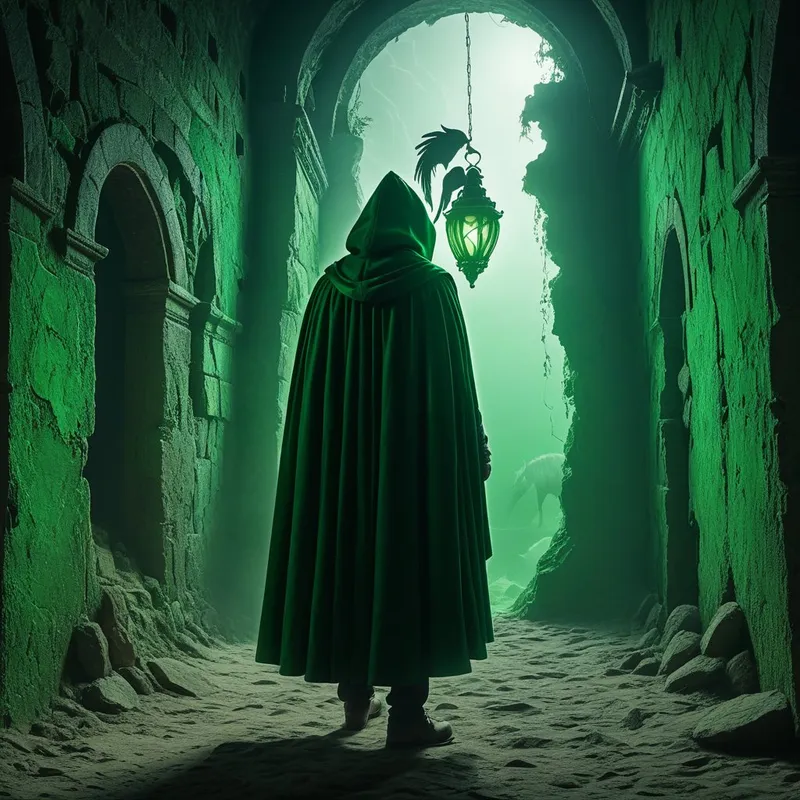
After a journey of years, marked by patience wearing thin, Musa found him at the rocky shore. Al-Khidr was not as he had imagined. There was no royal court, no circle of disciples. He was a solitary figure, his robe the color of deep moss and young leaves, his presence as calm and ancient as the stone beneath them. “May I follow you,” Musa implored, “so that you may teach me of the right guidance you have been taught?” Al-Khidr’s gaze was like looking into a still, deep well. “You will not be able to bear patiently with me,” he said. “For how can you be patient about that which your knowledge cannot comprehend?”
But Musa insisted, swearing his patience. Al-Khidr consented with one condition: “Do not question me about anything until I myself mention it to you.”
So they set out, walking the edge of the world. They came upon a fishing village and sought passage on a small, dilapidated boat. The fishermen, recognizing Al-Khidr, granted them passage freely. Once aboard, as the boat creaked into deeper waters, Al-Khidr seized a tool and began to scuttle the hull, breaching the planks. Water gushed in. Musa’s heart seized. “Have you scuttled it to drown its people?” he cried, breaking his oath. “You have done a grievous thing!”
Al-Khidr was unmoved. “Did I not say you would not be able to bear patiently with me?” Musa, shamed, begged forgiveness, and they continued.
On the shore, they encountered a young boy playing in the dust. Al-Khidr approached and, with a terrible, swift certainty, ended the child’s life. Musa’s cry was a raw wound in the air. “Have you slain an innocent soul who killed no one? Truly you have done a dreadful thing!”
Again, the sage’s reply was a cool wind. “Did I not say you would not be able to bear patiently with me?” Stricken, Musa vowed silence once more, though it trembled within him.
Their journey led them to a town whose people refused them the simplest hospitality. Weary, they found a wall on the verge of collapse. Instead of walking on, Al-Khidr set his hands to the stones and rebuilt it, making it strong. Musa, bewildered, could hold his tongue no longer. “You could have asked a wage for that!”
This was the third breach. “This is the parting between you and me,” said Al-Khidr, his voice final as a closing door. “But now I will inform you of the meaning of that which you could not bear patiently.”

Cultural Origins & Context
The narrative of Al-Khidr is immortalized in the Qur’an, in Surah Al-Kahf (The Cave), verses 60-82. It is presented as a story told to the Prophet Muhammad, featuring Musa as the seeker. While not named in the Qur’an, the figure is identified in the Hadith as Al-Khidr. His name, meaning “The Green One,” speaks to his association with vitality, immortality, and the ever-renewing knowledge of the divine.
The story functions as a profound teaching within Islamic spirituality, particularly for the Sufi traditions. It was passed down not merely as history, but as a living parable for mystics and seekers. It served a critical societal and psychological function: to humble institutional, law-bound knowledge and to validate a higher, often inscrutable, wisdom that operates on a cosmic scale. It comforted the community with the idea that apparent injustice or tragedy in the world might have a purpose unseen by human eyes, known only to God and His closest servants. The storyteller, in this case, is ultimately the Divine, using the journey to illustrate the vast gulf between human judgment and divine decree.
Symbolic Architecture
At its heart, the myth stages a monumental clash between two modes of knowing. Musa represents ilm al-sharia—the knowledge of the apparent, the lawful, the logical consequence. Al-Khidr embodies ilm al-ladunni—knowledge poured directly from the divine source, which operates by a logic of totality and timeless purpose.
The guide does not lead you along the paved road, but into the wilderness where the map burns away, leaving only the stars and the necessity of trust.
Each act of Al-Khidr is an icon of this higher logic. The scuttled boat preserved it from confiscation by a greedy king who seized all sound vessels. The slain child was destined to lead his righteous parents into arrogance and disbelief. The rebuilt wall concealed a treasure for two orphaned boys, safeguarding their future. Each violent or generous act was not an end in itself, but a surgical intervention in a unfolding story whose beginning and end Al-Khidr could see simultaneously. He is the personification of fate’s ambivalence, where a local evil serves a universal good, and where mercy can wear the face of cruelty.
Psychologically, Al-Khidr represents the Self—the transcendent, organizing center of the psyche that sees the whole pattern of an individual’s life. The ego, like Musa, judges events in isolation: a loss, a trauma, a strange opportunity refused. The Self acts in ways that often outrage the ego, dismantling its prized possessions (the boat), removing cherished but ultimately destructive potentials (the child), or shoring up resources for a future self not yet born (the wall).

The Dreamer's Resonance
When this myth stirs in the modern dreamer, it often manifests as a profound and frustrating encounter with the irrational. One might dream of a mysterious, calm figure who ruins something the dreamer has worked hard to build, or who abruptly ends a relationship or job the dreamer values. The dream ego reacts with Musa’s fury and betrayal. Alternatively, the dreamer is Al-Khidr, performing an act that feels intuitively right but is morally horrifying to others, carrying a secret certainty they cannot explain.
Somatically, this process can feel like a deep, unsettling tension between the gut and the head—a “knowing” in the body that contradicts all rational analysis. It is the psychological process of the ego’s certainties being dismantled by the wider intelligence of the unconscious. The dream is the space where the Self explains nothing but simply acts, forcing the dreamer to sit with the anxiety of not-knowing, of being guided by a principle that does not justify itself in the moment. It is the psyche’s way of practicing surrender to a process whose meaning is deferred, teaching patience not as passivity, but as a radical openness.
Alchemical Translation
The alchemy here is the transmutation of knowledge into wisdom. Musa begins with knowledge as possession—something to be obtained and wielded. His journey is an ordeal designed to break this container. Al-Khidr is the Green Lion of this process, the corrosive yet vitalizing force that dissolves the seeker’s assumptions.
The true work is not in acquiring answers, but in enlarging the vessel of the soul to contain the terrifying, liberating question.
The modern individuation journey mirrors this exactly. We enter therapy or self-work with a Musa-like agenda: to fix a problem, to gain a technique, to apply a law (of psychology, of wellness). The unconscious, in the role of Al-Khidr, responds not with solutions, but with enigmatic actions—synchronicities that disrupt our plans, symptoms that dismantle our comfortable identities, dreams that outrage our moral sensibilities. Our first reaction is to protest, to demand an explanation that fits our current logic.
The alchemical translation occurs when we move from protest to a humbled, active curiosity. We must learn to distinguish between the voice of the fearful, judging ego and the voice of the deeper pattern. This is the “patience” Al-Khidr demands: the capacity to withhold final judgment, to tolerate the anxiety of paradox, and to trust that a coherence exists beyond our limited vantage point. We rebuild the wall not knowing it shelters an orphan’s treasure; we let the boat be damaged, trusting it saves us from a greater theft. The goal is not to become all-knowing like Al-Khidr, but to become like Musa at the moment of parting—humbled, silent, and finally able to receive the revelation that meaning is woven in a tapestry too vast for instant comprehension. We integrate not his knowledge, but his mode of being—a participation in a wisdom that greens the soul from a source beyond time.
Associated Symbols
Explore related symbols from the CaleaDream lexicon: