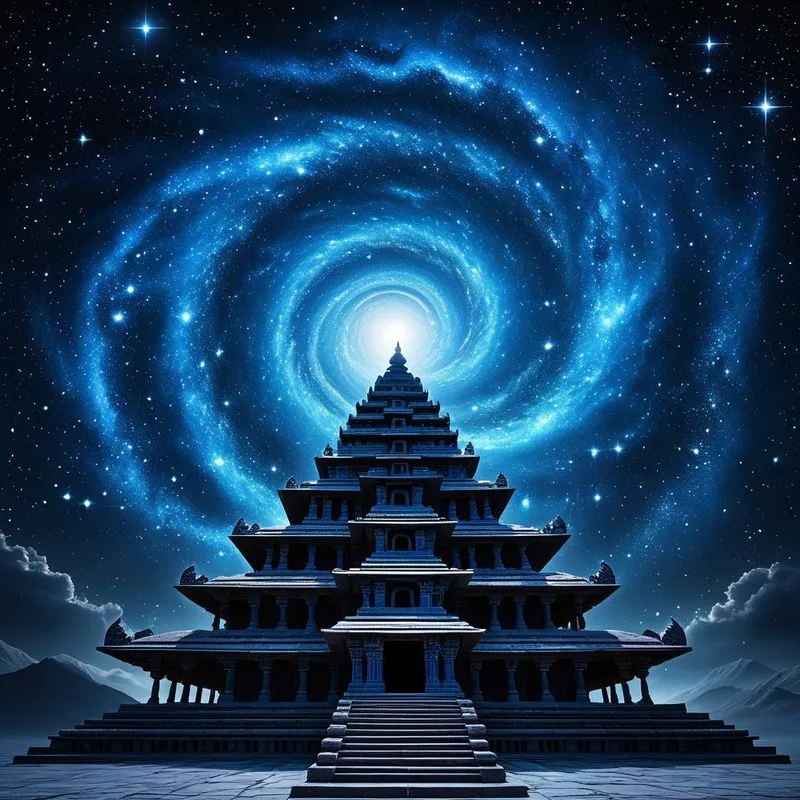
Akasha Myth Meaning & Symbolism
The story of Akasha, the first element born from the cosmic vibration, the silent womb of all potential from which the manifest world emerges.
The Tale of Akasha
In the beginning, there was not light, nor dark. There was not earth, nor water, nor fire, nor air. There was only That. A boundless, undifferentiated, silent potential. A sleeping giant of consciousness.
From within this profound stillness, a desire stirred. A first thought, a first tremor in the heart of the absolute. This tremor was not a sound you could hear, but the potential for all sound. It was a vibration in the very fabric of being. And from this vibration, the first subtle element was born. It was not a thing, but a condition. A spaciousness. A field of pure possibility.
They named it Akasha.
Imagine a womb of infinite, dark-blue transparency. It had no edges, no center. It was the canvas upon which nothing was yet painted, the silence between notes that makes the music possible. Within the embrace of Akasha, the seed of sound took form. It condensed, focused, and from the heart of the spacious void, the sacred syllable Aum resounded. It was not an explosion, but an emergence—a wave of pure being rippling outwards through the receptive medium of space.
This sound, this Aum, was the first differentiation. It carried within it the codes of all that would be. As it vibrated through Akasha, friction was born. From that friction, heat sparked into being—Agni, fire, was born. Fire, dancing and consuming, gave rise to smoke and dissipation, and from its activity, the first movements of Vayu, air, swirled into existence. Air, in its motion, condensed moisture, and Jala, water, coalesced. Finally, water settled, and from its depths, the solidity of Prithvi, earth, precipitated.
Thus, from the silent, spacious womb of Akasha, the four great tangible elements were spun. The world was not built upon earth, but upon space. Every mountain, every ocean, every flame, and every breath exists within Akasha, held and permeated by it. It is the unseen witness, the container of all stories, the first mother and the final home.
Cultural Origins & Context
The concept of Akasha is not a single myth with a linear narrative, but a foundational cosmological principle woven into the earliest layers of Hindu thought. Its roots dig deep into the Vedas and are explicitly systematized in the philosophical traditions of Samkhya and the Yoga Sutras.
It was the province of the Rishis—those who sat in deep meditation, turning their awareness inward to the very source of perception. They did not "discover" Akasha as an external object, but recognized it as the fundamental ground of their own consciousness and, by extension, of the cosmos. This knowledge was transmitted orally, through chants, philosophical discourses, and the rigorous practices of yoga, which aimed to help the practitioner directly experience this subtle element.
Societally, the understanding of Akasha served a critical function. It established a hierarchical, interconnected model of reality, from the most subtle (space/consciousness) to the most gross (earth/matter). This was not just physics; it was a map for spiritual ascent. It taught that to understand the solid world, one must first comprehend the space that allows it to exist. This principle informed temple architecture (the sanctum sanctorum as a womb-space), ritual (the use of mantras to vibrate the subtle field), and the ultimate goal of Moksha—merging back into that primordial spaciousness.
Symbolic Architecture
Akasha is the archetypal symbol of the container. It represents the unmanifest potential that precedes and makes possible all manifestation. Psychologically, it maps directly onto the concept of the unconscious—not as a chaotic repository of repressed memories, but as the vast, silent, and intelligent ground of being from which all thoughts, images, and impulses arise.
The world does not exist in space; space is the precondition for the world to appear. So too, the contents of the mind do not create consciousness; consciousness is the space in which mental contents arise and fall.
It is the "field" in field theory, the Brahman in its most accessible, experiential form. Its attribute is sound (Shabda), because the first thing we perceive in a void is not form, but vibration or resonance. This makes Akasha the medium of communication, memory (the Akashic Records), and intuition. It is the inner ear that hears the whispers of the soul before the mind translates them into words.
The birth of the other elements from Akasha symbolizes the process of differentiation and concretization. A thought (vibration in the space of mind) generates an emotional charge (fire), which leads to movement or impulse (air), which condenses into a plan or feeling-tone (water), and finally manifests as action or concrete reality (earth). The myth teaches that to alter the solid "earth" of our lives, we must work backward, through the subtle layers, to the originating space of pure potential.
The Dreamer's Resonance
When the archetype of Akasha stirs in the modern psyche, it often manifests in dreams of vast, empty spaces. One might dream of floating in the silent depths of space, standing in an endless, empty hall, or being in a completely dark, soundless room that is not frightening but profoundly peaceful.
These are not dreams of absence, but dreams of potential. They signal a somatic and psychological process of dissolution and deconstruction. The ego's familiar structures—its identities, plans, and certainties—are being gently dissolved back into the psychic space from which they emerged. This can feel like a loss of direction, a quiet depression, or a serene detachment. The body may feel weightless, ungrounded, or peculiarly receptive.
The dream is an invitation from the deep unconscious to create inner space. It asks the dreamer to stop doing and start listening. The conflict in such dreams is rarely dramatic; it is the tension between the mind's desire to fill the void with known content and the soul's need for the fertile silence of Akasha. To dream of this space is to be prepared for a new vibration, a new "Aum," to emerge from within—a new idea, a new feeling, a new chapter of life waiting to be born from the quiet center.

Alchemical Translation
The journey of individuation, of becoming a whole and integrated Self, mirrors the cosmogony of Akasha. Our modern lives are often lived at the level of Prithvi—solid, busy, and over-structured. We mistake the content for the container, the thought for the thinker. The alchemical work modeled by this myth is one of inversion and return to source.
The first, and most critical, operation is the creation of inner space. This is the practice of meditation, contemplation, or simply conscious withdrawal from the constant noise of external and internal stimuli. It is the disciplined cultivation of the void.
The alchemist does not seek to fill the vessel, but to perfect the vessel itself. The true gold is the quality of the space that can hold the lead of our suffering without breaking.
Within this cultivated inner Akasha, one learns to listen. This is the stage of Aum—attuning to the fundamental vibration of one's own being, the authentic voice beneath the chatter. From this listening, a new, purer impulse (fire of purpose) is kindled. This impulse organizes one's energy (air) and clarifies one's emotional currents (water), eventually leading to grounded, authentic action in the world (earth).
The triumph is not in the action itself, but in knowing that the action arose from the spacious ground of being, not from the reactive ego. The individual becomes a conscious co-creator. They no longer identify solely with the solid "elements" of their personality or circumstances, but with the vast, silent Akasha that holds it all. They realize they are not the painting, but the canvas; not the note, but the silence that gives the note its meaning. In this realization, the struggle for a solid identity transmutes into the peace of being the space in which all identities come and go.
Associated Symbols
Explore related symbols from the CaleaDream lexicon: