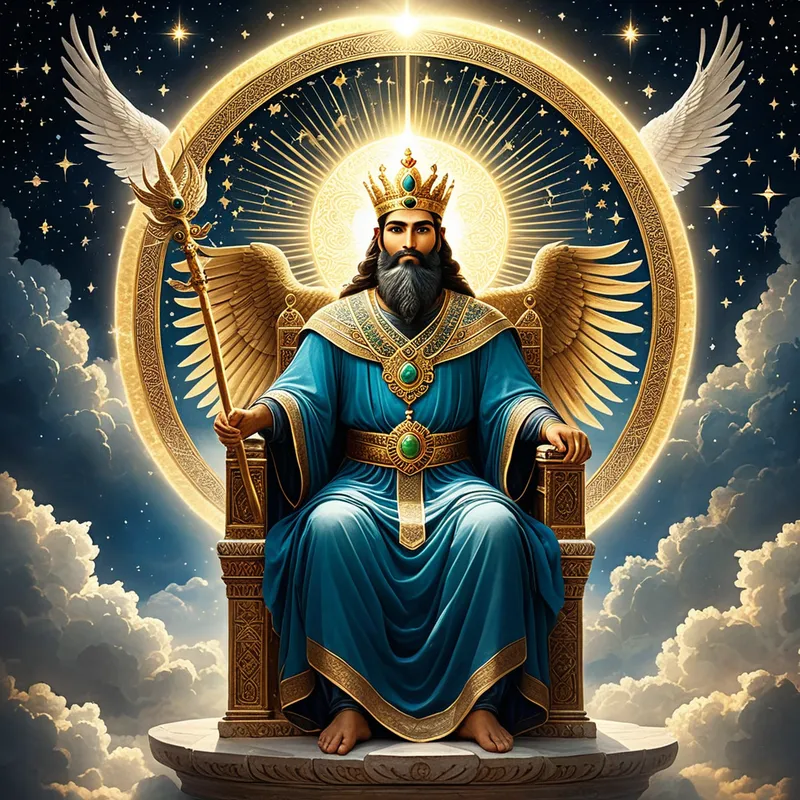
Ahura Mazda Myth Meaning & Symbolism
The story of the Wise Lord Ahura Mazda, who embodies cosmic truth and order, locked in an eternal struggle with the destructive spirit of chaos, Angra Mainyu.
The Tale of Ahura Mazda
In the beginning, there was no beginning. There was only boundless, infinite Time—Zurvan—a yawning, silent potential. And within that stillness, a thought was conceived. It was not a sound, but a vibration of pure knowing. It was the first truth, and its name was Ahura Mazda.
He was not born; he manifested. From the endless ocean of possibility, he gathered himself as a being of uncreated light, a lord whose body was wisdom and whose breath was the sacred law, Asha. His light was not merely illumination; it was the very structure of reality, the pattern of a perfect, harmonious cosmos waiting to be sung into existence. He was the singer and the song.
But a shadow stirred in the deep. From the same boundless Time, from the outer fringe of the unmanifest, a counter-thought arose. It was a thought of negation, of "No." This was Angra Mainyu, the Hostile Spirit, whose essence was the Lie, Druj. Where Ahura Mazda saw order, Angra Mainyu saw constraint. Where there was light, he desired to gnaw at its edges with teeth of endless night.
Ahura Mazda, in his omniscience, foresaw the conflict. He did not create the dark twin, but he recognized its inevitable emergence from the totality of existence. And so, with a gesture that spanned eternity, he began his great work. He fashioned the seven pure creations: the Sky of stone crystal, the Waters pure and deep, the Earth vast and round, the Plant of immortal life, the Unique Bull, the Primordial Man, and finally, the sacred Fire. Each was a hymn to Asha, a perfect note in a cosmic symphony.
Angra Mainyu, seething with envy, attacked. He pierced the perfect Sky, and it recoiled, forming the clouds. He poisoned the Waters with salt. He rent the Earth, creating deserts and mountains. He slew the Unique Bull and the Primordial Man, but from their seed and their essence, all beneficent animal and human life sprang forth. He assailed the Fire, trying to smother it with smoke, but it leapt and persisted, a defiant spark in every hearth and heart.
Thus the world was made—and marred. A battleground was established not in some distant heaven, but here, in the very fabric of stone, water, and flesh. Ahura Mazda did not reign from an untouchable throne. He invested his very essence into his creation, into the enduring structures of truth and the minds of those who would choose to uphold them. He became the lord of a war he must win through his creations, not for himself, but for the ultimate triumph of light, truth, and renovation—Frashokereti.
Cultural Origins & Context
This is the foundational narrative of Zoroastrianism, the pre-Islamic faith of the Persian empires. It was preserved in the sacred hymns of the Avesta, composed in an ancient Iranian language. The myth was not merely a story of creation but the central pillar of a cosmic worldview that profoundly influenced Persian culture for over a millennium.
It was transmitted by priestly scholars, the Magi, who were not just ritual specialists but the philosophers, astronomers, and moral guides of the court. The myth served a critical societal function: it provided a metaphysical justification for ethics, law, and kingship. The Persian king was seen as the earthly representative of Ahura Mazda, tasked with upholding Asha (order/truth) against Druj (chaos/the lie) in the human realm. This imbued statecraft with a divine imperative for justice, agriculture (nurturing the good creation), and truth-telling. The myth explained the presence of evil and suffering not as a divine flaw, but as an active, oppositional force, making human life a field of meaningful choice and cosmic consequence.
Symbolic Architecture
At its core, the myth presents a radical metaphysics of consciousness. Ahura Mazda is not a capricious sky-god but the archetypal principle of luminous, ordering intelligence. He represents the mind's capacity to perceive pattern, establish truth, and create harmonious systems.
Ahura Mazda is the archetype of the conscious ego at its highest potential: not as a tyrant, but as a wise steward of the inner and outer cosmos.
The eternal struggle with Angra Mainyu symbolizes the fundamental psychic tension between the integrating, meaning-making impulse (Asha) and the disintegrating, nihilistic, or shadowy impulse (Druj). This is not a simple battle of "good vs. evil" but a dynamic interplay between creation and destruction, form and entropy, consciousness and the unconscious. Angra Mainyu is the necessary adversary; without the resistance of the "Lie," the "Truth" has nothing to define itself against and no arena in which to prove its worth. The marred creation—the wounded sky, the salty sea—becomes the sacred ground where value is forged.
The seven creations are not just physical objects but layers of a sanctified reality, each a symbolic layer of the self awaiting its proper cultivation and defense.
The Dreamer's Resonance
When this myth stirs in the modern psyche, it often manifests in dreams of architectural integrity versus chaotic invasion. One may dream of a beautifully ordered house (the self) whose foundations are being subtly undermined, or of a sacred, luminous space being invaded by a creeping, formless darkness or vermin. Somatic sensations might include a sudden chill, a feeling of purity being polluted, or conversely, a profound sense of clarity and warm, radiant strength.
Psychologically, this signals a process of conscious differentiation. The dreamer is in a phase where a hard-won inner order—a principle, a truth, a personal code—is being tested. The "Angra Mainyu" figure in the dream represents not an external enemy, but an internal force of doubt, cynicism, old destructive habits, or repressed rage that threatens to undo one's psychological structure. The dream is a snapshot of the ongoing psychic work of maintaining integrity against the entropy of the unconscious or the pressures of a chaotic world.
Alchemical Translation
The individuation process modeled here is one of active stewardship. It moves beyond simply discovering the self to the relentless, ethical labor of defending and cultivating the self.
The alchemical gold is not found in a hidden cave, but forged in the daily choice to build with truth instead of the lie, to kindle the inner fire despite the surrounding smoke.
The first step is the Mazdaian moment: the emergence of a clear, guiding principle or value (Asha) from the boundless potential (Zurvan) of the psyche. This is the birth of a conscious standpoint. But wisdom foresees the shadow. The second step is the honest invocation of the adversary: consciously acknowledging the inner and outer forces of chaos, doubt, and destruction (Angra Mainyu) that will inevitably arise. Denial only empowers them.
The true work is the third step: the investment of light. Ahura Mazda does not hoard his light; he pours it into the seven creations. Psychologically, this means investing one's conscious values into the concrete aspects of life: one's environment (Earth/Sky), one's emotional fluidity (Waters), one's health and growth (Plant), one's instincts and vitality (Primordial Bull), one's humanity and relationships (Primordial Man), and one's passionate spirit (Fire). The battle is fought and won in these arenas. The final goal is Frashokereti—not a perfect, static state, but the ongoing process of renovation, where the wounded elements of the self are continually healed, restored, and made radiant through conscious effort. One becomes not a passive worshipper, but a co-worker with the Wise Lord within.
Associated Symbols
Explore related symbols from the CaleaDream lexicon:
- Light — The primary substance and symbol of Ahura Mazda, representing pure consciousness, truth, revelation, and the ultimate reality that dispels the darkness of ignorance and chaos.
- Fire — The sacred element and son of Ahura Mazda, symbolizing the divine spark within creation, the transformative power of truth, and the ritual focus for maintaining cosmic and moral order.
- Order — The cosmic principle of Asha, embodied by Ahura Mazda, representing the inherent truth, harmony, and rightness of the universe that humans are tasked to understand and uphold.
- Sky — The first creation, a crystalline dome of stone representing the overarching structure of reality, the firmament of law and truth established by the Wise Lord.
- Sun — The most glorious manifestation of Ahura Mazda's light in the material world, a visible symbol of his enduring sovereignty, wisdom, and life-giving power.
- Mountain — Symbolic of the enduring, steadfast nature of truth (Asha) and the lofty, immovable throne of divine wisdom and judgment.
- Shadow — The psychological counterpart to Angra Mainyu, representing the destructive, chaotic, and denying aspects of existence that must be consciously confronted and limited.
- Tree — Represents the cosmic tree of life, the ordered growth of creation, and the flourishing of all good things nurtured by the light and waters of truth.
- Warrior — The archetype of the human being who actively chooses to fight for Asha against Druj, aligning their will with the divine purpose in the great cosmic battle.
- Crown — Symbolizes the divine sovereignty of Ahura Mazda and the legitimate authority of those who rule or act in accordance with cosmic truth and justice.
- Spirit — Denotes the immaterial, divine essence of Ahura Mazda and the Amesha Spentas, as well as the fundamental choice between the Holy Spirit (Spenta Mainyu) and the Destructive Spirit.
- Star — The heavenly lights that are fragments of the original divine light, serving as guides and reminders of the perfect celestial order amidst the darkness.