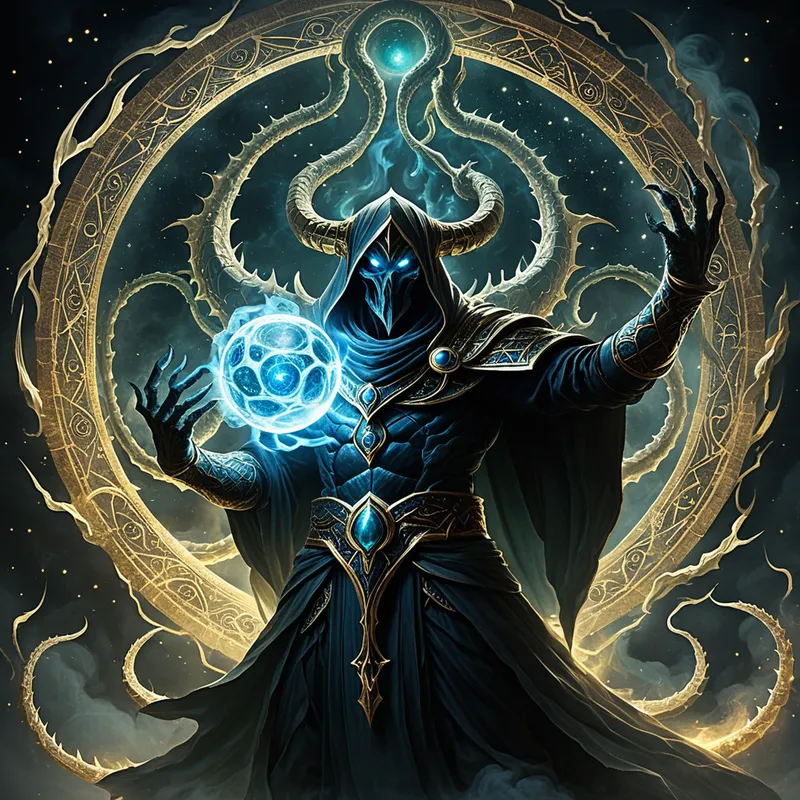
Ahriman's Creation of Evil Myth Meaning & Symbolism
In the Zoroastrian cosmos, the Angra Mainyu, Ahriman, creates evil not from nothing, but from a twisted reflection of the good creation, birthing a cosmic duality.
The Tale of Ahriman's Creation of Evil
In the beginning, which was not a time but a state, there was Ahura Mazda. From His boundless light and perfect thought, He fashioned the Seven Creations: the crystalline Mēnōg realm, and the sixfold splendour of the Gētīg—the Sky of stone, the Waters, the Earth, the Plant, the Animal, and finally, the Human. Each was a hymn of order, truth, and life, a radiant jewel set in the crown of Asha. The world was a fragrant garden under a sun that knew no setting, a symphony without a single note of discord.
But in the infinite absence, in the abyss beyond the light, something stirred. It was not created. It was the eternal counter-principle, the Angra Mainyu, whom men would later call Ahriman. He dwelt in utter darkness, in the non-place of Druj. And when the light of creation pierced the endless night, he did not rejoice. He recoiled in a spasm of infinite envy and hatred. The very existence of perfection was an affront to his nature.
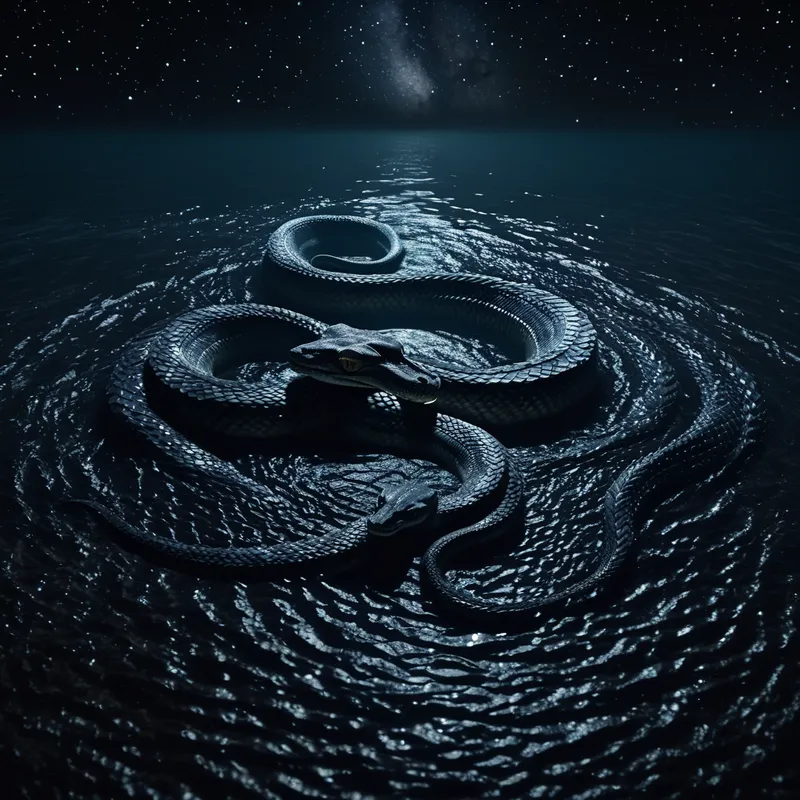
Driven by this venomous spite, Ahriman looked upon the good creation. But he could not create from nothing, for he possessed no creative fire. Instead, he could only mimic, pervert, and corrupt. He gazed upon the perfect, still Waters and conjured their opposite: salt, bitterness, and drought. He saw the lush, green Earth and spawned the desert, the thorn, and the venomous reptile. He beheld the free-roaming Animal and fashioned the predator, the parasite, and the beast of burden. He witnessed the clear, ordered Sky and vomited forth a miasma of clouds, storms, and eclipsing darkness.
His masterpiece of malice was reserved for the Human. Ahriman saw the noble form of Gayōmart, created from the earth but touched by the divine light of mind. From this image, Ahriman crafted not a being, but an infection: the Lie itself, planted in the human heart as doubt, greed, and the capacity for moral failure. He introduced decay into the body, death into the lifespan, and strife into the community. Where there was unity, he sowed division; where there was truth, he whispered deceit.
Thus, evil was not born from nothing, but from a twisted reflection. It was the shadow cast by the light, the crack in the perfect vessel, the invasive weed in the sacred garden. Ahriman’s creation was complete: a counter-creation, a universe of lack, lack, and opposition, now locked in a 9,000-year battle with the luminous world of Ahura Mazda. The first blow was struck, and the great cosmic war, which would be fought in every human heart and across every field of existence, had begun.
Cultural Origins & Context
This myth is the foundational narrative of Zoroastrianism, one of the world's oldest continuously practiced religions, which shaped Persian culture from the Achaemenid Empire through the Sassanian period. It is preserved primarily in the Avesta, especially in the Bundahishn ("Creation"), and in the Middle Persian Pahlavi literature.
The story was not merely theological speculation but a societal compass. It was transmitted by the priestly class, the Magi, and served to explain the presence of suffering, natural disasters, and moral evil in a world made by a supremely good deity. It provided a coherent cosmic framework for the Persian imperial ideology, where the king (Shah) was seen as a warrior for Asha against the forces of Druj. This dualistic worldview emphasized personal responsibility, active choice, and the ultimate triumph of good, structuring ethics, law, and the very perception of history as a linear progression toward a final renovation of the world.
Symbolic Architecture
At its core, the myth presents a profound model of ontological and psychological duality. Evil here is not primordial; it is reactive. It is born from the encounter between absolute light and absolute darkness, where darkness defines itself in opposition to the light.
Evil, in this cosmology, is not a substance but a relationship—a parasitic orientation of envy and negation toward all that is whole, true, and alive.
Ahriman symbolizes the psychic force of negation, the shadow not as personal failing but as an archetypal principle of de-creation. His act of "creation" is actually an act of infection or corruption. He does not make new things; he introduces distortion, decay, and death into existing systems of life and order. Psychologically, this represents how our own destructive impulses—envy, spite, cynicism—often work not by generating entirely new content, but by twisting our perceptions, poisoning our relationships, and corrupting our innate goodness into something self-defeating.
The myth also brilliantly inverts the typical creation narrative. Creation is not ex nihilo (from nothing) for the destructive spirit; it is ex contrarío (from the opposite). This mirrors the psychological truth that our darkest traits are frequently the inverted, corrupted forms of our greatest strengths: love becomes possession, courage becomes aggression, care becomes smothering control.
The Dreamer's Resonance
When this mythic pattern stirs in the modern unconscious, it often manifests in dreams of contamination, counterfeiting, or sinister reflection. The dreamer may encounter:
- A beautiful place (a garden, a home) that is suddenly invaded by a creeping blight, black smoke, or swarms of insects.
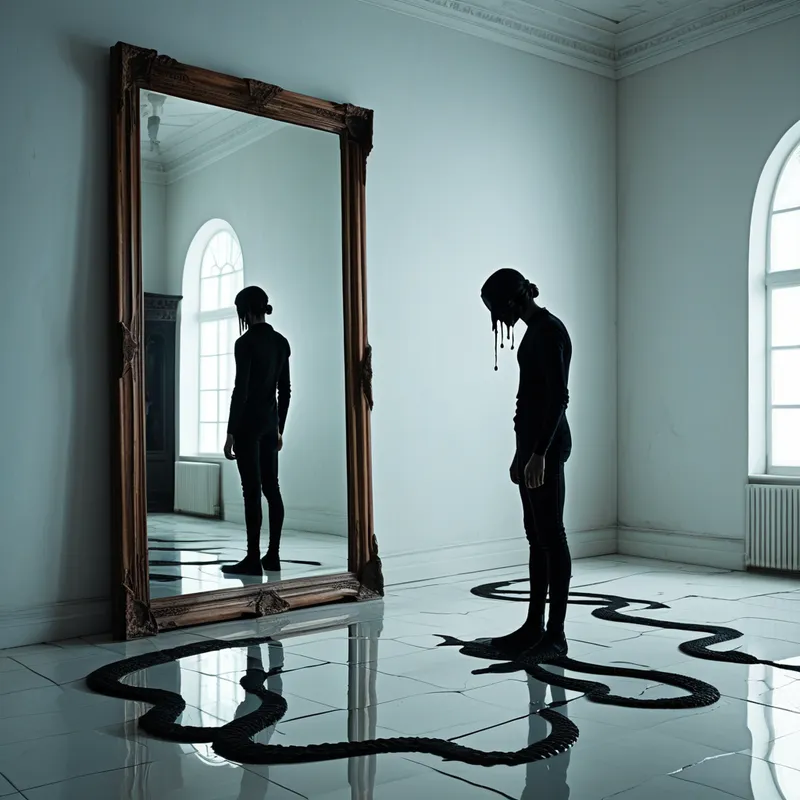
- A trusted person or a reflection of oneself that subtly shifts, revealing a mocking, hollow, or malicious duplicate.
- An attempt to create or build something (art, a structure) that is persistently sabotaged by an unseen force, resulting in twisted, ugly, or dysfunctional forms.
Somatically, this can feel like a cold dread, a sense of being poisoned from within, or a frustrating paralysis where one's best efforts are turned against them. Psychologically, this signals a profound engagement with the personal and collective shadow. The dreamer is not just facing a "bad" part of themselves, but confronting a negating principle within their own psyche—the part that says "you can't," "it's not worth it," or "destroy it before it fails." It is the process of seeing how one's own potential has been corrupted by envy, fear, or past wounds into self-sabotage.
Alchemical Translation
The individuation process modeled here is not one of simple integration, but of conscious contest. The goal is not to make peace with the Ahrimanic force within, but to recognize its nature, limit its influence, and transmute the corrupted material back toward its original, wholesome state.
The alchemical work is separatio followed by coagulatio: first, one must discern the authentic impulse from its corrupted shadow-twin, then patiently restore the distorted form to its true alignment.
The first step is Recognition: Seeing the "Ahrimanic" voice for what it is—not a truth-teller, but a negating spirit that defines itself only in opposition to life and growth. This is the "naming" of the shadow.
The second is Containment: Establishing psychic boundaries. Just as Ahura Mazda contains the assault of Ahriman within the bounded time of the cosmic battle, the individual must learn not to be identified with their negating impulses. This is the practice of observing destructive thoughts without acting on them.
The final, most delicate stage is Transmutation: This involves tracing the corrupted element back to its source. Is this rage a corruption of a passion for justice? Is this cynicism a corruption of a capacity for clear-eyed discernment? The task is to salvage the energy and redirect it toward its Asha-aligned purpose. One does not become whole by embracing the lie, but by relentlessly championing the truth within one's own being, thereby participating in the cosmic renovation of the world.
Associated Symbols
Explore related symbols from the CaleaDream lexicon:
- Shadow — The archetypal presence of Ahriman himself, representing the destructive, negating, and corrupting principle within the cosmos and the human psyche.
- Serpent — A primary creature of Ahriman's counter-creation, symbolizing stealth, poison, and the insidious, coiling nature of deceit and corruption.
- Water — The pristine element corrupted by Ahriman into salt and drought, representing the poisoning of life's source, emotion, and psychic fluidity.
- Mirror — Ahriman's mode of creation is a dark mirroring, a distorted reflection of the good; it symbolizes the genesis of evil through envy and perverse imitation.
- Fire — The sacred element of Ahura Mazda, representing truth and order, which Ahriman seeks to smother and corrupt into destructive, chaotic flame.
- Darkness — The native realm and essence of Ahriman, symbolizing the absence of creative light, ignorance, and the void from which negation arises.
- Evil — The core product of Ahriman's act, conceived not as a mere act but as an active, parasitic force of falsehood and decay.
- Light — The original, creative substance of Ahura Mazda, which Ahriman hates and opposes, representing consciousness, truth, and the force of creation itself.
- Order — The principle of Asha, the cosmic truth and harmony that Ahriman's entire existence is designed to disrupt and unravel into chaos.
- Dragon — The ultimate monstrous embodiment of the Ahrimanic force, a creature of chaos and destruction set against the divinely ordered world.
- Fires of Creation — The benevolent, formative flames of Ahura Mazda, which stand in direct opposition to the corrupting, destructive fires ignited by Ahriman's envy.