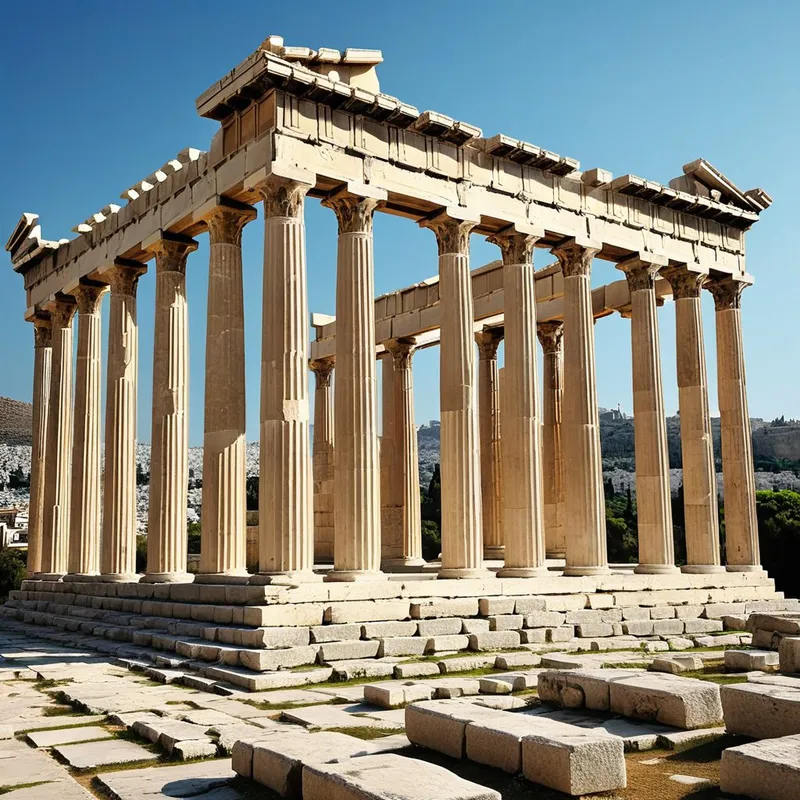
Agora of Athens Myth Meaning & Symbolism
The Agora was the sacred heart of Athens, a mythic space where mortal voices, divine law, and the restless human spirit converged to forge a city's soul.
The Tale of Agora of Athens
Listen, and let the dust of ages settle upon your tongue. This is not a tale of a single hero, but of a space that became a hero itself—the beating heart of Athena’s city.
Before the first stone was laid, there was only chaos: a muddy hollow between the twin hills, a place where goats strayed and voices were lost to the wind. It was a wound in the earth, a gaping mouth waiting for a soul. Then came the vision, not in a thunderclap, but in the collective breath of a people. They saw that a city is more than walls to keep danger out; it must have a center to draw wisdom in.
So they began to build, not a palace for a king, but a stage for citizenship. They hauled marble that caught the dawn light like honey. They raised the long, sheltering stoas, their columns standing like a forest of stone, offering shade not just from the sun, but from the tyranny of isolated thought. At its edges, they placed the temples—to Hephaestus, whose forge mirrored the shaping of laws; to the Olympians, whose eternal order they sought to echo.
And then, the people came. They flooded in at first light, a river of chitons and purpose. The air, once still, now thrummed with a thousand conversations—the clink of a merchant’s scale, the passionate declamation of a philosopher pointing to the sky, the solemn murmur of jurors by the Heliaia. Here, a farmer from the hills could challenge a general on a point of law. Here, a young student could sit at the feet of Plato and have his very mind rearranged.
The conflict was not against a monster, but against silence. The rising action was each debate, each vote cast into an urn, each new idea offered to the communal fire. The resolution was never final; it was the daily, fragile miracle of order emerging from discourse, of polis—the city—being born anew each day from the agreement of its people. You could smell it in the air: the scent of olive oil, dust, incense, and something else, something electric—the ozone of human potential being realized.
Cultural Origins & Context
The Agora was not born from a single mythic narrative penned by a rhapsode, but from the lived, breathing mythology of Athenian civic life. Its story is historical, yet it attained a mythic quality in the writings of philosophers, playwrights, and historians who recognized it as the tangible expression of an ideal.
Its primary “storytellers” were the citizens themselves. Every Athenian male who participated in the Ecclesia, served on a jury, or conducted business there was enacting and perpetuating its narrative. Playwrights like Sophocles and Aristophanes set scenes in the Agora, using it as a microcosm of the city’s virtues and follies. Philosophers, most notably Socrates, made it their classroom, their mythic “quest” being the pursuit of truth through public dialogue.
Societally, its function was sacred and profane intertwined. It was the marketplace of goods and the marketplace of ideas. It housed the altars of the gods and the courts of men. This fusion was deliberate: to remind the citizen that commerce, justice, worship, and politics were not separate spheres, but interconnected strands of the civic web. The myth of the Agora was the myth of Athenian identity—that order, wisdom, and freedom were not given by gods alone, but forged in the crucible of public space.
Symbolic Architecture
Psychologically, the Agora represents the organized conscious mind—the ego in its highest, most civilized function. It is the psychic space where disparate thoughts, feelings, and impulses are brought into the light of awareness to be examined, debated, and integrated.
The Agora is the psyche’s parliament, where the inner multitude is granted a voice and must learn the art of compromise.
The stoas symbolize structured thought—the colonnades of logic and tradition that provide shelter and framework. The temples represent the anchoring presence of overarching values and archetypal principles (the gods). The bustling, chaotic center is the raw content of life—desires, fears, ambitions, and relationships—that must be processed. The entire layout is a mandala of wholeness, insisting that for the individual or the city to be sane, every part must have a place and a pathway to the center.
The hero of this myth is not a person, but the act of dialogue itself. The sacred struggle is against the tyranny of the unexamined idea, the unspoken grievance, the isolated perspective. Victory is not conquest, but consensus; not silence, but harmonious discourse.
The Dreamer’s Resonance
To dream of an Agora is to dream of a critical phase of inner reorganization. It often appears during times of personal fragmentation, when one feels pulled in multiple directions by competing duties, identities, or internal voices.
The somatic sensation is often one of being in a crowded, overwhelming space, yet with a focal point—a speaker, a building, a ballot—demanding attention. You may dream of being unable to find your way to the speaker’s platform (the ego’s inability to find its voice) or of your own voice being drowned out by the crowd (the shadow or complexes overpowering consciousness). Alternatively, a dream of a serene, functioning Agora can signal successful integration, a feeling of having one’s internal “citizens” in productive dialogue.
This dream pattern signifies the psyche’s innate drive toward psychic democracy. It is the unconscious compelling the dreamer to convene their inner council, to give a hearing to neglected aspects of the self, and to establish a fairer, more representative internal governance.
Alchemical Translation
The alchemical process mirrored here is not the dramatic solve et coagula (dissolve and coagulate) of a hero’s journey, but the meticulous, ongoing labor of separatio and conjunctio—distinguishing elements and then marrying them into a higher synthesis.
For the modern individual, the Agora myth models the path of individuation as civic duty to the self. The “muddy hollow” is the undifferentiated psyche, ruled by instinct and chaos. The act of “building the Agora” is the conscious construction of a psychological structure—values, practices, and internal boundaries—within which the self can be safely explored.
Individuation is the daily governance of the soul’s city-state, where every thought must earn its citizenship through rigorous examination.
The merchant’s scale becomes the tool for weighing decisions. The law court is the inner conscience, judging actions against one’s own moral code. The philosophical debate is the internal dialogue between heart and head, intuition and reason. The triumph is the achievement of sophrosyne—the Greek ideal of balanced self-governance, prudence, and temperance. One becomes both the citizen and the city, participating in the eternal assembly of the self, forging not a static identity, but a living, breathing polity of the soul, capable of adapting, debating, and growing in wisdom. The goal is not a perfect, silent monument, but a vibrant, noisy, and eternally unfinished center of becoming.
Associated Symbols
Explore related symbols from the CaleaDream lexicon: