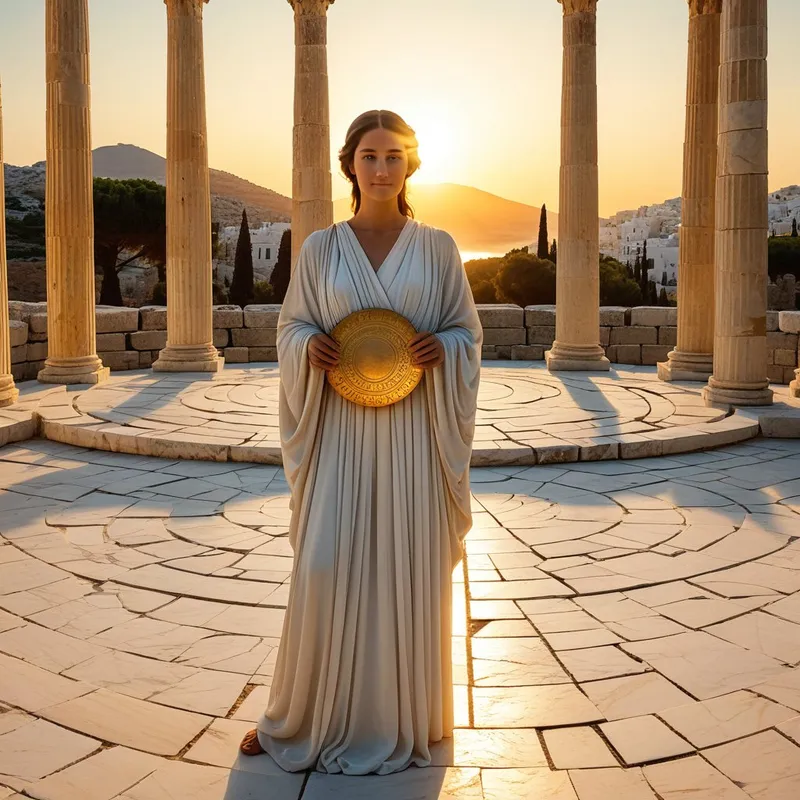
Agora Myth Meaning & Symbolism
The story of Agora, the divine personification of the public assembly, where human voices and divine will intertwined to forge the soul of the city.
The Tale of Agora
Listen. Before the laws were carved in stone, before the first coin rang upon the marble counter, there was a silence. It was the silence of men and women scattered across the hills, each voice a lonely echo in their own valley. The gods looked down from Olympus and saw not a people, but a scattering of sparks, each destined to flicker and die alone.
Then, from the breath of Athena and the deep, rumbling chuckle of Hermes, a new spirit was woven. She was not born of the sea’s foam nor the thunder’s crash, but from the space between two people standing face-to-face. They named her Agora.
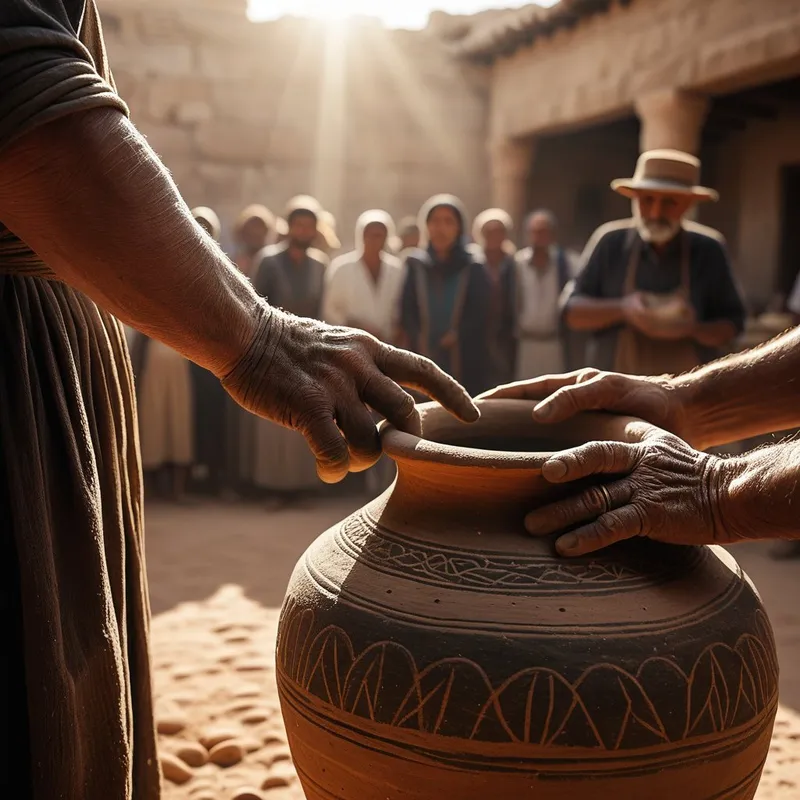
She did not descend in a chariot of fire. She emerged from the dust. It began at a crossroads, where a shepherd from the eastern slopes met a potter from the western coast. Suspicion was in their eyes, hands on their knives. But the space between them seemed to shimmer, to invite. The shepherd, desperate, gestured to his lame lamb. The potter, pointing to a cracked water jar, mimed a trade. No words, yet a understanding, fragile as a newborn bird, passed between them. They met in the middle. That spot of earth, where their shadows merged, grew warm.
Word spread. Not by herald, but by a pull in the chest, a feeling that one must go to the place between. They came—the farmer with his grain, the smith with his nails, the widow with her woven cloth. They came and they stood, not in a line, but in a rough circle. And in the center, unseen but felt by all, stood Agora. Her form was the collective breath held before a speech; her voice was the murmur that rises before the vote.
One fateful day, a dispute erupted. Two brothers claimed the same strip of land, their argument a tempest of rage and grief that threatened to tear the gathering apart. Violence simmered. Then, an elder, his back bent with years, stepped into the center. The shimmering presence of Agora seemed to settle on his shoulders. “Speak,” was all he said, first to one brother, then the other. He forced not silence, but sequence. Each man laid out his claim, his pain, before the circle of faces. The people listened. And in that listening, a third truth—a shared truth—was born. The land was divided not by force, but by a consensus that settled over the crowd like a calming mist. The brothers clasped forearms. Agora had not given an answer; she had held the space where the answer could be found.
Thus, the sacred circle of stones was laid, marking her eternal home. It became the beating heart of the city, the place where the solitary human spark joined others to become a guiding flame.
Cultural Origins & Context
The myth of Agora is not found in a single epic like the Iliad. It is a foundational myth, woven into the very fabric of Greek civic identity from the 8th century BCE onward. It was passed down not by bards in royal halls, but by citizens themselves through daily practice. Every time the assembly was called, every time a market transaction was honored, the myth was re-enacted and reinforced.
Its “storytellers” were the archons who convened the assembly, the philosophers who debated in her porticoes, and the common vendor who set up his stall at dawn. The Agora was the physical and psychic center of the polis. It was where abstract concepts of justice (dike), law (nomos), and equality (isonomia) took on flesh and voice. The myth served the critical societal function of sacralizing public discourse and commerce, transforming them from mundane activities into the rituals that sustained civilization itself. It taught that the community’s soul was not dictated by a king, but negotiated in the shared, sacred space between citizens.
Symbolic Architecture
Agora is not a goddess of answers, but a numen of the container. She symbolizes the psychic vessel necessary for the transformation of chaotic individual impulses into coherent collective will.
The true power lies not in the voice that shouts the loudest, but in the sacred space that compels every voice to be heard.
The circular layout of the historical agora is profoundly symbolic. It represents the Self in its wholeness, a mandala where every citizen, from every direction (every aspect of the psyche), has a place and a line of sight to the center. The center—where Agora stands—is the transcendent function, the point of synthesis where opposites (buyer/seller, accuser/defender, poor/rich) meet and are alchemized into something new: agreement, law, shared meaning.
Psychologically, Agora represents the ego’s capacity to create an internal temenos (sacred precinct). This is the ability to hold our conflicting inner voices—the critical parent, the fearful child, the ambitious hero—in a non-judgmental space of internal dialogue, allowing a guiding consensus of the whole personality to emerge.
The Dreamer's Resonance
To dream of an agora is to dream of the psyche’s communal dimension. A dream of a bustling, vibrant agora suggests a period of healthy internal and external discourse, where different parts of the self and different social roles are actively engaging and integrating.
More commonly, the modern dreamer encounters a liminal agora: empty, foggy, ruinous, or filled with silent, arguing specters. This signals a profound process related to the collective. Somatic sensations might include tightness in the chest (suppressed speech), a feeling of being pulled in multiple directions, or paralysis in the center of a crowd.
This dreamscape indicates that the dreamer’s relationship with the “public square” of their own psyche or their community is fractured. The internal “assembly” is not in session, or it is chaotic and dysfunctional. The dream is a call from the unconscious to rebuild this inner container, to consciously host the debate between competing values, identities, or obligations that are currently causing deadlock or fragmentation in one’s waking life.

Alchemical Translation
The individuation journey is not a solitary trek to a mountain peak. It is the gradual, often tumultuous, construction of an inner polis—a well-ordered city of the soul. The myth of Agora models the crucial alchemical stage of circulatio (circulation) and coniunctio (conjunction).
First, we must identify the scattered, polarized parts of ourselves—the inner hermit, the inner merchant, the inner warrior—and consciously “call them to the agora.” This is the circulatio: giving each a voice, allowing their often-contradictory claims to be aired in the light of consciousness. This feels like internal conflict, anxiety, or indecision.
The alchemical gold is not a single, pure truth, but the resilient, living agreement forged in the crucible of respectful conflict.
Agora’s role is the coniunctio. She does not take sides; she enforces the sacred protocol of the container. The ego, acting as the presiding elder, must learn to hold this space without collapsing into one faction. The triumph is not the victory of one inner voice over others, but the emergence of a third, synthesizing position—a “polis policy”—that respects the complexity of the whole self. This is the birth of genuine inner authority and ethical clarity. The modern individual transmutes the base metal of internal cacophony into the gold of integrated conviction by becoming, like the ancient citizen, both a participant in and a guardian of their own psychic public square.
Associated Symbols
Explore related symbols from the CaleaDream lexicon: