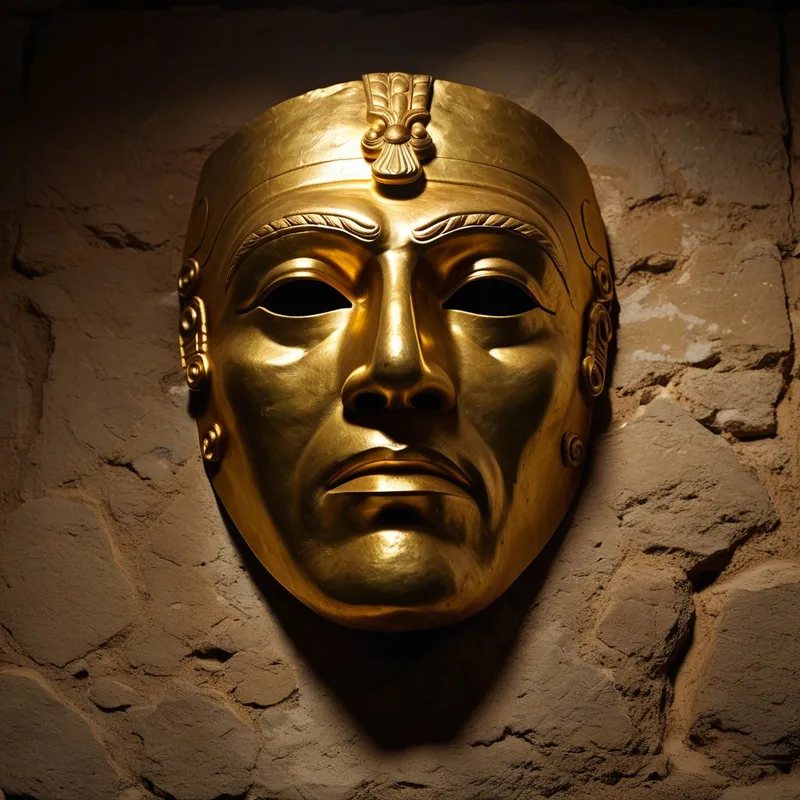
Agamemnon's Death Mask Myth Meaning & Symbolism
A king returns triumphant from war only to be murdered by his queen, his legacy sealed by a golden mask that hides a terrible truth.
The Tale of Agamemnon's Death Mask
Hear now the tale, not of a hero’s glory, but of a king’s final breath, a whisper that echoes through the halls of Mycenae. The air is thick with the scent of salt and sacrifice, for Agamemnon, son of Atreus, has returned. He returns not to peace, but to a home grown cold in his ten-year absence. The gods themselves are silent, their favor a fickle wind that has brought his black ships home but now seems to die at the shore.
He walks the familiar stones, the conqueror of Troy, his shoulders heavy with spoils and a heavier, unseen burden. Awaiting him is Clytemnestra, his queen. Her smile is a careful artifice, her eyes pools of still water hiding volcanic depths. For a decade, she has nurtured a grief as cold and hard as iron—grief for their daughter, Iphigenia, whom the king led to the altar at Aulis to buy a wind for his war. In her heart, grief has fermented into a vintage of pure vengeance.
She welcomes him with words of honey and ritual. "Come, my lord," she says, her voice smooth as oiled silk. "The dust of your long journey clings to you. Let the palace waters cleanse you." She leads him to the bath, a sunken marble bowl. She unfolds for him a great robe, a cunning web, a garment with no neck-hole, woven for this hour alone. As the warm water steams around him, as he relaxes his guard, believing the war truly over, she casts the net. The fabric entangles his limbs, a silken prison. From the shadows, her lover, Aegisthus, emerges, or perhaps it is the queen herself—the stories clash like cymbals in their horror. The blade falls, not on a battlefield, but in the sanctity of the bath. The king who commanded a thousand ships dies thrashing, entangled in luxury, betrayed in the place of purification.
And then, the silence. The bloody water stills. What remains is not the man, but the office; not the father or husband, but the King. With hands that may tremble or may be steady as stone, they prepare the body. Upon the cold, still face, they place a mask. Not of clay, but of beaten gold, hammered to capture an eternal, idealized sternness—the brow of command, the set jaw of authority. It is the face of the Ruler, forever sealing away the agonized visage of the betrayed man. The mask is a lid on a cauldron, a golden lie over a truth too terrible to behold. It is placed in the dark of the tomb, a final, glittering testament to a legacy forever split in two: the glorious conqueror and the murdered kin.

Cultural Origins & Context
This dark pearl of the Epic Cycle comes to us primarily through the chisel of Aeschylus, in his monumental tragedy, the Agamemnon. It was not mere entertainment for the Athenians gathered in the Theatre of Dionysus; it was a civic and spiritual ritual. The myth served as a foundational cautionary tale about the cyclical nature of violence (vendetta), the limits of authority, and the terrifying price of hubris.
Agamemnon’s story is the keystone in the arch of the House of Atreus curse, a generational wound. His murder is not an isolated crime but a link in a chain stretching back to his father’s atrocities and forward to his son Orestes's matricide. The culture that told this story was deeply concerned with order (kosmos) versus chaos, the sacred duties of the host and the guest, and the precarious justice of the gods. The death mask, while a poetic symbol in the myth, finds a chilling echo in the real, magnificent "Mask of Agamemnon" discovered at Mycenae—a tangible artifact that bridges legend and history, forcing us to confront the human face behind both the gold and the tale.
Symbolic Architecture
The mask is the central, devastating symbol. It represents the ultimate split between the persona and the shadow.
The golden mask is the perfected persona, the flawless face of authority presented to the world, while the face beneath is the raw, unprocessed truth of the self—betrayed, vulnerable, and murdered.
Agamemnon returns wearing the persona of the triumphant ptoliporthos, but his home is the realm of his shadow: the neglected wife, the murdered daughter, the corrupted hearth. The bath, a place of cleansing, becomes the site of defilement, symbolizing how the attempt to wash away the past (the blood of Iphigenia, the stains of war) only invites the repressed to return with greater violence. Clytemnestra embodies the Dark Feminine or the Terrible Mother, the psychic force that annihilates the unconscious, tyrannical ruler to make way for something new, however painfully. The entangled robe is fate itself—the inescapable net of consequences woven by one's own past actions.
The Dreamer's Resonance
To dream of Agamemnon’s mask is to encounter a profound moment of psychic reckoning. You may dream of finding or wearing a mask that is beautiful but suffocating, or of seeing your own reflection replaced by a rigid, metallic face. This is the somatic signal of a persona that has become a prison. The dream ego is experiencing the cost of maintaining an image—of the flawless leader, the perfect professional, the always-strong partner—that has severed connection with the authentic, feeling self.
The bath or water in the dream often signifies the emotional realm you are attempting to navigate. Murky or bloody water points to unresolved emotional trauma (your "Iphigenia sacrifice") now rising to the surface. A figure in the shadows with a blade represents the cutting truth your psyche is ready to deliver, the necessary betrayal of an old, unsustainable identity. This dream pattern signals a psychological process of deintegration—the healthy breakdown of an overly rigid ego structure so that a more authentic self can eventually emerge.
Alchemical Translation
The alchemical journey modeled here is the nigredo, the blackening, the descent into the darkest material of the soul. Agamemnon’s triumphant return is the inflated ego believing it has completed its great work. But the true work begins at home, in the base matter of personal history and relationship.
The murder in the bath is the brutal, necessary dissolution of the kingly complex. The gold of the mask must be melted down in the fires of self-awareness to be recast.
For the modern individual, this myth maps the agonizing but vital process of confronting the "curse" of one's personal or familial patterns. It is about daring to enter the steamy, vulnerable space of true feeling (the bath) and allowing the entangled robes of old identities—the "shoulds" and inherited roles—to be cut away. The goal is not to avoid the murder, but to move through it consciously. To take off the golden mask of one’s own accord, to gaze upon the betrayed and betrayer within, and to begin the long work of integration that Orestes, the son, must later undertake. The mask is not the end, but a relic of the old king. The alchemical gold is found not in the static image, but in the living, responsible consciousness that emerges from the tomb of the old self.
Associated Symbols
Explore related symbols from the CaleaDream lexicon: