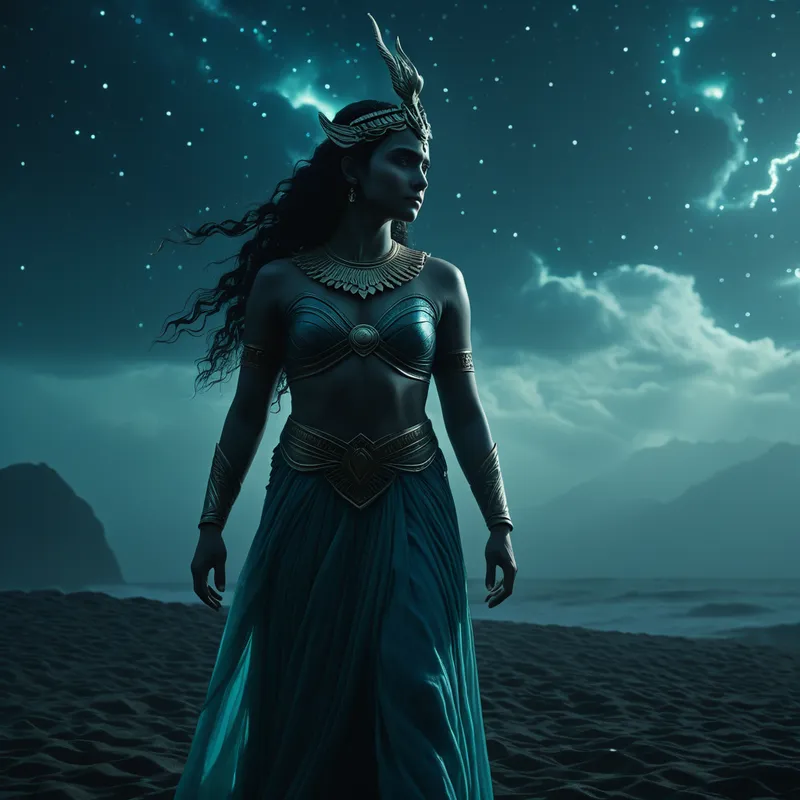
Aeons as Emanations of God
Divine emanations in Gnostic belief that bridge the transcendent God with the material world, revealing cosmic mysteries.
The Tale of Aeons as Emanations of God
In the beginning, before beginnings were counted, there existed the One—the Unknowable, the Ineffable, the [Monad](/myths/monad “Myth from Greek culture.”/). It was perfect, silent, and whole, a [pleroma](/myths/pleroma “Myth from Gnostic culture.”/) of absolute light beyond conception. Yet within this profound stillness, a movement stirred—not of need, but of the fullness of being’s inherent urge to know itself. From the depths of this silent divinity, the first thought was born: a self-reflection so potent it became a living entity. This was the first Aeon, Barbelo, the First Thought of the Father, the divine feminine principle of foreknowledge.
From this primal pair—the Ineffable Source and its First Thought—[emanation](/myths/emanation “Myth from Neoplatonic/Gnostic culture.”/) flowed in cascades of paired syzygies, male and female principles dancing in perfect union. Mind and Truth, Word and Life, Man and Church… each pair was a distinct facet of the divine fullness, a unique vibration of the godhead’s hidden nature. They were not created, but born of contemplation; each Aeon gazing upon the depth of the Father and bringing forth its counterpart, a new dimension of divine mystery. Together, they formed the Pleroma, a harmonious community of divine attributes, a celestial ecosystem of consciousness.
But within this harmony, a yearning arose. The youngest of these [Aeons](/myths/aeons “Myth from Gnostic culture.”/), often named [Sophia](/myths/sophia “Myth from Gnostic culture.”/) (Wisdom), was consumed by a passion to know the Unknowable Source directly, to grasp the Father in His ultimate essence, apart from the mediating presence of the other [Aeons](/myths/aeons “Myth from Gnostic culture.”/). This was a desire born not of malice, but of love’s most intense and reckless edge. In her passionate, unilateral striving, she overreached the harmonious balance of [the Pleroma](/myths/the-pleroma “Myth from Gnostic culture.”/). From this overreach, a thought was projected—a thought without the balancing syzygy, a fragment of divine longing severed from its source of wholeness.
This fragment, this lonely spark of divine intent wrapped in ignorance and anguish, fell. It precipitated from the luminous realms of spirit into [the void](/myths/the-void “Myth from Buddhist culture.”/) of absence, the Kenoma. From Sophia’s grief and the collective compassion of the Pleroma, a complex drama unfolded to rescue this lost spark. The Aeons collaborated, and from their unified light, they emanated a pair: [Christ](/myths/christ “Myth from Christian culture.”/) and [the Holy Spirit](/myths/the-holy-spirit “Myth from Christian culture.”/), to bring comfort and form to the [chaos](/myths/chaos “Myth from Greek culture.”/). Furthermore, they brought forth the [Demiurge](/myths/demiurge “Myth from Platonic culture.”/), a being born of Sophia’s confusion, who mistook himself for the only god.
Ignorant of the Pleroma above, [the Demiurge](/myths/the-demiurge “Myth from Gnostic culture.”/) took the raw substance of the fallen realm and fashioned it into the material cosmos—a flawed, heavy imitation of the divine order. He trapped the sparks of [divine light](/myths/divine-light “Myth from Christian culture.”/), the fragmented essence of Sophia’s desire, within the prison of matter and soul. Thus, the Aeons, the very emanations of the remote God, became the hidden architects of salvation. They are the bridge; their ongoing life is the process by which the divine fullness seeks to recover its own lost fragments, guiding the sparks of spirit, the [pneuma](/myths/pneuma “Myth from Greek culture.”/), back through the layers of cosmic ignorance to their original home.
Cultural Origins & Context
The myth of the Aeons is [the cornerstone](/myths/the-cornerstone “Myth from Biblical culture.”/) of classical Gnostic cosmology, most elaborately detailed in texts from the 2nd and 3rd centuries CE, such as the Apocryphon of John and the Gospel of Truth. It emerged within the turbulent spiritual crucible of the late Hellenistic world, where Platonic philosophy, Jewish mysticism, Zoroastrian dualism, and early Christian revelation clashed and melded. Gnostics were not unified but shared a radical, experiential conviction: that the material world was not the creation of the true, highest God, but the product of a tragic error or a malevolent power.
In this context, the Aeonology provided a profound answer to the primordial religious question: How did the perfect, spiritual God give rise to an imperfect, suffering material world? Orthodox Christian and Jewish narratives of a sovereign Creator God who declares his material creation “good” were seen as addressing a different, lesser deity. The Gnostic system, with its cascading Aeons, offered a more psychologically nuanced theodicy. Evil and suffering were not willed by the True God, but were the inevitable consequence of a “fall” within the divine realm itself—a fall into longing and ignorance that then echoed through all subsequent layers of being. The Aeons represent the means by which the transcendent remains connected to, and actively redeems, the fallen realm without being contaminated by it. They are the channels of gnosis.
Symbolic Architecture
The [architecture](/symbols/architecture “Symbol: Architecture in dreams often signifies structure, stability, and the framing of personal identity or life’s journey.”/) of the Aeons is a map of [consciousness](/symbols/consciousness “Symbol: Consciousness represents the state of awareness and perception, encompassing thoughts, feelings, and experiences.”/) itself. They are not distant gods but the very structures of divine self-[knowledge](/symbols/knowledge “Symbol: Knowledge symbolizes learning, understanding, and wisdom, embodying the acquisition of information and enlightenment.”/). Each syzygy (male-female pair) represents a fundamental polarity of existence—Mind/[Truth](/symbols/truth “Symbol: Truth represents authenticity, honesty, and the quest for knowledge beyond mere appearances.”/), [Logos](/myths/logos “Myth from Christian culture.”/)/[Life](/symbols/life “Symbol: The symbol of ‘Life’ represents a journey of growth, interconnectedness, and existential meaning, encompassing both the joys and challenges that define human experience.”/)—whose harmonious union generates the next level of manifest [reality](/symbols/reality “Symbol: Reality signifies the state of existence and perception, often reflecting one’s understanding of truth and life experiences.”/). This is a cosmology of [emanation](/symbols/emanation “Symbol: A spiritual or divine energy flowing outward from a source, often representing creation, influence, or the manifestation of the sacred into the material world.”/), not creation ex nihilo; each level flows from the one before as a necessary [expression](/symbols/expression “Symbol: Expression represents the act of conveying thoughts, emotions, and individuality, emphasizing personal communication and creativity.”/) of its [fullness](/symbols/fullness “Symbol: A state of complete satisfaction, abundance, or completion, often representing emotional, spiritual, or physical fulfillment.”/), like light radiating from a [source](/symbols/source “Symbol: The origin point of something, often representing beginnings, nourishment, or the fundamental cause behind phenomena.”/) or thoughts arising from a deep mind.
The Pleroma is not a place, but a state of being—the integrated psyche where all opposites are held in creative, fecund tension. The fall of Sophia is the moment a single complex (here, the desire for unmediated knowledge) splits off from the whole and identifies with its own partial perspective, losing connection to the unifying ground.
The [journey](/symbols/journey “Symbol: A journey in dreams typically signifies adventure, growth, or a significant life transition.”/) of the lost spark back through the Aeons is the archetypal [path](/symbols/path “Symbol: The ‘path’ symbolizes a journey, choices, and the direction one’s life is taking, often representing individual growth and exploration.”/) of individuation. One must recognize and integrate the qualities each Aeon represents—moving from the [chaos](/symbols/chaos “Symbol: In Arts & Music, chaos represents raw creative potential, uncontrolled expression, and the breakdown of order to forge new artistic forms.”/) of embodied life (the [realm](/symbols/realm “Symbol: The symbol of ‘Realm’ often signifies the boundaries of one’s consciousness, experiences, or emotional states, suggesting aspects of reality that are either explored or ignored.”/) of the Demiurge) toward the coherence of Mind, the authenticity of Truth, and finally, the silent unity of the Source. The Aeons are both the [path](/symbols/path “Symbol: The ‘path’ symbolizes a journey, choices, and the direction one’s life is taking, often representing individual growth and exploration.”/) and the guides.
The Dreamer’s Resonance
To dream of emanations, of successive layers of reality unfolding from a central source, is to touch the [psyche](/myths/psyche “Myth from Greek culture.”/)’s own creative and revelatory process. The Aeons mirror how our own consciousness structures itself: from an unconscious, unknowable ground ([the Monad](/myths/the-monad “Myth from Gnostic/Hermetic culture.”/)), a first self-image or thought emerges (Barbelo), which then gives rise to the myriad complexes, sub-personalities, and archetypal patterns that constitute our inner world. A dysfunctional complex—like a trauma or a compulsive desire—is akin to the fallen Sophia: a fragment of psychic energy that has split off from the whole system, acting autonomously and creating distress in our personal “cosmos.”
The Gnostic drama resonates with the feeling that part of us is trapped—in a job, a relationship, a pattern of suffering—that feels alien, not truly “us.” This is the pneuma asleep in matter. The Aeons represent the innate, often hidden, structures of the psyche that can facilitate liberation: moments of insight (Mind), encounters with deep truth (Truth), transformative words (Logos), and renewing vitality (Life). The path of gnosis is the therapeutic journey of recalling the “[divine spark](/myths/divine-spark “Myth from Gnostic culture.”/)” to its source by recognizing and integrating these inner structures, thereby restoring the inner Pleroma.
Alchemical Translation
In alchemical terms, the Pleroma is the [Unus Mundus](/myths/unus-mundus “Myth from Alchemical culture.”/), the one unified world preceding differentiation. The emanation of the Aeons is the process of separation (the [separatio](/myths/separatio “Myth from Alchemical culture.”/))—the division of the primal unity into the active and passive, masculine and feminine, fixed and volatile principles necessary for the work. Sophia’s passion and fall represent the crucial, risky stage of [nigredo](/myths/nigredo “Myth from Alchemical culture.”/), the blackening. It is the descent into the [prima materia](/myths/prima-materia “Myth from Alchemical culture.”/), the chaotic, suffering state of raw, unintegrated experience, which is a necessary prelude to purification.
The Demiurge is the unenlightened operator who works only on the literal, material level, mistaking the leaden prison for the whole of reality. The true alchemist works with the spark of the Aeons—the spiritual intelligence within matter—to conduct the opus contra naturam, the work against the fallen nature, guiding the soul through successive purifications (albedo) and integrations (rubedo) back to its golden origin.
The entire Aeonic system is a blueprint for the opus magnum. Each Aeon is a stage in the transformation of consciousness, a vessel (vas) in which a specific union of opposites is achieved. The final return to the Monad is the achievement of the [lapis philosophorum](/myths/lapis-philosophorum “Myth from Alchemical culture.”/), the stone of the wise—the fully integrated, redeemed Self, at once perfectly individual and one with the divine source.
Associated Symbols
Explore related symbols from the CaleaDream lexicon:
- Emanation — The process by which the divine unfolds into multiplicity, not through creation but as an overflowing of its own essence, like light from a source.
- Bridge — A structure spanning a chasm; the Aeons themselves form the living bridge between the transcendent God and the entrapped spark in the material world.
- Light — The primary substance of the Pleroma and the Aeons, representing pure consciousness, truth, and the divine essence fragmented in creation.
- Mirror — The First Thought, Barbelo, as the perfect reflection of the Unknowable; the Aeons as reflections of divine attributes.
- Ocean — The boundless, unfathomable depth of the divine source (the Monad) and the Pleroma as a sea of luminous being.
- Key — The gnosis or knowledge each Aeon embodies, which unlocks the successive gates on the path of return to the divine fullness.
- Shadow — The realm of the Demiurge and the material cosmos, a distorted shadow-play cast by the ignorance born from Sophia’s fall.
- Wound — Sophia’s passionate overreach and the resulting fracture in the Pleroma, the primal wound that generates the cosmos and the longing for healing.
- Seed — [The divine spark](/myths/the-divine-spark “Myth from Gnostic culture.”/) or pneuma trapped within material humanity, containing the latent potential for its entire journey of awakening and return.
- Veiled Knowledge — The hidden nature of the true God and the Pleroma, which the Aeons progressively reveal to the seeking spirit.
- Circle — The wholeness and self-contained perfection of the Pleroma, and the cyclical journey of emanation, fall, and return.
- [Dragon](/myths/dragon “Myth from Chinese culture.”/) — The chaotic, archonic forces of the lower cosmos that guard and bind the divine spark, representing the psychic obstacles to integration.