Aegishjalmur Myth Meaning & Symbolism
A myth of primal terror and the power to master it, where a symbol born from a dragon's hoard becomes a key to the self.
The Tale of Aegishjalmur
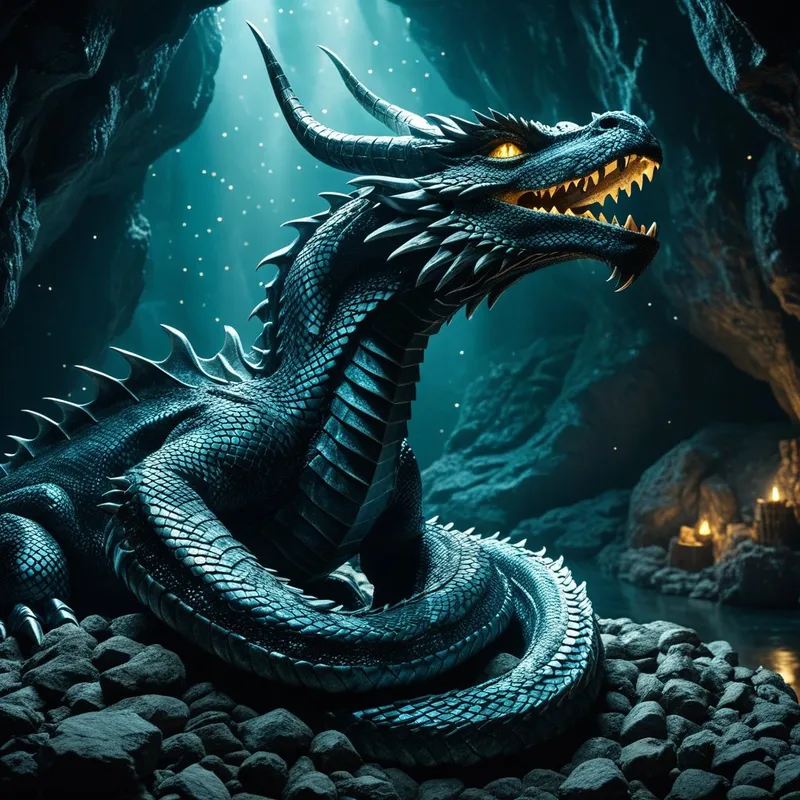
Listen, and hear the tale of a terror that became a treasure. In the deep, root-tangled earth, where the sun’s kiss is a forgotten memory, there lay a hoard. It was no mere collection of gold, but a mountain of it, a glittering, cursed heart in the womb of the world. And upon it, coiled in possessive slumber, lay Fafnir. Once a son, now a serpent, his scales were plates of shadow, his breath a fog of greed that poisoned the very stone. His single, lidless eye held the cold light of a star that wished only for dominion.
This was the Aegishjalmur—not a helm of iron, but a terror made manifest. It radiated from him, a silent, crushing wave. Warriors who sought the gold would feel their breath catch, their hearts become frantic birds in a cage of bone. Their courage, so bright by the mead-hall fire, would gutter and die before they even saw the gleam of a scale. This was Fafnir’s true power: to project his own monstrous fear into the mind of another, to turn their spine to water and their sword arm to lead.
But the ørlög had woven a different thread. A hero came, not for gold, but for vengeance and the unraveling of a curse. Sigurd, fostered by the cunning smith Regin, descended into the dark. He did not charge. He waited. In the damp silence, he dug a pit in the dragon’s path, a grave in the making. As the earth shook with Fafnir’s approach, Sigurd lay hidden, the cold soil against his back, the scent of worm and metal in his nostrils.
Then, the underbelly—a expanse of softer scale—passed above. With a cry that was part shout, part prayer to forgotten gods, Sigurd thrust his sword, Gram, upward. The sound was not of ringing metal, but of a terrible, wet tearing. A roar shook the cavern, a sound of fury and profound, world-ending pain. Hot blood, black as night and thick with potency, fountained into the pit.
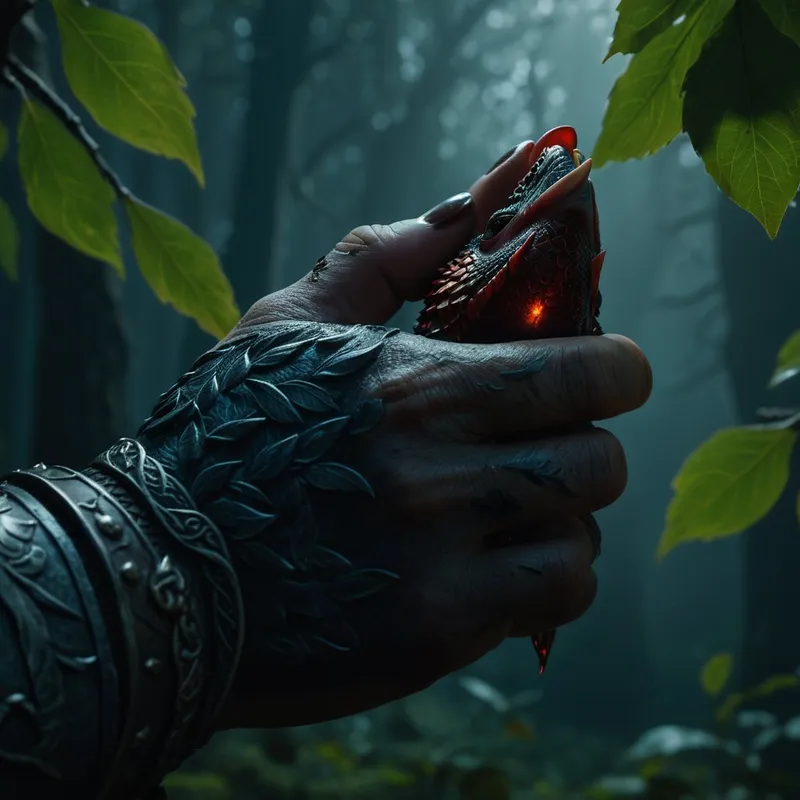
As the dragon’s life fled, Sigurd clambered from his hiding place. Regin, consumed by the very greed that birthed the dragon, demanded the heart. Sigurd roasted it. When the blood bubbled, he touched it, testing the heat, and burned his thumb. Instinctively, he brought the thumb to his mouth.
The world dissolved, and then reassembled in clarity. The dripping of water became speech. The rustle of leaves in the trees above the cave entrance became urgent, chattering counsel. He heard the voices of the nuthatches. They spoke of Regin’s imminent betrayal, of the hoard that awaited, and of the power that now lay dead before him. With the dragon’s blood on his lips and wisdom in his ears, Sigurd understood. He took the gold, yes. But he also took the principle of the terror. He mastered the force that had emanated from Fafnir. The Aegishjalmur was no longer the dragon’s weapon. It was the hero’s prize—the power to stand unshaken, to make one’s own spirit a fortress.
Cultural Origins & Context
The myth of the Aegishjalmur is woven into the Volsung Saga and the Poetic Edda. It was not a story told for mere entertainment by the hearth, but a vital transmission of a core Germanic and Norse worldview. In a universe perceived as inherently hostile—a world of frost giants, chaotic forces, and inevitable Ragnarök—the individual’s primary task was the cultivation of inner fortitude.
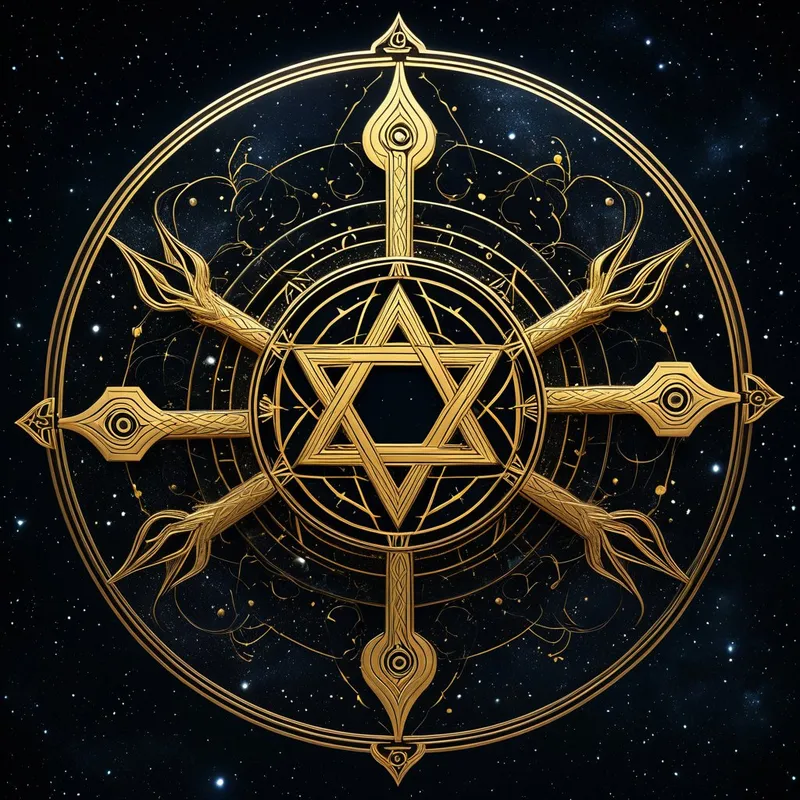
The symbol itself, the eight-armed stave, appears in later Icelandic grimoires, but its mythological roots are in this narrative. It was a galdrastafur, an object of magical practice. The story provided its mythic pedigree and operational logic: true power is not taken from another, but claimed by confronting and integrating the source of primal fear. Skalds and storytellers passed this down not as a recipe for magic, but as a map of a psychological operation. Its societal function was to model the process by which a person, or a community, could transform an external, paralyzing threat into an internalized principle of unwavering resolve.
Symbolic Architecture
At its core, the myth of the Aegishjalmur is an allegory for the conquest of the paralyzing Self by the conscious Ego, and the subsequent birth of a new, integrated authority. Fafnir is not just a dragon; he is the ultimate shadow of possession. He is what happens when desire (Andvari’s gold) is left unchecked, festering in the unconscious (the cave) until it transforms the self into a monstrous, isolated hoarder of life energy.
The dragon does not create fear; it is fear incarnate. To possess its helm is not to wield terror, but to have stared into the abyss of one's own potential for monstrosity and remained whole.
The Aegishjalmur symbolizes the radiant, structured ego-consciousness that can form after this encounter. Its eight arms, often seen as spears, represent a dynamic, all-directional defense that originates from a stabilized center. Sigurd’s journey—the guidance (Regin), the cunning preparation (the pit), the decisive action, and the crucial, accidental ingestion of wisdom (the blood)—models the complete heroic arc. The key is the tasting of the dragon’s essence. One does not simply kill the fear; one must metabolize its power, integrating the fierce, territorial, survival-level energy of the dragon into a higher order of understanding.
The Dreamer's Resonance
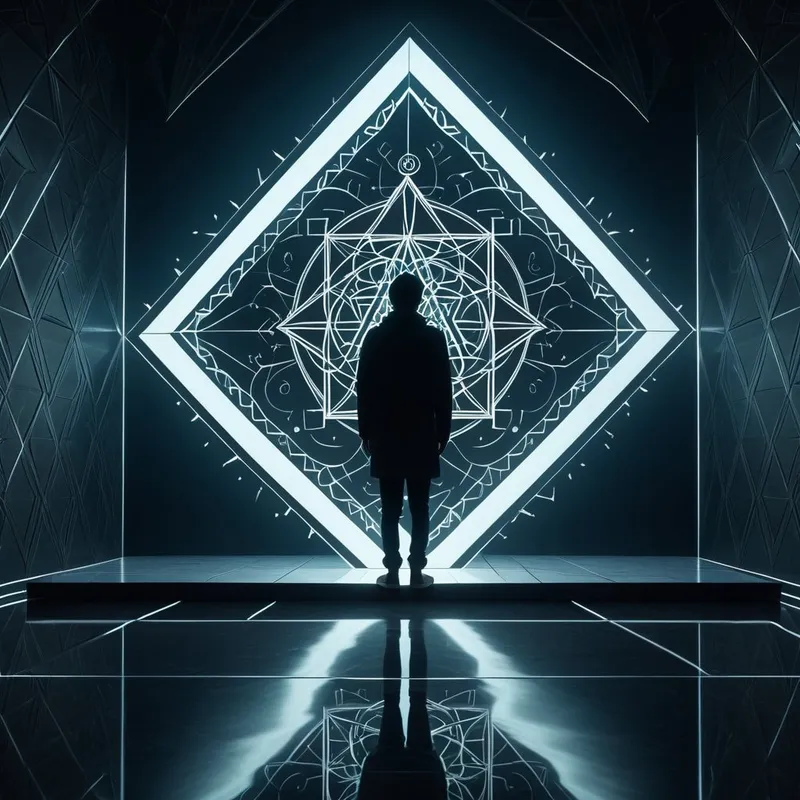
When the Aegishjalmur pattern emerges in modern dreams, it rarely appears as a literal Norse symbol. Instead, one may dream of standing before an overwhelming, oppressive presence—a looming figure, a tidal wave of darkness, a crushing weight of responsibility. This is the somatic echo of Fafnir’s terror. The dreamer is in the pit, feeling the vibration of their own undigested fear or unintegrated power approaching.
The turning point in such a dream is the moment of confrontation, often not through brute force, but through a surprising, clever, or even passive action (like Sigurd’s ambush). Following this, there may be images of tasting something bitter yet potent, of hearing hidden messages (like bird speech), or of discovering a geometric pattern, a mandala, forming in the center of the chaos. This signals the psyche’s attempt to forge its own “Helm of Awe”—to structure the chaotic energy of the confrontation into a resilient, centered identity. The dream is an active rehearsal for claiming one’s authority in waking life.
Alchemical Translation
The alchemical process mirrored here is the Nigredo leading to the creation of the Lapis Philosophorum, the Philosopher’s Stone. The initial state is the blackening: the greedy, unconscious hoarding of potential (the gold in the dark cave). The dragon is the prima materia, the base, terrifying matter of the unexamined self. Slaying it is the necessary mortification, the breaking down of the old, rigidified complex.
The true alchemy is not in the slaying, but in the roasting of the heart. It is the transformative fire of conscious attention applied to the core of one's trauma or fear.
Sigurd’s tasting of the blood is the albedo, the whitening. The raw, instinctual power (the blood) is purified by the fire of experience and brought to consciousness (the mouth, the seat of speech and taste). Hearing the birds represents the influx of intuitive wisdom from the Self, guidance that comes only after the ego has done the hard, dirty work of confrontation. The final result, the Aegishjalmur, is the symbol of the Lapis: the fully integrated psyche. It is not an invulnerability to external threats, but an unassailable inner citadel. For the modern individual, the myth prescribes a path: identify your “dragon”—the source of your primal, paralyzing fear (of failure, of lack, of annihilation). Confront it not head-on in its terms, but with cunning and patience. Be wounded by it (the burned thumb), and in that wounding, ingest its lesson. From that integration, a natural, radiant authority—your own Helm of Awe—will crystallize, allowing you to move through the world not in arrogance, but in unshakable, quiet sovereignty.
Associated Symbols
Explore related symbols from the CaleaDream lexicon: