Adam Naming the Animals Myth Meaning & Symbolism
In the primal garden, the first human is tasked with naming every living creature, establishing consciousness and order through the power of the spoken word.
The Tale of Adam Naming the Animals
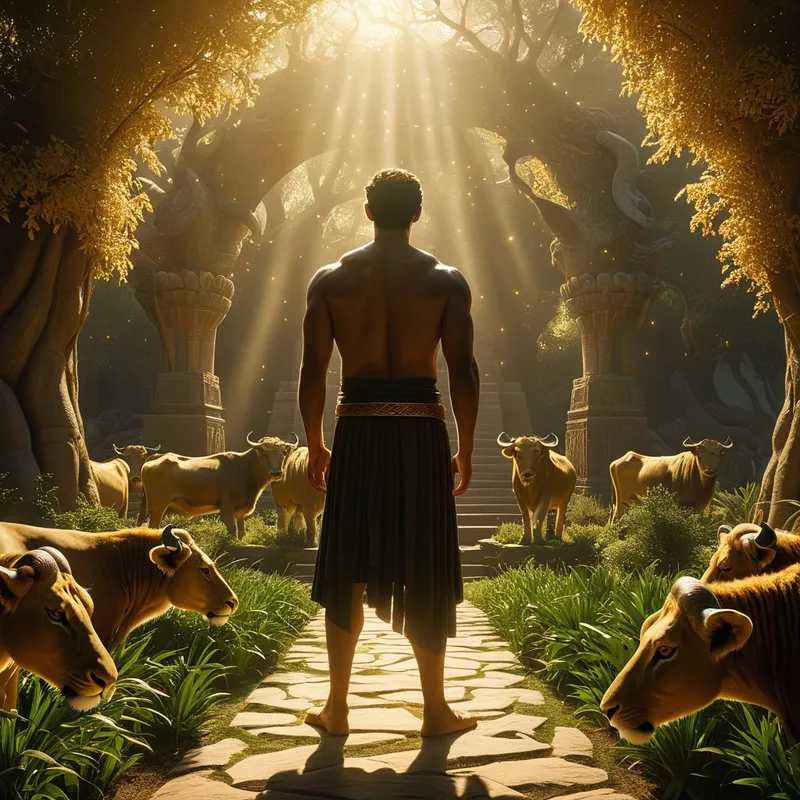
In the beginning, before memory, there was a garden. Not a garden as we know it, tame and bordered, but the Garden, a place of humming, teeming, fragrant life where the light itself was a kind of honey. And in its heart, formed from the red clay of its soil, was Adam, the earth-creature. He was alone, a being of silent wonder, walking barefoot on dew-slick grass, his eyes drinking in a world unnamed.
Then came the Voice, not a sound that struck the ear, but a knowing that filled the space between his thoughts. It was the breath of Yahweh, the unnameable One who had shaped him. And the Voice presented a procession.
From the misty thickets and the sun-dappled clearings, from the burrows in the earth and the heights of the cedars, they came. Not in fear, not in submission, but in a solemn, curious parade of being. The great shaggy aurochs with horns like crescent moons, the sleek leopard whose spots were shadows of leaves, the soaring eagle that was a piece of the sky given motion, the industrious ant, the chattering finch, the coiling serpent whose scales held the rainbow’s memory. Every creature that moved upon the earth, that swam in the waters, that flew in the expanse of the heavens—they passed before the man.
And a great task settled upon Adam’s spirit. The Voice had formed them, but it was for the man to know them. To know them not just by sight, but by essence. He looked into the liquid, patient eye of the ox and felt its steadfast strength. He observed the cunning grace of the fox and understood its silent intelligence. He saw the communal purpose of the bee and the solitary grandeur of the lion. And from the depths of his own being, from the place where his breath met the divine spark within, a word would rise.
He opened his mouth, and sound—purposeful, resonant sound—flowed out for the first time. “Aryeh,” he said to the lion, and the great cat dipped its head, its identity now echoing in the air between them. “Nesher,” he called to the eagle, and it seemed to climb higher on the syllable. “Nachash,” he whispered to the serpent, and it acknowledged the title with a slow blink. One by one, he spoke their names. He did not invent them from nothing; he discovered them, listening to the silent song each creature sang of itself and giving it a vessel of sound. The garden, once a symphony of anonymous life, became a cosmos of known beings. With each utterance, Adam was not just labeling the world; he was weaving a net of relationship, of conscious recognition, casting it over the chaos of life and drawing it into the order of the mind.
Cultural Origins & Context
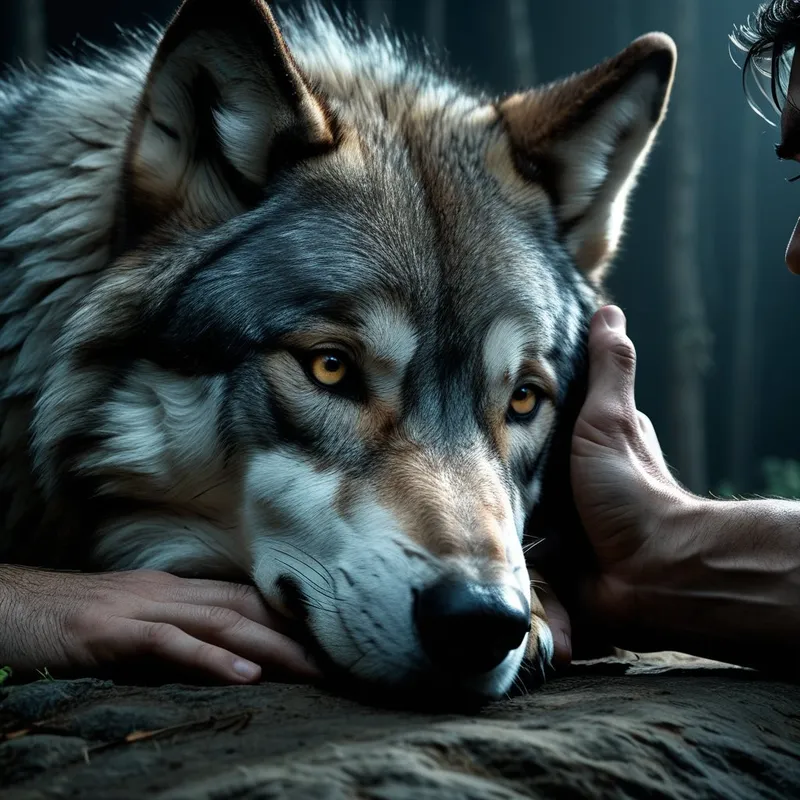
This narrative is nestled within the Book of Genesis, specifically the so-called “Priestly” creation account (Genesis 1:1–2:3) and its following elaboration (Genesis 2:4-25). It is a foundational text of the Hebrew tradition, compiled during a period of exile and reflection, likely in the 6th century BCE. The story was not merely an etiological tale (explaining why things are named) but a profound theological and anthropological statement.
Passed down orally by priests and scribes before being codified, its function was multifaceted. It established the unique status of humanity within creation—not as a mere animal, but as a being endowed with a God-like capacity for language and rational order. It illustrated humanity’s God-given role as steward and mediator, tasked with understanding and caring for the natural world. Furthermore, in a culture where naming implied authority, intimate knowledge, and even essence (to know a name was to know the thing itself), this act cemented the human relationship with the animal kingdom as one of responsible dominion, not tyrannical domination. It was a myth that answered the deepest questions: Who are we? What is our purpose? And what is our place in this vibrant, terrifying, beautiful world?
Symbolic Architecture
At its core, this is the myth of consciousness awakening to itself and its environment. Adam represents the nascent human ego—the “I”—emerging from the undifferentiated unity of the Garden (the unconscious). The animals symbolize the totality of psychic contents: instincts, drives, emotions, and potentials that swirl within the unconscious, unnamed and unknown.
The act of naming is the primal act of consciousness. It is the moment the light of awareness falls upon the shadowy forms of the inner world and says, “You are this.”
The procession of animals is the procession of all that is “not-I” within the psyche. The fierce lion of anger, the cunning fox of strategy, the patient ox of endurance, the soaring eagle of spirit, the lowly worm of decay—all must be brought before the seat of consciousness to be recognized and integrated. To name them is to begin the process of relating to them, of taking responsibility for their existence within one’s own being. It is the foundation of all psychology: making the unconscious conscious. The myth posits that our humanity is not defined by the absence of animal nature, but by our conscious relationship to it. We do not cease to be animal; we become the animal that knows it is animal.
The Dreamer's Resonance
When this mythic pattern stirs in the modern dreamer, it signals a critical phase of self-discovery and psychic ordering. You may dream of being in a strange, lush place surrounded by unfamiliar animals. You might be tasked with sorting them, feeding them, or, most potently, trying to identify them.
This dream experience mirrors the somatic and psychological process of differentiation. The “animals” are often powerful, undigested emotions or emerging aspects of the personality (the shadow, the anima/animus) that demand recognition. The anxiety in the dream—the fear of getting the name wrong, or of being overwhelmed by the beasts—reflects the ego’s fear of being consumed by the unconscious. The resolution comes when the dreamer finds the correct “name,” which is not a literal label but a felt sense of understanding: “Ah, this is my buried rage. This is my untamed creativity. This is my profound grief.” Naming, in the dream, is akin to a sigh of relief in the body; it is the moment of integration, where a chaotic inner force is acknowledged and brought into the fold of the self.

Alchemical Translation
The alchemical journey begins in the prima materia—the confused, primal mass of the unexamined life. Adam in the Garden is the soul in this state. The divine command to name the animals is the call to individuation, the imperative to undertake the great work of self-becoming.
The process is one of psychic transmutation. First, observation (the animals are brought forward). Then, discernment (Adam perceives their unique qualities). Finally, verbalization (he speaks the name). In our lives, this translates to: 1) Allowing our inner complexities to surface without judgment. 2) Contemplating their nature and origin with honest curiosity. 3) Defining them, perhaps through journaling, therapy, art, or simply mindful acknowledgment.
The triumph of the myth is not dominion over the beasts, but the establishment of a conscious covenant with them. The transformed psyche is not a tyrannical ruler over its instincts, but a wise steward in a thriving, internal ecosystem.
The ultimate “philosopher’s stone” forged in this operation is a fully realized consciousness—a self that knows its own depths, names its own creatures, and in doing so, finds not loneliness, but a profound kinship with all that is. We complete the myth when we move from being passive inhabitants of our inner world to active, compassionate namers of its inhabitants, thereby creating a true and authentic self, spoken into being one honest recognition at a time.
Associated Symbols
Explore related symbols from the CaleaDream lexicon: