Adam and Eve Myth Meaning & Symbolism
A foundational myth of human awakening, where innocence is lost to knowledge, and the divine garden is exchanged for the mortal world of choice and consequence.
The Tale of Adam and Eve
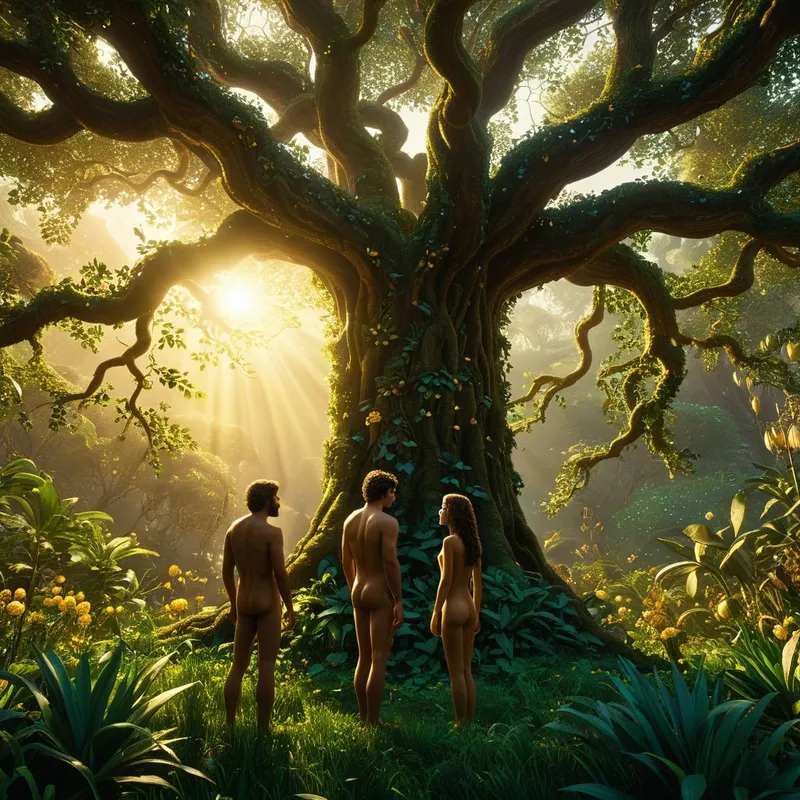
In the beginning, before time was counted, there was a breath. From the formless void and the deep, silent waters, a Word was spoken, and light shattered the darkness. From this divine breath, the heavens were stretched like a tent, and [the earth](/myths/the-earth “Myth from Hindu culture.”/) was called forth from the deep. And upon this new earth, in the east, Yahweh Elohim planted a garden. It was a place of unthinkable beauty, where every tree that was pleasant to the sight and good for food sprang from the soil. A river flowed from it, parting into four heads to [water](/myths/water “Myth from Chinese culture.”/) [the world](/myths/the-world “Myth from Tarot culture.”/). In the midst of the garden stood two trees: the [Tree of Life](/myths/tree-of-life “Myth from Kabbalistic culture.”/), and the Tree of the Knowledge of Good and Evil.
Then, from the dust of the ground, Yahweh Elohim formed a man, Adam, and breathed into his nostrils the breath of life. The man became a living soul. He was placed in the garden to tend and keep it, with one solemn charge: “You may surely eat of every tree of the garden, but of the tree of the knowledge of good and evil you shall not eat, for in the day that you eat of it you shall surely die.”
Yet the man was alone. So, from the man’s own side, while he slept a deep sleep, Yahweh Elohim fashioned a woman, Eve. Bone of his bones and flesh of his flesh. And the man said, “This at last is!” And they were both naked, the man and his woman, and they felt no shame. They walked together in the cool of the day, in the presence of their maker, in a state of pure, unconscious unity.
But the garden held another voice. The serpent was more crafty than any other beast of the field. It came to the woman and said, “Did Elohim actually say, ‘You shall not eat of any tree in the garden’?” And the woman replied, “We may eat of the fruit of the trees in the garden, but Elohim said, ‘You shall not eat of the fruit of the tree that is in the midst of the garden, neither shall you touch it, lest you die.’”
But the serpent whispered, “You will not surely die. For Elohim knows that when you eat of it your eyes will be opened, and you will be like Elohim, knowing good and evil.”
The woman looked at the tree. She saw that it was good for food, a delight to the eyes, and that it was to be desired to make one wise. The whisper took root. She took of its fruit and ate, and she also gave some to her man, who was with her, and he ate.
Then, their eyes were opened. The first sensation was not power, but exposure. They knew they were naked. They sewed fig leaves together and made themselves loincloths. And they heard the sound of Yahweh Elohim walking in the garden in the cool of the day, and they hid themselves among the trees.
A voice called out, “Where are you?” And the man, his voice trembling, said, “I heard the sound of you in the garden, and I was afraid, because I was naked, and I hid myself.” The question echoed back, “Who told you that you were naked? Have you eaten of the tree of which I commanded you not to eat?”
The man pointed to the woman. The woman pointed to the serpent. And the voice pronounced consequences: enmity, pain in childbirth, toil upon cursed ground. Then Yahweh Elohim made for them garments of skins and clothed them. And he said, “Behold, the man has become like one of us, knowing good and evil. Now, lest he reach out his hand and take also of [the tree of life](/myths/the-tree-of-life “Myth from Kabbalistic culture.”/), and eat, and live forever—” Therefore, Yahweh Elohim sent them out from [the garden of Eden](/myths/the-garden-of-eden “Myth from Global/Universal culture.”/) to work the ground from which he was taken. He placed [cherubim](/myths/cherubim “Myth from Judeo-Christian culture.”/) and a flaming sword that turned every way to guard [the way](/myths/the-way “Myth from Taoist culture.”/) to [the tree of life](/myths/the-tree-of-life “Myth from Kabbalistic culture.”/).
And the gates closed behind them. They stood outside, clothed in skins, looking back at the lost east, holding only the terrible, beautiful knowledge of their own existence.

Cultural Origins & Context
This foundational narrative is found in the book of Genesis, chapters 2-3. It is part of the Torah, the core of Israelite sacred literature. Scholarly consensus places its composition in the context of the Post-Exilic period, though it draws upon much older oral and written traditions. It functions as an etiological myth, answering profound communal questions: Why do we labor? Why do women bear children in pain? Why is there enmity between humans and serpents? Why are we mortal? Most importantly, it establishes the core Yahwistic theological framework of a personal, creator God who issues moral law, and humanity’s fraught relationship with divine command and free will. It was not merely a story of the past, but a living parable for a people understanding their identity, their suffering, and their [covenant](/myths/covenant “Myth from Christian culture.”/) in a complex world.
Symbolic Architecture
The myth is a profound map of the [birth](/symbols/birth “Symbol: Birth symbolizes new beginnings, transformation, and the potential for growth and development.”/) of [consciousness](/symbols/consciousness “Symbol: Consciousness represents the state of awareness and perception, encompassing thoughts, feelings, and experiences.”/). The Garden represents the unconscious unity of the [psyche](/myths/psyche “Myth from Greek culture.”/), a state of undifferentiated wholeness where [the self](/myths/the-self “Myth from Jungian culture.”/) is seamlessly part of its [source](/symbols/source “Symbol: The origin point of something, often representing beginnings, nourishment, or the fundamental cause behind phenomena.”/), unaware of its own separate existence.
The Fall is not a moral catastrophe, but a psychological necessity—the painful awakening of the ego from the womb of the unconscious.
The [Tree](/symbols/tree “Symbol: In dreams, the tree often symbolizes growth, stability, and the interconnectedness of life.”/) of [Knowledge](/symbols/knowledge “Symbol: Knowledge symbolizes learning, understanding, and wisdom, embodying the acquisition of information and enlightenment.”/) symbolizes [the principle](/symbols/the-principle “Symbol: A fundamental truth, law, or doctrine that serves as a foundation for a system of belief, behavior, or reasoning, often representing moral or ethical standards.”/) of [differentiation](/symbols/differentiation “Symbol: The process of distinguishing or separating parts of the self, emotions, or identity from a whole, often marking a developmental or psychological milestone.”/) itself—the [capacity](/symbols/capacity “Symbol: A measure of one’s potential, limits, or ability to contain, process, or achieve something, often reflecting self-assessment or external demands.”/) to discern, judge, and know oneself as distinct from the other. The [serpent](/symbols/serpent “Symbol: A powerful symbol of transformation, wisdom, and primal energy, often representing hidden knowledge, healing, or temptation.”/) is the archetypal [trickster](/symbols/trickster “Symbol: A boundary-crossing archetype representing chaos, transformation, and the subversion of norms through cunning and humor.”/) and the catalyst of this awakening. It is the [inner voice](/symbols/inner-voice “Symbol: A spiritual or subconscious guide representing intuition, conscience, or higher self, often seen as a connection to divine wisdom or ancestral knowledge.”/) of curiosity, rebellion, and the drive toward consciousness, often perceived as adversarial to the [status](/symbols/status “Symbol: Represents one’s social position, rank, or standing within a group, often tied to achievement, power, or recognition.”/) quo of [innocence](/symbols/innocence “Symbol: A state of purity, naivety, and freedom from guilt or corruption, often associated with childhood and moral simplicity.”/). Eating the [fruit](/symbols/fruit “Symbol: Fruit symbolizes abundance, nourishment, and the fruits of one’s labor in dreams.”/) is the irreversible act of ego-formation. The immediate consequence—knowing they are naked—is the [dawn](/symbols/dawn “Symbol: The first light of day, symbolizing new beginnings, hope, and the transition from darkness to illumination.”/) of self-[awareness](/symbols/awareness “Symbol: Conscious perception of self, surroundings, or internal states. Often signifies awakening, insight, or heightened sensitivity.”/), with its attendant feelings of [shame](/symbols/shame “Symbol: A painful emotion arising from perceived failure or violation of social norms, often involving exposure of vulnerability or wrongdoing.”/), [vulnerability](/symbols/vulnerability “Symbol: A state of emotional or physical exposure, often involving risk of harm, that reveals authentic self beneath protective layers.”/), and the need for [persona](/symbols/persona “Symbol: The social mask or outward identity one presents to the world, often concealing the true self.”/) (the fig leaves).
The expulsion is not merely [punishment](/symbols/punishment “Symbol: A dream symbol representing consequences for actions, often tied to guilt, societal rules, or internal moral conflicts.”/), but the inevitable result of this new consciousness. One cannot stay in [paradise](/symbols/paradise “Symbol: A perfect, blissful place or state of being, often representing ultimate fulfillment, harmony, and transcendence beyond ordinary reality.”/) once one knows. The [Tree of Life](/symbols/tree-of-life “Symbol: Embodies the interconnectedness of all living things and the cycle of life, death, and rebirth.”/), now guarded, represents a wholeness that is no longer accessible through unconsciousness, but must be re-earned through the difficult [journey](/symbols/journey “Symbol: A journey in dreams typically signifies adventure, growth, or a significant life transition.”/) of [life](/symbols/life “Symbol: The symbol of ‘Life’ represents a journey of growth, interconnectedness, and existential meaning, encompassing both the joys and challenges that define human experience.”/)—the road of individuation.
The Dreamer’s Resonance
When this myth pattern appears in modern dreams, it signals a critical threshold in the dreamer’s psychological development. Dreaming of a forbidden, luminous fruit or a whispering serpent often coincides with a growing, unsettling awareness that one’s current state of being—a job, a relationship, a self-concept—is a kind of unconscious “garden.” It feels safe but restrictive. The dream serpent is the psyche’s own provocative intelligence urging a necessary, if frightening, expansion.
Dreams of being naked in a public or formal setting directly mirror Adam and Eve’s primal shame. This is the somatic feeling of the emerging ego feeling exposed, inadequate, and seen for what it truly is, without its protective garments. The feeling is one of profound vulnerability, signaling that a previously hidden aspect of the self is coming to light, demanding integration. The dream of being expelled from a beautiful, safe place reflects the painful but necessary process of leaving behind a developmental stage—childhood, a naive worldview, a dependent relationship—to enter the wider, more challenging world of adult responsibility and complex self-knowledge.

Alchemical Translation
The alchemical journey modeled here is the [Nigredo](/myths/nigredo “Myth from Alchemical culture.”/), the blackening, the first necessary stage of dissolution. The pristine, unified [Prima Materia](/myths/prima-materia “Myth from Alchemical culture.”/) of the garden must be broken apart for the work of the soul to begin.
The flaming sword that guards Eden’s gate does not bar the way back, but illuminates the way forward—through the shadowlands of experience toward a redeemed, conscious wholeness.
The modern individual’s “Eden” might be the comfort of unquestioned beliefs, the shelter of familial or cultural paradigms, or the innocence of an unexamined life. The “serpent” is the inner call to critique, to question, to seek knowledge that may disrupt that peace. Eating the “fruit” is the act of choosing that difficult knowledge—of one’s shadow, one’s trauma, one’s authentic desires—even when it leads to the “[death](/myths/death “Myth from Tarot culture.”/)” of the old, naive self.
The labor “east of Eden” is the alchemical work itself: toiling in the fields of one’s own life, suffering the heat of conflict and the thorns of consequence, to slowly, consciously, integrate the knowledge gained. The goal is not to return to unconscious paradise, but to achieve the [Rubedo](/myths/rubedo “Myth from Alchemical culture.”/), the reddening—a state of integrated, conscious wholeness where the differentiated self, having fully lived in the world of duality (good and evil), achieves a mature, hard-won connection to the divine source. The guarded Tree of Life is then understood not as a lost relic, but as the symbol of the Self, the ultimate prize at the center of one’s own completed journey.
Associated Symbols
Explore related symbols from the CaleaDream lexicon: