Achilles' Pelian Spear Myth Meaning & Symbolism
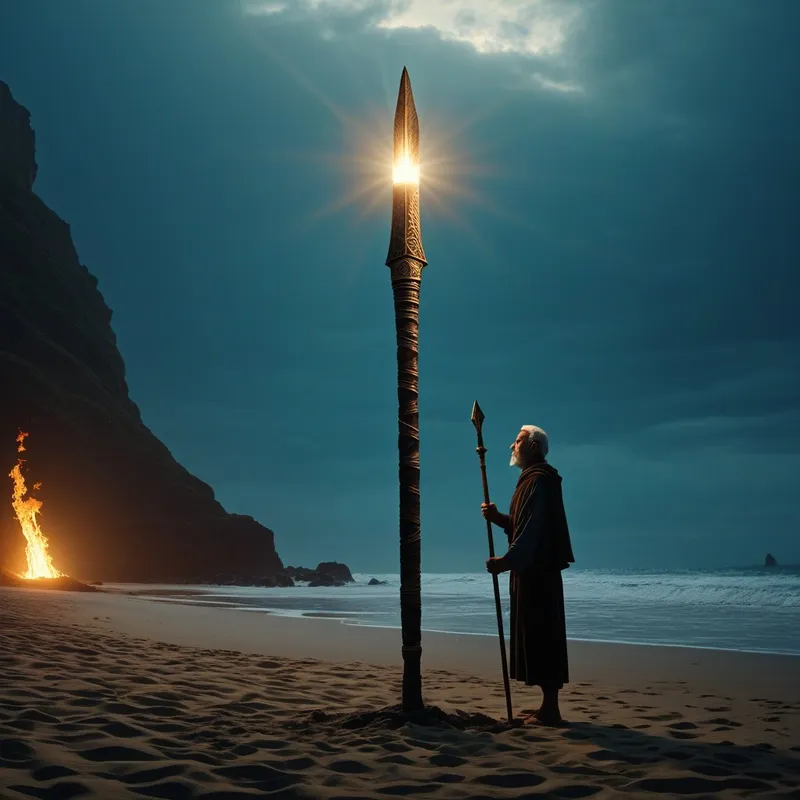
The spear, hewn from a sacred ash tree on Mount Pelion, was a gift from Chiron to Peleus, passed to Achilles, and a symbol of his fated, destructive power.
The Tale of Achilles’ Pelian Spear
Hear now the tale of the ash-wood spear, a story not of its point’s final strike, but of its long, silent becoming. Before the clamor of Troy, before the rage that shook the world, there was a mountain. Not the sun-baked rock of Olympus, but the deep, wooded slopes of Pelion, where the air smelled of damp earth and ancient bark.
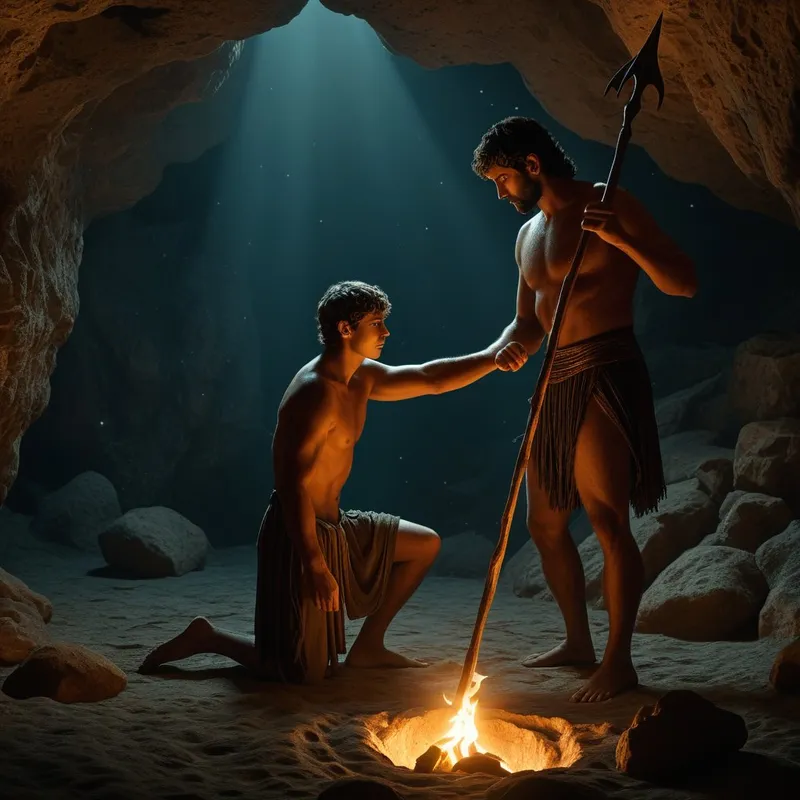
In a cave warmed by a single fire dwelled Chiron, his eyes holding the patience of centuries. Before him stood Peleus, a king, yes, but here a supplicant, a man soon to wed a goddess and tremble at the fate of his unborn son. Chiron spoke no hollow blessings. Instead, he led Peleus deep into the mountain’s heart, to a grove where a single ash tree stood apart. Its trunk was straight as a plumb line, its bark silver-grey in the gloom. “This tree,” Chiron’s voice was the rustle of leaves, “knows the weight of the sky. It was born when the world was young. It will bear the weight of a destiny.”
With hands that could set a bone or string a lyre, the centaur felled the sacred ash. The sound was not a crash, but a deep sigh that echoed through the valleys. He stripped the branches, not with an axe, but with a blade of obsidian, whispering prayers to the Dryads. For days and nights, he worked the wood, smoothing it until it was taller than two men, a shaft that thrummed with a latent power. He fitted it not with a common point, but with bronze smelted in a furnace stoked with herbs of prophecy. The spear was born—the Pelian Spear. A gift from the tutor to the father, a dowry for a destiny.
Years flowed like the river Styx. The son, Achilles, grew in Chiron’s cave, fed on lion’s marrow and wisdom. The day came when Peleus placed the great spear into his son’s hands. The wood, once cold, grew warm. The balance was perfect, as if the ash remembered the shape of the boy’s grip before he was born. It was not a weapon he chose; it was a limb he inherited.
Then, the sandy plains of Troy. Here, the spear found its voice. No other Achaean could wield it; its weight would crush them. But in Achilles’ hands, it became a blur of ash and bronze, a scythe that reaped Trojan princes. It was the tool of his aristeia, his moment of god-like glory. Yet, feel the paradox in the heat of battle: this gift from the gentle healer Chiron became the primary instrument of apocalyptic rage. When Patroclus fell, and Achilles’ grief curdled into a black, divine wrath, it was the Pelian Spear he took up. He drove it through the ranks with a sound like a hurricane, and finally, through the throat of the noble Hector. The ash wood, born in sacred silence, was now stained with the blood of a city’s heart. The gift had fulfilled its grim purpose. The story does not end with the spear’s breaking, but with its silent witness, leaning against a tent as its master, in turn, meets the fate the spear could not avert.
Cultural Origins & Context
This myth is woven into the epic tapestry of Homer’s Iliad, passed down through generations of oral bards before being crystallized in writing. Its function was multifaceted. On one level, it grounded the superhuman prowess of Achilles in a tangible, mythological reality. His strength wasn’t just personal; it was ancestral and divine, channeled through an object of lineage. The spear connected him to his father’s marriage, to his tutor’s wisdom, and to the primal, untamed power of the Pelian mountain itself.
In a culture deeply concerned with kleos (glory) and timē (honor), the spear was a physical symbol of both. It was an heirloom that conferred status, but also a burden that dictated a specific, violent path. The bards used it to highlight the tragic irony of the hero: his greatest tool, a gift of nurture and education from the civilized centaur, becomes the very engine of his most destructive, fate-sealing actions. It served as a narrative device to explore the tension between inherited destiny and personal action, a theme that resonated deeply in the Greek worldview, where the will of the gods and the choices of mortals were in constant, often deadly, dialogue.
Symbolic Architecture
The Pelian Spear is not merely a weapon; it is a dense node of symbolic meaning. It represents the Inherited Shadow of Power. From Chiron, the archetypal Senex, it carries the knowledge of healing, music, and civilization. From the sacred ash, it holds the raw, untamed power of nature. From Peleus, it bears the weight of mortal lineage and expectation. When passed to Achilles, it becomes the embodied paradox of his existence.
The tool given by the wise healer becomes the instrument of the fated destroyer. In this, we see the unconscious truth of inheritance: we are given not only strengths, but the specific forms our wounds will take.
The spear is his strength, but also his tether to a destructive fate. He cannot be Achilles without it, yet to wield it is to enact the very tragedy his mother Thetis tried to avert. Psychologically, it symbolizes the potent, often burdensome gifts of our lineage—the talents, the traumas, the core narratives that are handed to us before we have a choice. We must wield them, but we may not control the full scope of their consequences.
The Dreamer’s Resonance
When this myth stirs in the modern unconscious, it may manifest in dreams of finding an impossibly heavy, beautiful, or ancient object in one’s home—a family heirloom that feels both empowering and ominous. One might dream of a tree growing through the floorboards, its wood morphing into a tool or weapon. The somatic sensation is often one of potent, almost overwhelming energy in the hands and arms, coupled with a deep anxiety in the gut.
This dream pattern signals a psychological process of confronting one’s inherited complex. The dreamer is grappling with a potent aspect of their identity or capability that feels “given,” not chosen—a family profession, a natural talent, a generational trauma, or a prescribed role. The dream asks: Can you lift this weight? Do you have the strength for the destiny it implies? The anxiety points to the shadow side of the gift: the fear that accepting this power will lock one into a predetermined, perhaps isolating or destructive, life path, just as it sealed Achilles’ glory and doom.

Alchemical Translation
The alchemical journey modeled by this myth is the transmutation of the inherited object. The prima materia is the raw, fate-laden inheritance—the “Pelian Spear” as given. The process is not about rejecting the spear, but about attempting to change its nature through the fire of conscious relationship.
The first stage is Recognition: seeing the spear for what it is—not just a tool for glory, but a carrier of ancestral shadow. Achilles only perceives its power, not its symbolic weight, until it is too late. The modern individual must ask, “What is this gift, and what story of destiny or damage comes with it?”
The second is Confrontation: wielding the spear consciously, feeling its full weight and its consequences. This is the painful engagement with the complex, using the inherited talent or confronting the generational pattern in the full light of awareness, not on autopilot.
The final, elusive stage is Redirection. The myth shows us a failure in this, for Achilles never redirects the spear’s purpose; it serves only wrath and fate. The alchemical goal, however, is to take the same primal energy—the strength of the ash, the wisdom of Chiron, the lineage of Peleus—and forge it into a new form. Can the spear become a staff of leadership, a pillar of a new foundation, a bridge rather than a piercer? This is the work of individuation: to take what was given and, through the crucible of the conscious self, give it back to the world in a redeemed form, breaking the fatalistic cycle. The spear remains ash and bronze, but its telos is transformed.
Associated Symbols
Explore related symbols from the CaleaDream lexicon: