Achan's Hidden Treasure Myth Meaning & Symbolism
After Jericho's fall, a warrior secretly takes forbidden plunder, cursing his people until the hidden treasure is exposed and ritually purified.
The Tale of Achan's Hidden Treasure
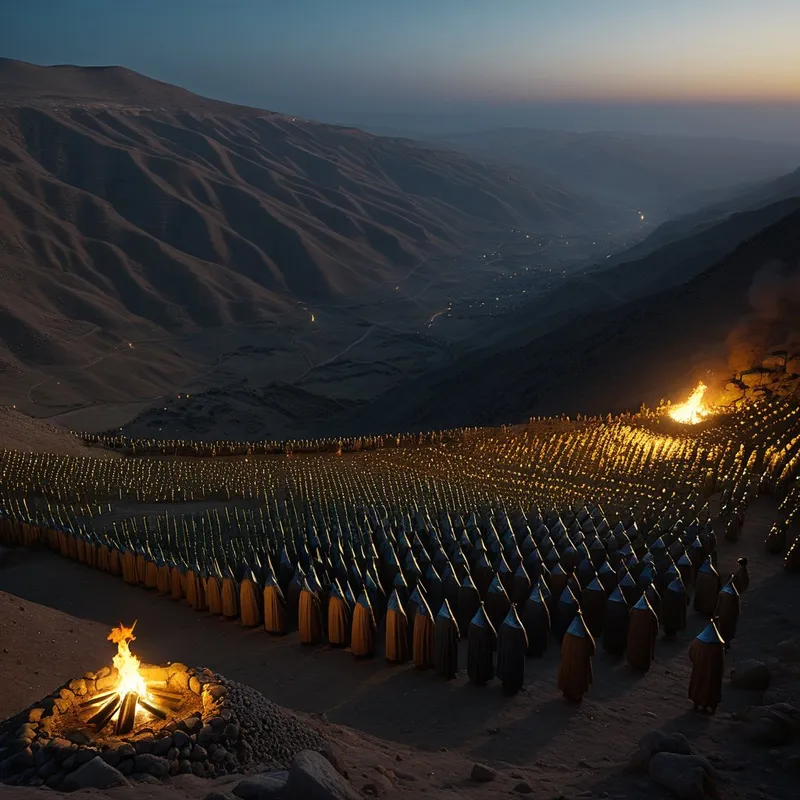
The dust of a shattered city still hung in the air, a bitter perfume of powdered brick and sacred ash. Jericho had fallen, not by sword or siege, but by the shofar’s blast and the shout of a people bound by a terrible vow. Joshua had spoken the decree of YHWH: the city and all within it were cherem, devoted to destruction. Not a thread, not a coin, not a crumb was to be taken. The spoils were an abomination, a seed of corruption that would poison the camp from within. The people heard, and they trembled, and they agreed.
But the eye sees what the heart already covets.
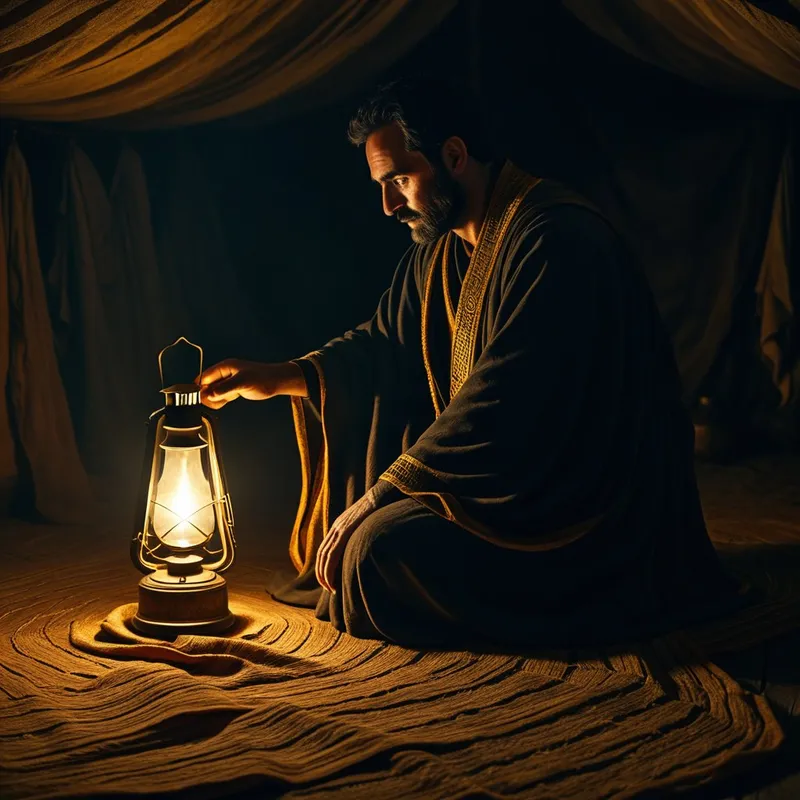
Among the thousands was Achan, son of Carmi, of the tribe of Judah. As the smoke cleared, he walked through the carnage, and his gaze fell upon it: a magnificent robe from Shinar, woven with colors that spoke of distant rivers and foreign gods. Beside it, a weight of silver that sang a cold, clear song, and a wedge of gold, heavy as a secret. The vow echoed in his ears, but the treasure whispered to his blood. In a moment that stretched into eternity, he reached. He took. He hid them in the earth beneath his tent, believing the darkness would keep his sin.
The curse did not announce itself with thunder. It arrived as a silent rot, a failure of spirit. When Joshua sent men to the next town, Ai, they were routed. Hearts that had been stone-strong melted like wax. Joshua tore his clothes and fell before the Ark of the Covenant, his voice a raw plea. "Why did you bring this people across the Jordan only to give us into the hands of the Amorites?"
The answer came, stern and unyielding. "Israel has sinned. They have taken some of the devoted things. They have stolen and lied. That is why they cannot stand before their enemies."
Dawn the next day brought a dread ritual. Tribe by tribe, clan by clan, family by family, man by man, they were brought near. The lot fell to Judah, then to the clan of the Zerahites, then to the house of Zabdi, and finally, it settled upon Achan. Joshua’s voice was grief and iron. "My son, give glory to the LORD, the God of Israel, and make confession to him."
Achan’s confession poured out, a flood of guilty detail. "It is true… I saw the robe, the silver, and the gold… I coveted them and took them. They are hidden in the ground inside my tent."
Messengers ran. They found the treasure, exactly as described, and brought it before all the people, laying it out before YHWH. Then they took Achan, the silver, the robe, the gold, his sons, his daughters, his oxen, donkeys, and sheep, his tent, and all that he had. The whole assembly brought them up to the Valley of Achor.
There, Joshua said, "Why did you bring trouble on us? The LORD brings trouble on you today." And all Israel stoned them, and burned them with fire. They raised over him a great heap of stones that remains to this day. Then the fury of the LORD turned away. The valley of trouble became, in that terrible moment, a door to hope.
Cultural Origins & Context
This narrative is embedded in the Book of Joshua, a text that sits at the fraught intersection of tribal memory, theological covenant, and national identity formation. It belongs to the Torah's historical shadow, detailing the violent entry into the Promised Land. The story of Achan functions as a critical etiological myth—it explains why a place is called the "Valley of Trouble" (Achor), and more importantly, it establishes a foundational principle of the Sinai Covenant: the collective responsibility of the community.
Passed down through priestly and deuteronomic traditions, the tale was not mere history but sacred law in narrative form. It was told to reinforce the absolute holiness (kadosh) required of the people and the dire consequences of breaching the boundary between the profane and the devoted-to-God (cherem). The storyteller, likely a priest or levitical teacher, used it to illustrate that the community’s fate was a single woven fabric; one hidden thread of disobedience could unravel the strength of the whole. It served as a stark warning against personal greed and the idolatry of foreign wealth, defining identity through purity and separation in a land filled with other gods.
Symbolic Architecture
At its core, this myth is a profound drama of the individual shadow corrupting the collective body. Achan is not a cartoon villain, but Everyman in the grip of an unintegrated desire. The forbidden treasure—the beautiful robe, the silver, the gold—symbolizes more than material wealth. It represents the allure of the "other," the psychic energy of the conquered world that is meant to be completely destroyed (i.e., consciously rejected or transformed) in the process of forging a new identity.
The treasure hidden in the tent is the undisclosed self, the secret life that feeds on the community's vitality while giving nothing back.
The treasure is cherem, meaning it exists in a state of dangerous, contagious holiness. It cannot be assimilated through personal possession; it must be collectively and ritually processed or it becomes a poison. Achan’s sin is not merely theft, but a failure of consciousness—an attempt to privatize a numinous, collective charge. The subsequent military defeat at Ai symbolizes the psychic paralysis that ensues when the group’s directed will (telos) is sabotaged by an unconfessed shadow element.
The ritual of the lot—the narrowing down from tribe to clan to family to man—symbolizes the inexorable process of truth-seeking consciousness closing in on a repressed complex. The confession, when it finally comes, is a brutal but necessary act of bringing the hidden into the light of collective awareness. The Valley of Achor, the place of trouble, becomes the very site of purification. The destruction of Achan, his family, and the treasure together is a horrific but symbolically complete act: the sin, its human vessel, and its tempting object are all eradicated, allowing the blocked energy (the favor of the LORD) to flow once more.

The Dreamer's Resonance
When this myth pattern stirs in the modern psyche, it rarely appears as a Biblical pastiche. Instead, one may dream of a hidden, beautiful but forbidden object in the basement of one's childhood home, or a secret room in an office building containing something that brings both thrill and dread. The somatic feeling is one of constriction, a sticky secret, a low-grade anxiety that something is "off" and sapping one's strength.
This is the dream of the unintegrated shadow complex actively sabotaging the ego's endeavors. The "Ai" in the dream might be a failed project, a collapsed relationship, or a persistent creative block—the place where one's forward momentum is mysteriously routed. The dreamer is experiencing the psychological cost of a split. Part of their energy is tied up in maintaining a hidden identification (the "treasure"), perhaps a grandiose fantasy, a nursed resentment, or an addictive pattern that is incompatible with their stated values and goals. The dream signals that this hidden element is no longer passive; it is actively creating "trouble" (Achor) in the external world, demanding recognition and conscious handling.

Alchemical Translation
The alchemical process modeled here is the separation and purification of the psyche, a necessary stage in the journey of individuation. The promised land—the goal of the conscious personality—cannot be entered or held while carrying undeclared, incompatible elements from the "ruins of Jericho," that is, from past phases of life, old identities, or unconscious inheritances.
The valley of trouble is the crucible of the self. One does not bypass it; one is transformed within it.
The first step is the painful realization that one's efforts are being mysteriously thwarted (the defeat at Ai). This forces a turning inward, a "falling before the ark" in prayerful self-examination. The next is the rigorous, often frightening process of the "lot"—using introspection, therapy, or honest dialogue to trace the source of the blockage back from general anxiety (the tribe) to the specific complex (Achan). The climax is the confession, not necessarily to another, but to oneself with full conscious acknowledgment: "I saw, I coveted, I took, I hid." This is the moment the shadow is brought into the light of ego-awareness.
Finally, the ritual destruction in the Valley of Achor. Psychologically, this is not a physical killing, but the conscious, deliberate, and often painful sacrifice of the treasured complex. One must "stone and burn" the hidden identification, relinquishing the secret pleasure, the nursed grievance, or the illicit fantasy. It is a total offering, leaving a "heap of stones" as a memorial—a permanent marker in one's psychic landscape that this is where a difficult but necessary integration occurred. Only through this ruthless honesty and sacrifice is the "fury" of the Self appeased, and the blocked libido released to flow toward the next stage of life. The trouble, fully faced, becomes the gate.
Associated Symbols
Explore related symbols from the CaleaDream lexicon: