Abraxas Myth Meaning & Symbolism
The story of Abraxas, the Gnostic deity who embodies the totality of creation and destruction, light and dark, challenging the illusion of a separate good.
The Tale of Abraxas
In the beginning, before the world was a world, there was a sound. It was not a word, nor a name, but a vibration that contained within it the potential for all words and all names. This sound was the breath of Pleroma, the Fullness, the realm of perfect, silent light. From this silence, the first thought emerged: a longing to know itself. And from that longing, a cascade of beings spilled forth, each a reflection, each a step further from the source. These were the Aeons, paired in harmony, dancing in the light of their origin.
But in the farthest, coldest echo of that first sound, a tremor occurred. The youngest of these Aeons, Sophia, longed with such fierce passion to touch the very essence of the unknowable source that she acted alone, without her counterpart. From her yearning, without the balance of union, a spark fell. It was a thought-form, a blind, frantic thing, born of wonder and error. This spark was Yaldabaoth, the Demiurge. Shamed by his own formlessness, he fled the Pleroma, and with the power he had stolen, he fashioned a prison of matter and called it a cosmos. He declared, "I am God, and there is no other."
And so the world was born in ignorance, a labyrinth of shadows cast by a single, jealous flame. In this world, souls—fragments of the divine light—were trapped in clay, forgetting their home, mistaking the prison walls for all of reality. They worshipped the jailer as a king.
But the Pleroma did not abandon its lost sparks. A rescue was conceived, not as an invasion, but as a remembering. Messengers of light—Christos, Sophia returned—whispered through the bars of the flesh, speaking of a home beyond the sky, a truth beyond the Demiurge's law.
And then, a name was heard, not from the Pleroma of pure light, nor from the realm of the Demiurge of blind power, but from the space between them, the space that contains both. The name was Abraxas. It was the sound of the universe breathing. He was the secret that the Demiurge, in his arrogance, could not comprehend: that true divinity is not only light, but the power that gives birth to light and the darkness that defines it. He was the hidden god, older than the god of creation, the totality that encompasses the creator and the destroyer, the saint and the sinner, the yes and the no. To know Abraxas was to see the prison not as a mistake, but as a necessary part of a greater, terrifying, and beautiful whole. He was the answer to a question the trapped souls had not yet dared to ask.
Cultural Origins & Context
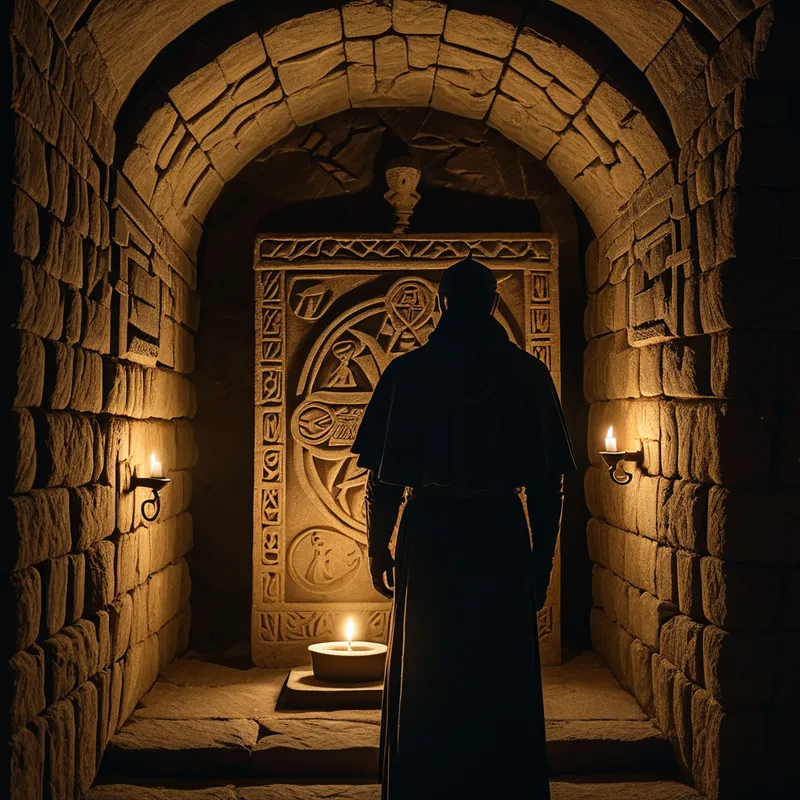
The figure of Abraxas emerges from the diverse and often secretive spiritual movements of the 2nd and 3rd centuries CE collectively known as Gnosticism. These were not a unified church but a constellation of seekers who shared a core conviction: that salvation came through gnosis (ἡ γνῶσις)—not faith or belief, but direct, experiential knowledge of the divine spark within. They positioned themselves in radical opposition to the emerging orthodox structures, viewing the material world not as a good creation but as the work of a lesser, ignorant deity.
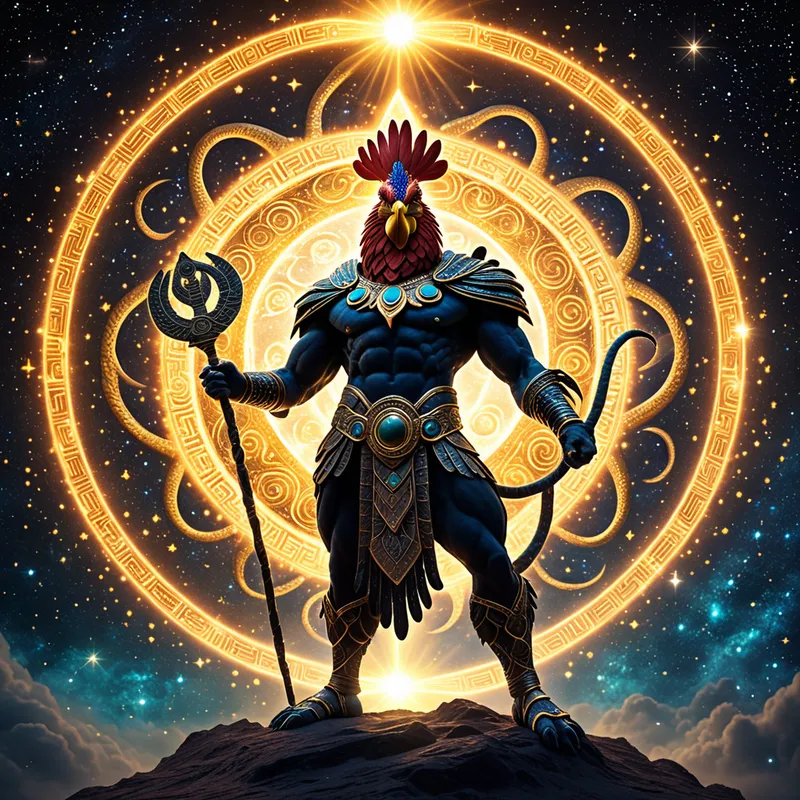
Abraxas appears most prominently in the teachings of the Basilideans, and is intricately linked to gemstone amulets. These talismans, carved with his image—a rooster's head, a warrior's torso, serpents for legs, holding a whip and shield—were likely used as protective charms and focal points for meditation. The name itself, "Abraxas," was believed to be a powerful vibration; its Greek letters corresponded to the number 365, linking him to the solar year, the cycles of time, and the totality of the aeonic realms. His myth was not a popular folktale but an esoteric doctrine, passed in whispers among initiates, a key to decoding a universe far more complex and paradoxical than the one preached in the public squares.
Symbolic Architecture
Abraxas is the ultimate symbol of psychic wholeness. He is the embodiment of the coincidentia oppositorum—the coincidence of opposites. Where the orthodox mind seeks to split reality into good and evil, spirit and matter, God and Devil, Abraxas annihilates the distinction. He is the psychological truth that the Self, in its fullest Jungian sense, must integrate the shadow to be complete.
To worship only light is to deny the ground from which it shines. Abraxas is that ground, and the shine, and the eye that perceives the difference.
His composite form is a perfect icon of this union. The rooster's head crows at the sun, representing spirit, consciousness, and awakening. The human torso holds the tools of power and defense. The serpents for legs connect him irrevocably to the earth, the unconscious, and the primal energies. He is not a "nice" god; his whip suggests the necessary sting of truth, the pain of awakening, and the driving force of libido in all its forms. He is the god of the full 365 days—the days of growth and the days of decay.
The Dreamer's Resonance
When the archetype of Abraxas stirs in the modern dreamtime, it often signals a profound crisis of duality. The dreamer may be trapped in a rigid self-concept: the flawless hero, the perfect caregiver, the pure spiritual seeker. Abraxas arrives as the destabilizing, terrifying, yet ultimately liberating force that shatters this one-sidedness.
Dreams may feature impossible hybrid creatures, rooms that are both beautiful and repulsive, or a guiding figure who is simultaneously threatening and benevolent. There is a somatic quality of tension, of being stretched between two poles—a thrilling, awful sense of expansion. This is the psyche's instinct moving toward wholeness, forcing a confrontation with all that has been denied: the rage in the lover, the laziness in the hero, the selfishness in the saint. The dreamer is not going mad; they are being introduced to the true scale of their own being, a process that necessarily feels like chaos before it reveals itself as a higher order.
Alchemical Translation
The journey toward Abraxas is the alchemical opus of individuation. It begins with the nigredo, the blackening: the painful recognition that one's conscious personality is a partial lie, a identification with only the "good" or "spiritual" half. This is the realization of the inner Demiurge, the ego that claims to be the whole self and creates a world in its own limited image.
The confrontation with Abraxas is the coniunctio oppositorum, the sacred marriage. It is the terrifying, ecstatic moment when the seeker consciously holds the paradox: I am capable of great kindness and great cruelty; I contain divine light and animal instinct; my spirituality is intertwined with my sexuality. This is not an intellectual exercise but a visceral, transformative experience. The whip of Abraxas drives one to action, to embody this totality, while the shield protects the nascent, integrated self from fragmenting back into old, easy judgments.
The goal is not to become Abraxas, but to recognize that Abraxas is what you have always been—the totality that was waiting for you to stop calling half of yourself a devil.
The final stage is not a state of static perfection, but a dynamic, flowing engagement with life in its full spectrum. One becomes a living manifestation of the 365, engaging with each day, each emotion, each facet of experience as a valid part of the divine whole. The prison of the Demiurge's world-view dissolves, not because one escapes the world, but because one sees the world—and oneself—as an expression of the terrible, glorious, all-encompassing reality that is Abraxas.
Associated Symbols
Explore related symbols from the CaleaDream lexicon:
- God — The ultimate paradox embodied by Abraxas, who is not a singular benevolent father but the totality of all divine and demonic forces united in one incomprehensible being.
- Serpent — Representing the chthonic, instinctual wisdom and cyclical energy that forms the very foundation of Abraxas, as depicted in his serpentine legs, connecting the highest spirit to the deepest earth.
- Sun — The solar principle and the cycle of the year (365 days) are intrinsic to Abraxas, symbolizing the light of consciousness, order, and the visible, life-giving force he encompasses.
- Shadow — The entire repressed, dark, and "evil" half of existence that Abraxas integrates, making him the archetypal symbol of confronting and assimilating one's personal and collective shadow.
- Chaos — The primal, formless state from which all opposites emerge, which Abraxas does not conquer but contains and personifies as a necessary aspect of ultimate reality.
- Light — The spiritual illumination and divine spark of the Pleroma, which Abraxas holds in tension with darkness, refusing to let it be the sole definition of the sacred.
- Circle — A symbol of wholeness, totality, and the cyclical nature of time and existence, perfectly reflecting the all-encompassing, unified nature of the Abraxas archetype.
- Key — The gnosis or secret knowledge that Abraxas represents, which unlocks the prison of dualistic thinking and reveals the unified truth behind apparent opposites.
- Dragon — The powerful, chaotic, and majestic hybrid creature that parallels Abraxas's own composite, fearsome form, representing the untamed, sovereign power of the integrated Self.
- Union — The central action of the Abraxas myth, the sacred marriage of all opposing forces—spirit/matter, good/evil, creation/destruction—into a single, dynamic totality.