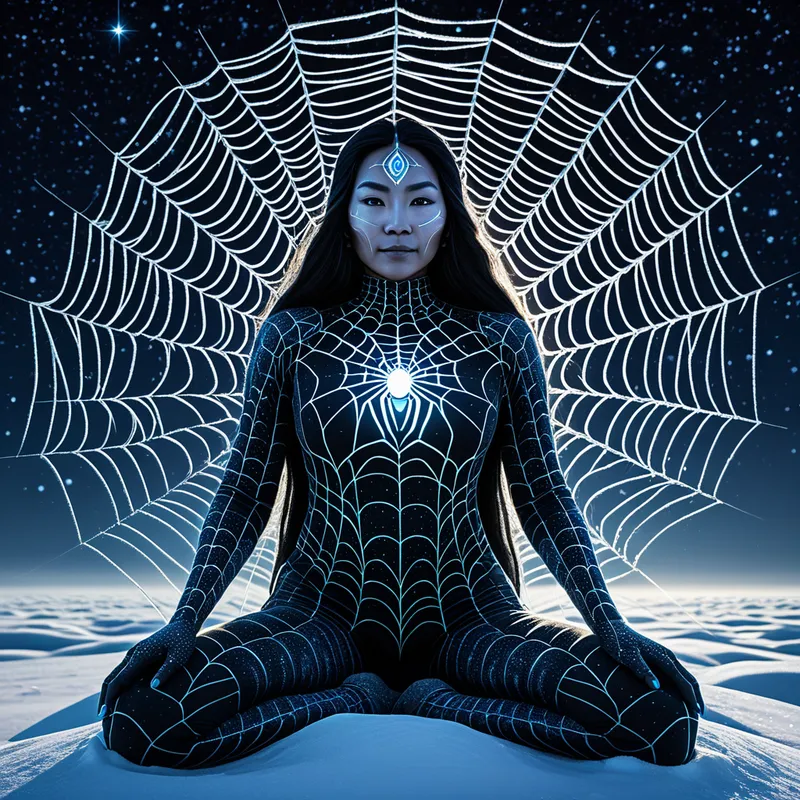
Aasivak the Spider Myth Meaning & Symbolism
A myth of a woman transformed into a spider, weaving the threads of life and fate, embodying resilience and the interconnectedness of all things.
The Tale of Aasivak the Spider
Listen, and hear a story from the time when the world was still being dreamed into shape, when the ice sang and the wind carried voices of the old ones. This is the tale of Aasivak.
In a village by the great frozen sea, there lived a woman of great skill. Her fingers were clever, her mind sharp. She could sew a parka so tight it turned back the breath of the fiercest storm. She could weave sinew into cord stronger than a walrus hide. But Aasivak was alone. In her solitude, she turned her genius inward, to the making of things not just for survival, but of breathtaking beauty. She wove patterns into belts that told stories of the hunt, she fashioned amulets that seemed to hold moonlight.
Yet, her very excellence bred a silent resentment among some. A whisper began, carried on the cold air: her skill was too great. It was unnatural. It must come from a pact with hidden forces, from a turning away from the communal spirit. The whispers grew into accusations, a chilling fog that isolated her further. One night, under a bruised purple sky, the accusation became decree. She was cast out, banished from the warmth of the communal hearth, sent onto the barren ice with nothing but her sewing kit.
The cold was a living beast. The wind scoured her skin. In her despair, as death’s sleep began to pull at her, Aasivak made a final, desperate act of creation. With her last lengths of sinew, with her frozen fingers, she began to weave. Not a mitten, not a hood. She wove a net, a strange, looping structure, a cage or a cradle for her own failing spirit. She sang a low, humming song to it, a song without words, filled with all her loneliness, her skill, her love for making, and her grief at being unmade.
As she tied the final knot, the world shifted. The sinew threads became part of her, multiplying, extending. Her body transformed, becoming both woman and something else entirely. She felt the vast, humming network of life on the tundra—the lemming in its burrow, the ptarmigan under the snow, the great bear in its den. She was no longer in the world; she was of it, connected to every thread of existence. She had become the Spider Woman, Aasivak. From that day, she did not walk the earth but dwelled in the spaces between, her web the very fabric of connection, fate, and delicate balance. She became the weaver of life’s pattern, a silent witness to all stories, her creation born from the very act of her destruction.
Cultural Origins & Context
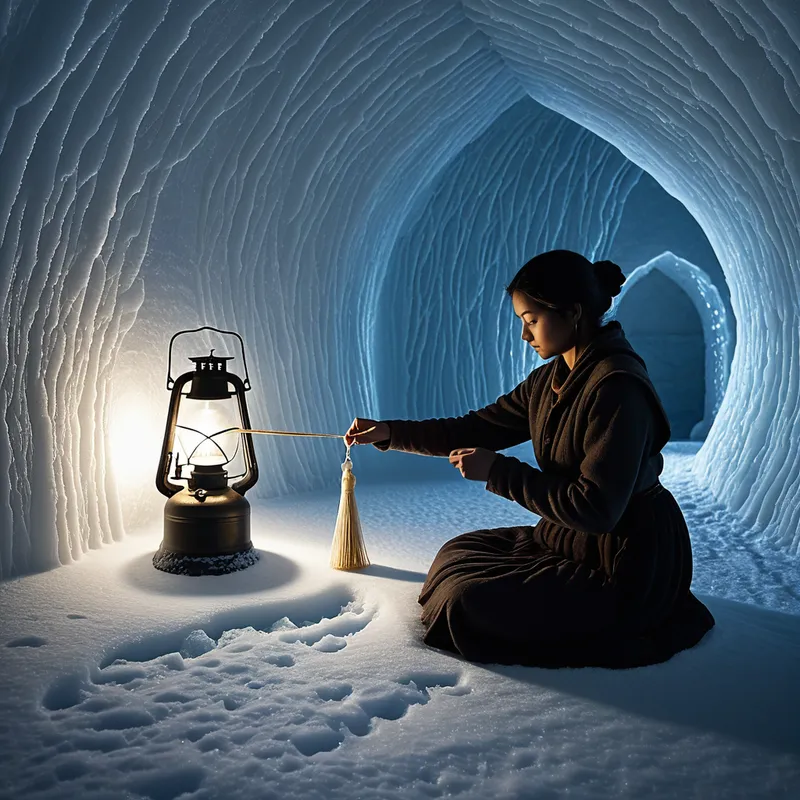
The stories of Aasivak belong to the rich oral traditions of the Inuit peoples across the Arctic regions of Alaska, Canada, and Greenland. These narratives were not mere entertainment; they were the living encyclopaedia of a people, encoding survival knowledge, social values, and cosmological understanding. Told during the long winter nights in the qarmaq or sod house, the rhythm of the story worked in tandem with the flickering seal oil lamp, making the images dance in the listeners' minds.
Elders, the keepers of this knowledge, would narrate tales of Aasivak to illustrate profound truths. For a culture surviving in an environment of extreme scarcity and interdependence, the myth served multiple functions. It warned against the dangers of envy and social exclusion, which could literally mean death on the ice. Simultaneously, it honoured the vital importance of skill (Inuinnauq) and creativity, even when misunderstood. Most importantly, it presented a model of the universe as an interconnected web, where every action, every creature, is a thread in a larger, sacred design. Aasivak’s transformation offered a spiritual explanation for the delicate, visible webs of frost on the tundra grass—seen as her literal handiwork, a reminder of the invisible connections binding all life.
Symbolic Architecture
At its heart, the myth of Aasivak is a supreme allegory for the transformative power of creative suffering. The spider is the ultimate symbol of the creator, but here, creation is not an act of primal fiat; it is an alchemy born of profound crisis. Aasivak’s exile represents the soul’s darkest night, the point of utter isolation where the old identity is shattered by the cold judgement of the collective.
The most profound creation often springs not from abundance, but from the void left by destruction. The self is woven from the very threads of its own unraveling.
Her weaving in the face of death is the critical act. It is the ego’s last, instinctive move toward meaning-making. The web she creates is a symbolic blueprint of the psyche itself—a central point of consciousness (the self) from which radiate lines of connection to all complexes, memories, and archetypal forces (the environment, the community, the spirits). Her physical transformation into the spider signifies a permanent psychic shift: she no longer identifies solely with the individual ego-personality but with the larger, animating pattern of life. She becomes the embodiment of the Self, the organizing principle of the psyche that connects all parts. The web, therefore, is not a trap but a map of wholeness.
The Dreamer's Resonance
When the archetype of Aasivak stirs in the modern dreamer, it often signals a profound process of psychic re-weaving. To dream of spinning webs, of being a spider, or of being caught in a beautiful, intricate web speaks to a confrontation with one’s own fate and interconnectedness.
Somatically, this might manifest as a feeling of being “pulled in many directions” or a tight, fibrous tension in the hands and chest—the body remembering the act of weaving and the constriction of exile. Psychologically, the dreamer is likely undergoing a period where old social identities or roles are falling away (the banishment). There is a deep, often lonely, engagement with one’s innate skills or creative drives (the weaving). The dream may feel claustrophobic yet strangely purposeful.
The appearance of the Spider is an invitation from the unconscious to stop fighting isolation and to begin, consciously, to spin. To use the very material of one’s loneliness, grief, or alienation as the thread to craft a new, more expansive understanding of oneself. It is the psyche’s instruction to move from being a victim of circumstance to becoming the architect of one’s own meaningful pattern within the larger whole.
Alchemical Translation
The individuation process mirrored in Aasivak’s journey is one of transmutation through creative engagement with the shadow. The initial state is one of conscious skill and value (her sewing), which paradoxically attracts the projection of the community’s shadow—their unacknowledged envy and fear. Her banishment is the nigredo, the blackening, the descent into the chaotic, frozen state of the unrecognized self.
The crucible of exile is where the soul learns to spin gold from the straw of its own abandonment.
Her act of weaving on the ice is the albedo, the whitening. It is the first conscious, purposeful work done in the depths. She does not try to return to the old village (regression) or simply lie down to die (identification with the victim). She engages her core faculty. This work with the “prima materia” of her life—her skills, her memories, her suffering—initiates the transformation. The moment of becoming the Spider is the rubedo, the reddening, the attainment of a new, enduring psychic state. The ego is not inflated; it is relocated. It becomes the conscious center of a vast, interconnected network.
For the modern individual, the alchemical instruction is clear: when life delivers a cruel frost, one must begin to weave. Identify the core thread of your unique skill or passion—your “sinew.” Use it to make meaning, even if no one else yet sees the pattern. The goal is not to escape the web of relationships and fate, but to consciously become the weaver at its center, understanding that your thread is essential to the integrity and beauty of the whole tapestry of being.
Associated Symbols
Explore related symbols from the CaleaDream lexicon:
- Spider — The central archetype of the creator-weaver, representing the ability to spin destiny from one's own substance and to perceive the interconnected web of life.
- Spider's Web — The symbolic architecture of the psyche and the cosmos, a map of fate, relationship, and the delicate, beautiful interconnection of all things.
- Journey — The path of exile and transformation, moving from the known social world into the barren wilderness of the self to achieve a higher state of being.
- Destiny — The pattern woven into the web, representing the fate one both suffers and actively creates through choices and creative acts.
- Transformation — The radical metamorphosis of Aasivak from human to spider, symbolizing profound psychic change and the birth of a new archetypal identity.
- Creation — The fundamental act of weaving, which here is an act of survival and world-making, turning raw material (sinew, suffering) into meaningful structure.
- Shadow — Represented by the community's envy and the act of banishment, the rejected parts that ultimately force the necessary crisis of transformation.
- Fate — The threads of the web, which are both predetermined and constantly being respun by the actions and consciousness of the weaver.
- Isolation — The essential, painful precondition for the deep inner work of weaving a new self, symbolized by the exile onto the barren ice.
- Skill — The practical intelligence and dexterity (Inuinnauq) that becomes the literal and metaphorical tool for salvation and transcendence.