Aaron's Rod Myth Meaning & Symbolism
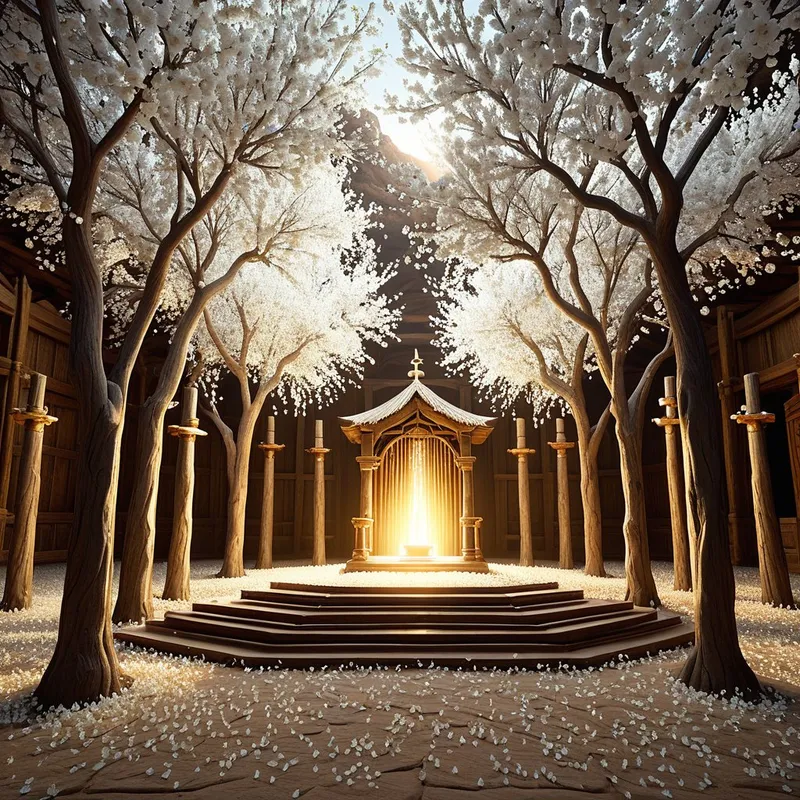
A barren staff, chosen by God, miraculously blossoms with almonds, silencing dissent and revealing divine authority through living proof.
The Tale of Aaron's Rod
The air in the Tabernacle was thick with the scent of incense and discontent. A murmur, low and persistent as desert wind, had grown into a storm of voices. "Who is Aaron," they grumbled, "that he alone should stand closest to the Holy? Are we not all holy? Does the spirit of the Lord not dwell among us all?"
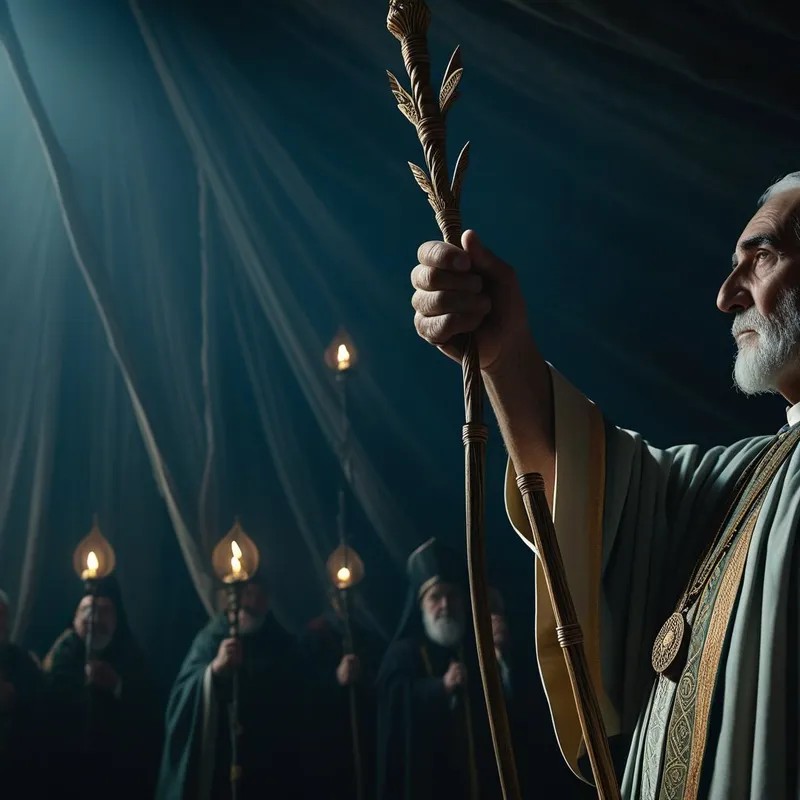
The weight of their rebellion pressed upon Moses, a burden heavier than stone. In the silence of the Tent of Meeting, a directive came, clear and uncompromising. From each of the twelve tribes, a staff was to be taken—one from each ancestral house, from every leader. Twelve rods of dead wood, stripped of bark, bearing only the name of the man who carried it. These were to be laid before the Ark of the Covenant, in the profound darkness of the Holy of Holies. "And the staff of the man I choose," spoke the voice of the Lord, "will sprout. I will make this grumbling against me cease."
So it was done. The leaders, solemn and skeptical, brought their staffs. The staff of Levi bore the name of Aaron. They were placed side by side on the cold ground, twelve identical symbols of earthly authority, twelve pieces of lifeless timber. The heavy curtain was drawn shut. For a night, the rods lay in the palpable presence of the Divine.
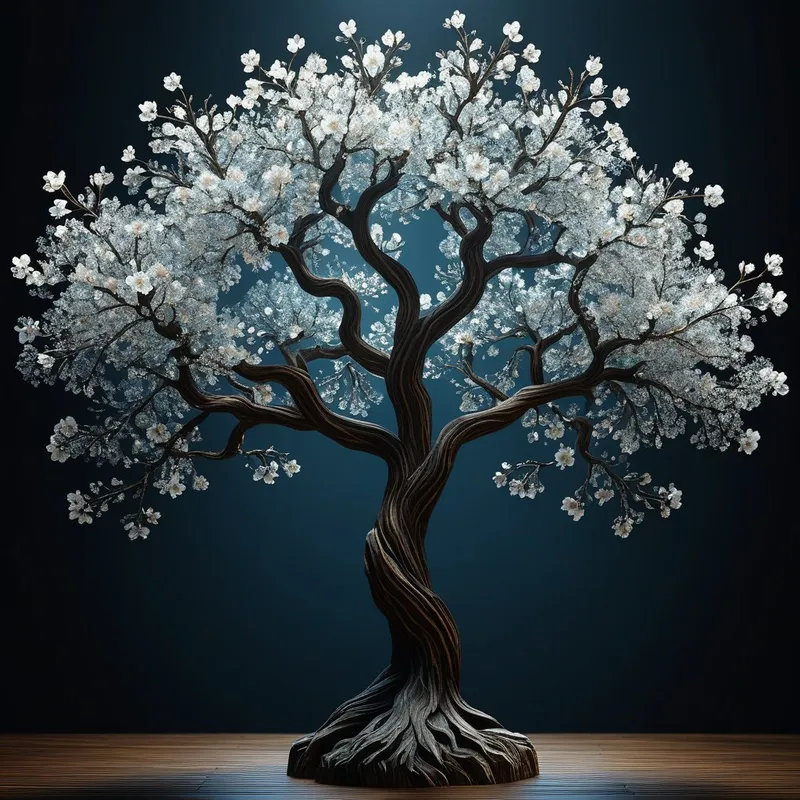
When Moses entered at dawn, the sight stole his breath. There, in the gloom, one staff was no longer dead. From the rod of Levi, from Aaron's named wood, life had erupted in a silent, glorious defiance. It had put forth buds, swelled into blossoms of the most delicate white, and ripened into perfect almonds. A full cycle of life—conception, flowering, fruition—had occurred in the space of a single, sacred night. The other rods lay as they were: barren, unchanged.
Moses brought all the rods out before the eyes of the assembled people. The evidence was incontrovertible, a miracle not of thunder or plague, but of quiet, generative power. Each man reclaimed his own barren staff. But Aaron's rod was commanded to be kept before the Ark, a permanent testimony, a sign for the rebels. The murmuring died, swallowed by awe. The chosen vessel had been revealed not by decree alone, but by the undeniable, living fruit of the spirit itself.
Cultural Origins & Context
This narrative is embedded within the Book of Numbers (Chapter 17), a text concerned with order, lineage, and sacred authority during the Israelites' wilderness wanderings. It functions as a divine ratification of the Aaronic priesthood following a severe challenge from Korah and other leaders. The story served a critical societal function: to end disputes over priestly and leadership roles by appealing to a direct, miraculous sign from Yahweh.
Passed down through priestly and later rabbinic traditions, the tale reinforced the theology of divine election. Authority was not merely a human appointment but was authenticated by supernatural fecundity. The artifact of Aaron's rod subsequently became part of the legendary treasures of the First Temple, symbolizing the enduring and God-given nature of the priestly covenant. It was a story told to remind the community that true spiritual authority is validated by its life-giving capacity, not merely by tribal lineage or political power.
Symbolic Architecture
At its core, the rod is a symbol of authority—but it is authority of a specific kind. It begins as a dead thing, a tool, a piece of the natural world stripped of its vitality. It represents law, structure, and the potential for correction or punishment. The miracle transmutes this symbol entirely.
The true staff of authority is not the one that subjugates, but the one that blossoms.
The almond tree (shaqed in Hebrew) is profoundly significant. Its name is a pun on the Hebrew word for "watchful" (shoqed), as it is the first tree to awaken from winter's sleep. Thus, Aaron's rod symbolizes watchful, quickening divine authority. The buds, blossoms, and ripe fruit appearing simultaneously represent the compression of sacred time—promise, manifestation, and fulfillment existing in one eternal moment. Psychologically, the rod represents the ego's claim to power, while the blossoming signifies the moment that claim is validated by, and subsumed into, a greater life-giving force from the Self, the central archetype of wholeness.
The Dreamer's Resonance
When this mythic pattern stirs in the modern psyche, it may manifest in dreams of dead wood coming to life: a withered houseplant sprouting new leaves, a fallen log in a forest glowing with fungus or cradling a nest, or a simple pencil on a desk suddenly putting out roots. The somatic sensation is often one of surprise and deep relief, a loosening in the chest.
This dream imagery signals a critical psychological process: the validation of one's authentic vocation or authority from a deep, inner source. The dreamer may be struggling with imposter syndrome, feeling like a "barren staff" in their professional or creative life, or facing external challenges to their rightful role. The blossoming rod is the unconscious affirming, "Your authority here is legitimate because it is fruitful. It gives life." It marks the end of an internal "rebellion" of self-doubt and the beginning of an authority grounded not in arrogance, but in generative, organic proof.
Alchemical Translation
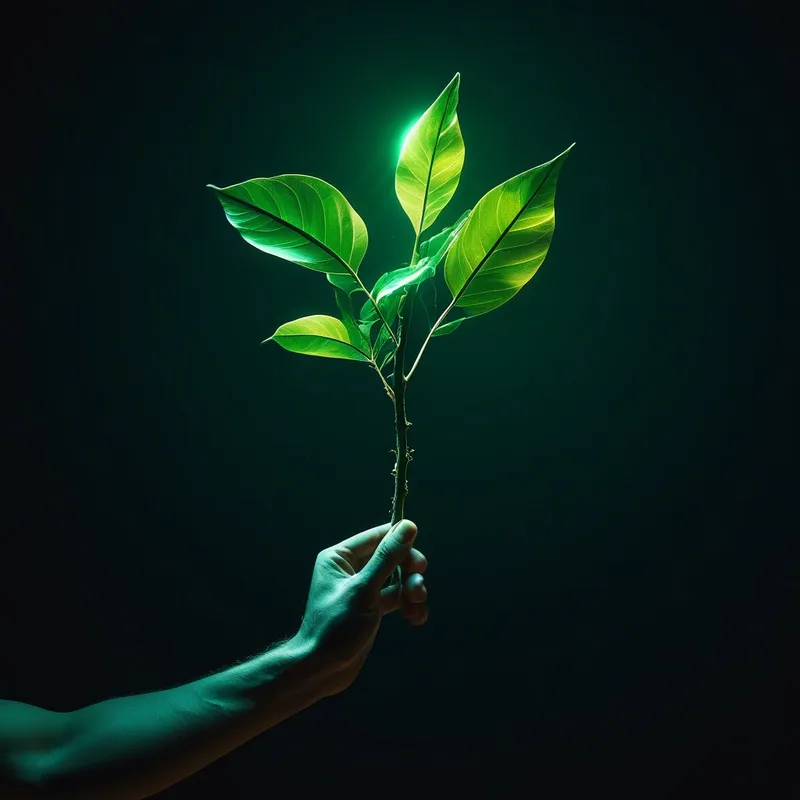
The alchemical journey mirrored here is the transmutation of the dry, rigid principle (Saturn) into the living, fruitful principle (Mercury/Luna). The initial state is one of petrificatio—everything is rigid, defined by law, competition, and barren comparison (the twelve identical rods). The conflict—the grumbling, the doubt—provides the necessary heat (calcinatio).
The night before the Ark is the solutio, the dissolution in the divine waters of the unconscious. Here, in the dark, the chosen vessel does not merely resist dissolution but is fertilized by it. The miracle is the coagulatio—the return to form, but now imbued with spirit. The dead wood (the old, rigid identity) becomes the vessel for a new, living reality.
Individuation often requires that our chosen tool—our career, our art, our role—must first be experienced as dead wood before it can be resurrected as a living tree by the Self.
For the modern individual, this myth models the process of moving from seeking external validation to embodying internal, fruit-bearing authority. We are asked to lay our "staff"—our claim to a role, a talent, a path—before the ultimate inner authority (the Ark/Self). We must let it sit in the darkness of unknowing. The outcome is not guaranteed by effort alone. But if the claim is true to the deep Self, it will be returned to us, not as we left it, but miraculously alive, blossoming with unexpected creativity and bearing the nourishing fruit of meaning. The rod is kept as a permanent reminder: true power is always viriditas, the greening power, the ever-watchful force of life asserting itself through form.
Associated Symbols
Explore related symbols from the CaleaDream lexicon: