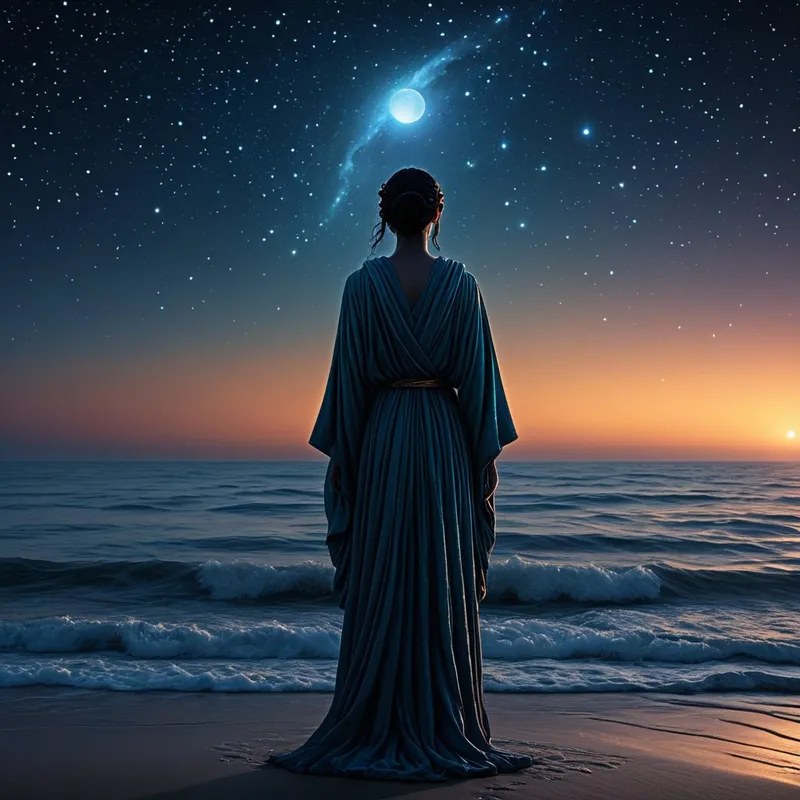
A Vesper Myth Meaning & Symbolism
A myth of a twilight deity who gathers the day's fragments to weave the night, embodying the sacred pause where all transformation begins.
The Tale of A Vesper
Listen, and let the breath of the world grow still. For there is a moment that is not day, and not yet night—a sliver of time so thin it can cut the soul. This is the domain of A Vesper.
Before the first star pins itself to the deepening blue, before the creatures of the dark dare to stir, the air grows heavy with the scent of damp earth and spent light. It is then that They come. You will not see a form, not at first. You will feel a presence like a held breath, a softening of the edges of all things. The clamor of the day—the shouted triumphs, the silent wounds, the half-finished thoughts, the dropped tools—all of it falls into a profound and waiting silence.
From this silence, A Vesper emerges. Not as a figure of flesh, but as an intention made visible: a shimmer in the air where light bends, a whisper that is the aggregate of every sigh released at day's end. Their work is not creation, but curation. With hands unseen, They move across the world's table.
They gather the sun's last, desperate rays, fractured by branches and window panes. They collect the fallen petal from the noon bloom, the forgotten promise spoken at dawn, the bead of sweat from the laborer's brow now cool. They sweep up the echoes of arguments and the ghost of laughter that lingers in empty courtyards. All the fragments, the beautiful and the broken, the completed and the abandoned, are drawn into Their gathering cloak, which is the sky itself turning to indigo.
This is the sacred pause. The world hangs in the balance. In that hushed suspension, A Vesper does not judge, does not repair. They simply hold. They are the cup that receives the pour of the day. And when the cup is full to brimming with the collected essence of what has been, They turn.
With a motion that is the universe inhaling, A Vesper weaves. From the gathered fragments, They do not make a replica of the day. They spin a new thing: the night. The forgotten promise becomes a distant, winking star. The tear and the laugh together become the soft gradient of the Milky Way. The spent strength of the sun becomes the deep, velvety darkness that cradles the seeds in the soil, that allows the roots to drink, that gives the mind permission to dream.
And as the first true star blazes forth, A Vesper dissolves. Not into nothing, but into the condition of the night itself—into potential, into rest, into the fertile void from which the next day must be born. The threshold is crossed. The transformation is complete.

Cultural Origins & Context
The myth of A Vesper finds its roots not in a single civilization, but in the universal human experience of the crepuscular hours—the "tween times" of dusk and dawn. It is a folkloric motif that appears in the interstitial spaces of many cultures, often as a personification of the evening star (Hesperus) or the liminal moment itself. It was not a myth of state or temple, but a hearth-story, told by elders as lamps were lit, or murmured by parents to settle children as the light failed.
Its societal function was profoundly psychological and practical. It served as a narrative container for the daily ritual of closure. In an age without electric light, the onset of night was a powerful, non-negotiable transition. The myth provided a sacred logic for this shift: the day was not merely ending in failure or darkness; it was being received, its value harvested by a conscious, benevolent presence. It transformed the anxiety of diminishing light into a ceremony of offering. The story taught that nothing of the day was truly wasted; all experiences, raw and unprocessed, were raw material for the cosmos's own alchemy.
Symbolic Architecture
A Vesper is the archetypal personification of the limen—the threshold. They represent the psychic function that manages transitions, not by rushing through them, but by honoring the sacred pause in between.
The threshold is not a line to be crossed, but a chamber to be inhabited. It is the crucible where the lead of daily experience is held before it can become the gold of understanding.
Psychologically, A Vesper symbolizes the capacity for reflection and integration. The "fragments" They gather are the disparate elements of our conscious experience: memories, emotions, interactions, and sensations that we have not had time to assimilate. A Vesper does not judge these fragments as good or bad; They acknowledge them as existent, as part of the day's yield. This non-judgmental containment is the first and necessary step toward inner unity.
The act of weaving the night from these fragments symbolizes the unconscious process that occurs when we sleep and dream. Our psyche takes the day's residues and recombines them into the symbolic narratives of dreams, facilitating memory consolidation, emotional processing, and problem-solving—creating the "night" of the unconscious, which is essential for the "day" of consciousness to have meaning.

The Dreamer's Resonance
When the pattern of A Vesper stirs in modern dreams, it often manifests as a profound somatic sense of pause. One might dream of standing utterly still in a place of transition—a doorway, a bridge, a train platform—feeling neither urge nor ability to move forward or back. The dream environment is typically quiet, hushed, lit by twilight or a single source of soft, directional light.
The psychological process at work is one of forced integration. The conscious ego, which drives us relentlessly through the day's agenda, is temporarily suspended. In this pause, the contents we have repressed, ignored, or simply not processed rise to the surface. We may see scattered objects from our waking life, hear echoes of conversations, or feel the presence of a calm, observing entity (the dream-self as A Vesper). The dream is presenting an opportunity—or imposing a necessity—to "gather the fragments." It is the psyche's way of insisting, "Before you move on, you must first collect what you have left behind." The anxiety or peace felt in such a dream is a gauge of our relationship with our own unintegrated experiences.
Alchemical Translation
The alchemical journey mirrored in this myth is the Nigredo, not as a morbid end, but as the essential first stage of transmutation. In individuation—the process of becoming a psychologically whole individual—we cannot move toward the gold of the Rubedo without first passing through the black.
The work of the soul begins not in striving for light, but in the conscious descent into the gathering dusk of all that has been avoided.
The modern individual, perpetually in motion, fears the pause. To stop is to risk being overwhelmed by the backlog of unlived life, unattended grief, and unacknowledged joy. The myth of A Vesper provides a model for this critical phase. It teaches us to become our own Vesper.
The "alchemical translation" is a daily practice: the conscious, ritualistic pause at the day's end. This is not merely reviewing a to-do list, but engaging in a non-judgmental recollection—gathering the fragments of feeling, success, failure, and interaction. It is the journal entry, the silent meditation, the walk without a podcast. In this space, we hold our experiences in the vessel of awareness, as A Vesper holds the twilight. We do not rush to fix or analyze; we simply acknowledge and contain.
From this gathered material, the unconscious "weaves the night." It processes what we have consciously held. The transformation occurs in the dark, in sleep, in the depths we cannot control. The new day then dawns not from sheer willpower, but from the integrated substance of the previous one. We cross the threshold renewed, not because we escaped our experiences, but because we allowed them to be transformed in the sacred pause. We learn that our wholeness depends not on constant illumination, but on our respectful relationship with the gathering dusk.
Associated Symbols
Explore related symbols from the CaleaDream lexicon: