
The Alchemy of Absence: Dreaming the Void
The Somatic Echo
It arrives not as a thought, but as a condition of the body. A hollowing out behind the sternum, a gravity well in the gut. It is the feeling of standing in a familiar room and finding the air has turned to liquid lead, thick and resistant. Your breath becomes shallow, not from panic, but from a profound atmospheric shift—as if the psychic pressure has dropped, leaving you in a silent, weightless chamber of your own interior. This is the somatic signature of the Void: a visceral experience of negative space becoming palpable. It is the system sensing a deletion in the code of your identity, a missing subroutine where a belief, a role, or a connection once hummed. The mind will rush to label it loneliness, grief, or failure, but those come later. First, it is pure, unmediated sensation—the architecture of the self registering an empty room.
The Dreamer's Log
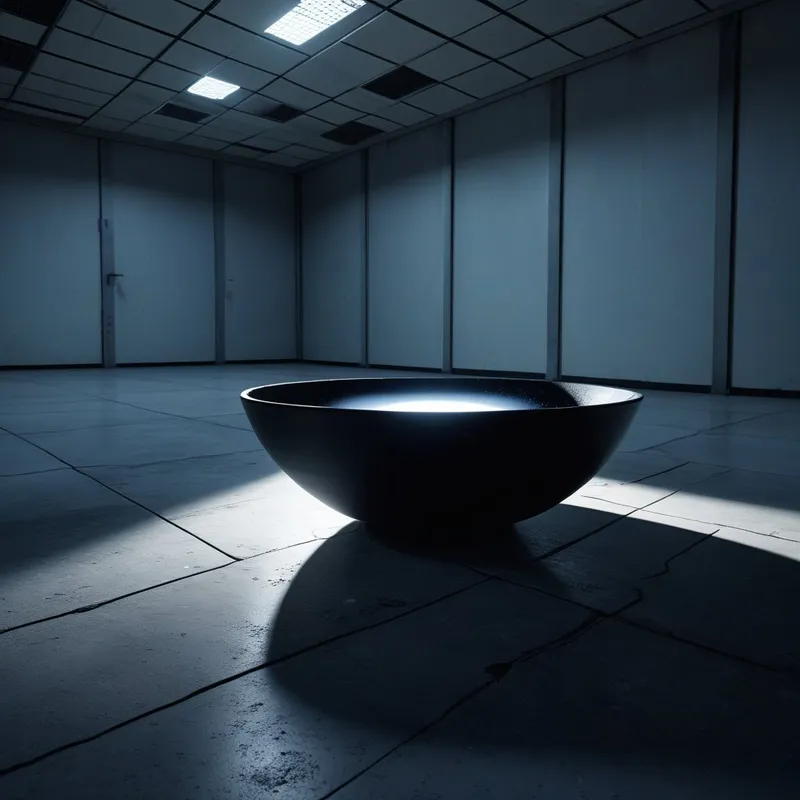
I am in my childhood home, but every object is gone. Not stolen, but erased. The walls, floors, and ceilings remain, pristine and white, but there is no furniture, no art, no dust. I walk into the kitchen and find a single, smooth black bowl on the floor. It is empty. I know, with dream certainty, that I must fill it, but I have nothing to give. The knowing itself becomes the void.
Alchemical Interpretation: The dream presents the ego’s structure stripped of its historical contents, forcing a confrontation with the foundational vessel of consciousness itself—the empty bowl that must be filled not from memory, but from source.
The False Lead
This theme is not about circumstantial loss or transient melancholy. To mistake the Void for mere “bad luck” or a passing mood is to confuse the ocean for a puddle. The Void is structural. It is not the grief of a relationship ending, but the terrifying freedom of the identity formed around that relationship dissolving. It is not the anxiety of unemployment, but the silent scream of the professional persona, now obsolete, echoing in a suddenly vacant internal office. The Void is the shadow of creation, the necessary blankness that precedes the new sentence. To interpret it as only deprivation is to stand at the edge of a new continent and see only the empty sea behind you.
Psychological Architecture
When you dream the Void, you are not witnessing collapse, but deconstruction. The psyche’s internal family system—those well-worn roles of the Inner Critic, the Pleaser, the Achiever—has gone quiet. Their chairs in the council chamber are empty. This is the Shadow work of absence: it asks you to sit in the silence without rushing to rehire the old management. This is the individuation process in its most raw form, where you are severed from the collective and the personal to face the impersonal. It is the ego’s winter. The land is fallow. Every previous identity, every “I am this…” or “I am that…” statement, feels like a lie echoing in a cavern. The process is one of unbecoming. The pressure is the agony of non-identity, the heat is the fear that nothing will ever grow again. Yet, this is the precise condition required for the authentic self, the one that exists beyond adaptation and agreement, to be glimpsed—not as a new image, but as the awareness that perceives the emptiness itself.
Mythic Resonance
We see this eternal process in the Babylonian myth of Tiamat, the primordial saltwater chaos, the void-as-womb from which all forms are born and to which they return. She is not a monster to be slain, but the fundamental, formless ground of being that the hero-god Marduk must engage to create the world. Similarly, in the Buddhist parable, the disciple is asked to bring a painting of the finest horse. The master praises not the detailed brushstrokes, but the vast, empty spaces of the scroll, for they are what give the horse room to run. The Void is this Tiamat-sea, this essential negative space—the unformed potential that is the prerequisite for any authentic creation. It is the universe’s firmware for resetting a corrupted program.
Symbolic Nodes
- Endless, featureless plains or oceans.
- Empty rooms, halls, or containers (vases, bowls, boxes).
- Blank pages, screens, or canvases.
- Silent phones or communication devices with no signal.
- Missing objects in otherwise familiar settings (the absent book, the vanished door).
- Transparent or invisible barriers.
- Starless, moonless night skies.
Archetypal Resonance
The Shadow Creator is the archetypal force most active in the theme of the Void. This is not the Creator in its generative, artistic flow, but its inverted aspect: the architect staring at the blank blueprint, the artist paralyzed before the empty studio. Its core energy is the terror of the unmanifest, the dizzying freedom of pure potential that curdles into a sense of impotence and self-centered despair (“I have nothing to say, therefore I am nothing”). The somatic echo of hollowness is its native climate. Yet, within this shadow lies the alchemical potential of the theme: the Shadow Creator holds the raw, unfiltered material of genesis. To move through its paralysis is to realize that the void is not a judgment, but the first and most essential tool of the true Creator—the silent space from which all original meaning must courageously emerge.
The Alchemical Process
The transmutation here is from Terror of the Empty to Sovereignty of the Source. The alchemical nigredo, the blackening, is this very experience of dissolution and void. The required heat is the courage to stay in the absence without reflexively filling it. The pressure is the societal and internal panic that screams, “Become something! Define yourself!” The process is one of radical subtraction and patience. You must let the old identities fully burn away until only the ground of awareness remains. Then, a slow, organic fermentation begins. From the stillness, a new question arises, not “What should I put here?” but “What wants to emerge from here?” The void ceases to be a lack and becomes a listening vessel. Sovereignty is born when you realize you are not the object that fills the bowl, but the hand that holds it—and more, you are the substance from which both bowl and content can be formed. The emptiness becomes fertile, a dark soil.

The Integration Protocol
Question 1: Where in my waking life do I feel a similar atmospheric hollowness or resistance—not about a specific problem, but about the very ground of a role or belief I hold? Question 2: What old identity or story has recently gone silent or felt “erased,” and what is the visceral sensation of the space it left behind? Question 3: If this void is not an error but a necessary clearing, what is it making room for that my previous structures could not contain?
Action 1 (Grounding in the Hollow): For five minutes, sit quietly and focus on the physical sensation of emptiness or stillness in your body. Do not analyze it. Imagine your breath flowing into that specific space, not to fill it, but to acknowledge its presence as a real, valid part of your landscape. Action 2 (Vessel Mapping): Take a blank piece of paper. With unstructured writing or abstract drawing, let your hand express the shape, texture, and “feel” of the void itself. Is it a pit, a bowl, a tunnel, a silent room? Give the absence a form on the page without trying to populate it. Action 3 (Ritual of the Empty Bowl): Place a simple, empty bowl in a significant spot in your home. For one lunar cycle, each day, place one small, natural object inside it (a stone, a leaf, a seed) as an act of conscious, non-verbal offering to the space of potential. Let the bowl gradually fill not with thought, but with substance.
Final Validation
To dream of the Void is to be invited to the most profound and frightening threshold of your own being. It is not a sign of brokenness, but a testament to your psyche’s courage to dismantle what is no longer true. The emptiness you feel is the echo of a vanishing illusion, making way for a resonance that is authentically your own. This is the dark grace before the dawn. The bowl is empty because it is waiting for you, not to find something, but to become the source that fills it.