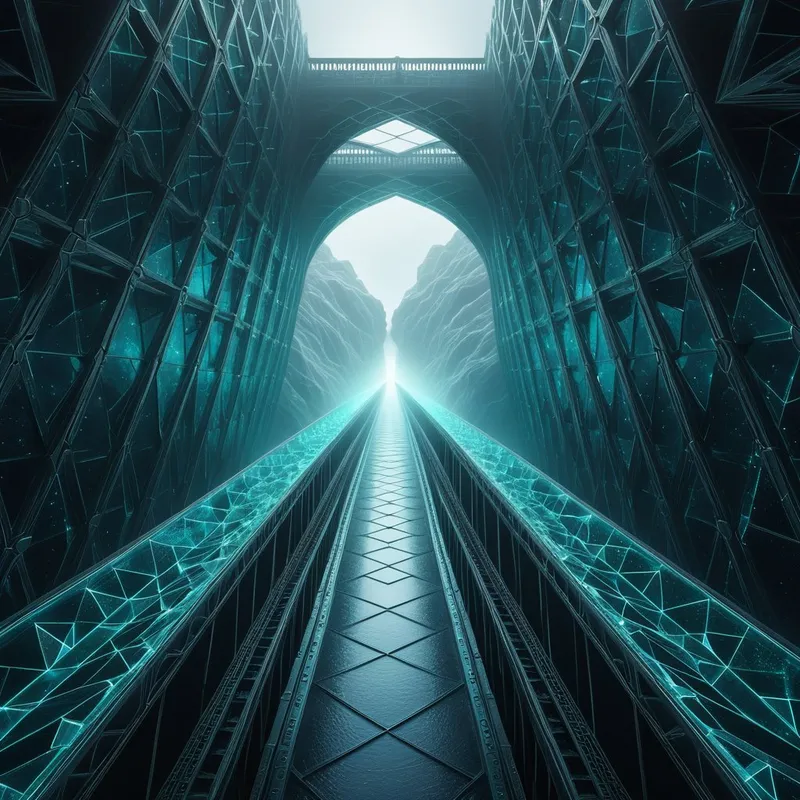
The Liminal Crucible: Dreaming in Transitional States
The Somatic Echo
Before the image forms, the body knows. It is a specific, hollow ache in the solar plexus—not a pain of injury, but the vertigo of a floor giving way. It is the sensation of standing in an elevator between floors, feeling the machinery hum but receiving no confirmation of direction. The breath becomes shallow, held in anticipation of a destination that has not yet been named. Muscles are neither tense nor relaxed, but suspended, caught in the act of preparing for a motion whose script has been lost. This is the visceral grammar of transition: a profound disorientation that is the somatic signature of the psyche entering its own chrysalis. The mind will later furnish airports, bridges, and empty corridors, but first, the nervous system registers the fundamental truth: you are between stories.
The Dreamer's Log
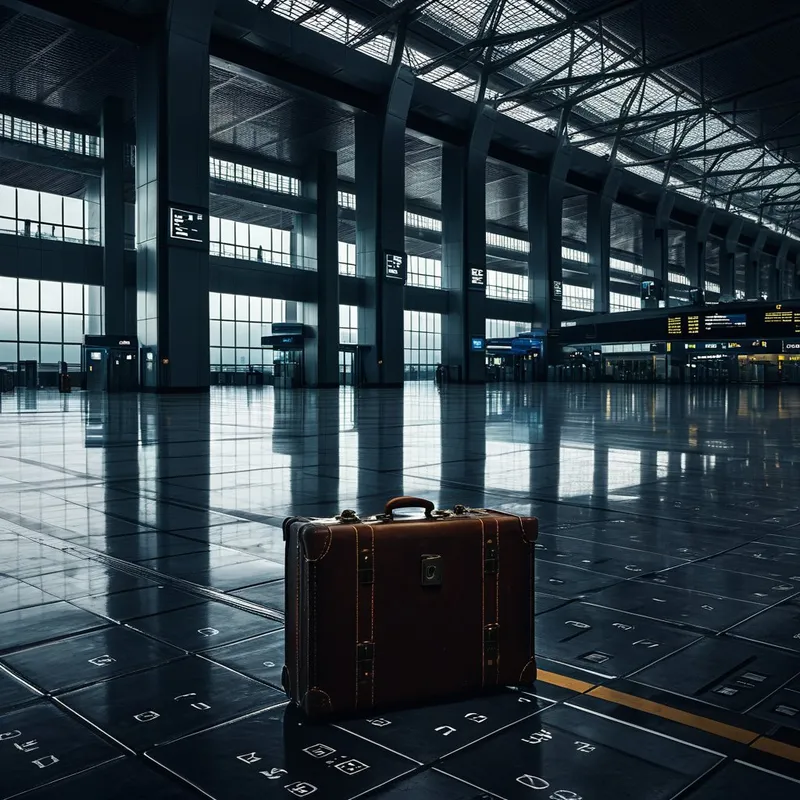
I am in a vast, silent airport terminal. The departure board flickers with symbols I cannot read. I know my flight is called, but I cannot find my gate. My suitcase is beside me, but when I open it, it contains only a single, unlit candle and a key that fits no lock I own.
This dream is the alchemical nigredo—the blackening, the dissolution of known coordinates, where the contents of one’s identity are rendered strange and useless, preparing the soul for a new and unknown ignition.
The False Lead
This theme is not about procrastination or indecision, though it may wear their clothes. It is not the anxiety of a delayed train, but the terror of the track itself vanishing beneath you. To mistake a transitional state for mere “being stuck” is to pathologize the necessary pause in the heartbeat of the self. The discomfort is not a flaw in your navigation, but evidence that navigation, as you knew it, is obsolete. You are not lost. You are in the process of becoming unmappable.
Psychological Architecture
Transition is the psyche’s most daring act of shadow work. It requires the conscious dissolution of an internal family system that has, until now, governed your inner world. The Inner Manager who booked the flights, the Protector who packed the suitcase, the Orphan who clings to familiar landmarks—all are temporarily relieved of duty. In this liminal space, their rules do not apply. This is the terrifying grace of the threshold: it forces a confrontation with the parts of you that are pure potential, unformed by role or trauma. The process of individuation here is not about adding a new module to the existing structure, but about allowing the entire architecture to become liquid, to question its own foundations. You are not changing your mind; you are changing the ground upon which your mind is built.
Mythic Resonance
Consider the Babylonian goddess Inanna, who must pass through seven gates on her descent into the underworld. At each, she is stripped of a royal garment or symbol—her crown, her lapis beads, her robe. She enters the core of her sister’s domain naked and bowed. This is not a defeat, but the ultimate transition: the voluntary surrender of every defining attribute to achieve a transformed state of being. Her story echoes in every dream of forgotten luggage or missing passports. We too must be stripped to pass through. Similarly, the Wandering of the Israelites in the desert for forty years was not a pointless delay, but a necessary period of unlearning—a generation of slave mentality had to die off so a people capable of sovereignty could be born. The desert itself was the transitional state, the crucible where an identity was dissolved and reformed.
Symbolic Nodes
- Bridges, Tunnels, Hallways, Staircases: The architecture of between.
- Airports, Train Stations, Waiting Rooms: Places of scheduled, yet personally uncertain, departure.
- Thresholds: Doorways, Gates, Veils: The precise point of crossing.
- Fog, Mist, Deep Water, Twilight: Sensory metaphors for the loss of clear perception.
- Packing/Unpacking, Missing Luggage, Wrong Vehicles: The failure or reevaluation of one’s prepared identity.
- Molting, Shedding Skin, Chrysalises: Biological imperatives of transformation.
Archetypal Resonance
The energy humming at the core of the transitional state is that of The Magician Archetype in its most potent and vulnerable phase. This is not the Magician as master of ceremonies, but as the alchemist in the dark night of the soul, standing before the prima materia—the chaotic, base matter of the self. The Magician’s core power is transformation, and here, that power is turned inward. The somatic echo of vertigo is the feeling of the Magician’s formula being applied to the very ground of their being: “As above, so below” becomes a terrifyingly intimate equation. The alchemical potential lies in this archetype’s ability to hold the tension of opposites—the dissolved past and the unformed future—and, through sheer symbolic vision, begin to perceive the new pattern coalescing in the void. The shadow of manipulation is useless here; the only thing to be manipulated is the raw substance of one’s own existence.
The Alchemical Process
The alchemy of transition is Solution and Coagulation. First, the solve: the intense heat and pressure (felt as anxiety, grief, disorientation) are not obstacles, but the necessary agents to dissolve the hardened structures of your former self. Relationships, beliefs, and identities that seemed solid are rendered into their emotional and psychic components. This is the painful, essential liquefaction. Then, the coagula: from this psychic solution, new crystals of understanding begin to form. They do not resemble the old shape. This coagulation is not a return to solidity, but an arrival at a new, more complex order. The sovereignty gained is not control over circumstances, but a foundational trust in the process of dissolution and reformation itself. You become sovereign of the liminal, at home in the becoming.

The Integration Protocol
Question 1: What familiar part of my identity (a role, a story, a self-concept) feels like it is being gently—or forcibly—unpacked from my suitcase in this season of life?
Question 2: If the anxiety of the threshold is a form of energy, not just a warning signal, what might this suspended energy be waiting to build once it receives a new direction?
Question 3: What one, small, forgotten, or disowned aspect of myself feels most present or alive in this ambiguous space, now that the louder, more familiar parts are quiet?
Action 1 (Threshold Marking): Physically demarcate a threshold in your home—a doorway, the space between two rooms. For one week, pause for three full breaths each time you cross it. Feel the transition. Do not hurry. This grounds the metaphysical in the physical.
Action 2 (Liquid Journal): Engage in a creative, unstructured writing session. Begin with the prompt: “What I cannot carry with me…” Let the writing be non-linear, poetic, or fragmented. Allow it to be a vessel for the dissolved, unformed thoughts. Do not aim for coherence; aim for expression.
Action 3 (Ritual of the Unlit Candle): Place a candle in a central, quiet space. Sit with it for a few minutes each evening. Do not light it. The ritual is in the contemplation of its potential for flame, not the flame itself. This honors the power of the unmanifest, the journey before the arrival.
Final Validation
The disorientation is real. The grief for a shore that has faded from view is legitimate. This is the cost of profound change. Yet, within this very ache is the encrypted blueprint of your next becoming. You are not falling apart. You are falling together, according to a deeper, more ancient pattern. The bridge you dream of is not just something you cross; it is something you are, for a sacred and necessary time. To endure its humming span is to become the transition, and in doing so, to author the self that will step onto the new, unknown shore.