The Somatic Echo
It begins not as a thought, but as a hollow resonance in the solar plexus. A low-grade hum of static in the bones. You feel unmoored, a ghost in your own life, your feet not quite touching the ground of any solid reality. There is a pervasive sense of waiting, but for a train whose schedule you never received. The body becomes a waiting room—a temporary vessel holding a self that is no longer quite what it was, and not yet what it will be. Breath feels shallow, as if the air itself is provisional. This is the somatic signature of the Transitional State: the visceral, pre-verbal knowledge that the old architecture of your being is undergoing silent, seismic renovation.
The Dreamer's Log
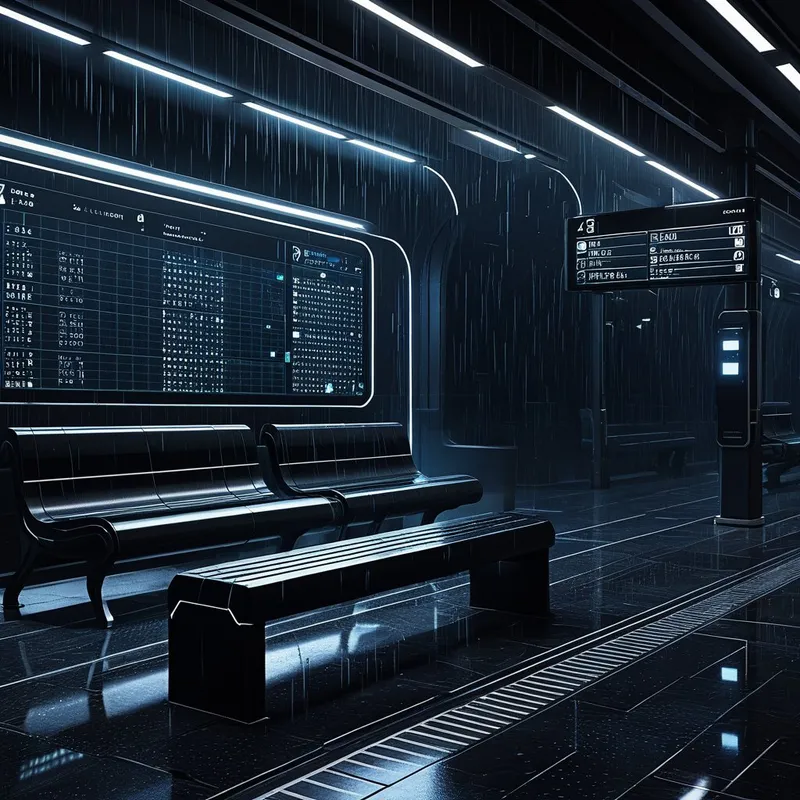
You stand alone in a vast, deserted train station in the dead of night. The departure board flickers, its destinations scrolling in an alien script. A voice over a crackling intercom announces delays for all lines, but the words dissolve into static before reaching their end. You sit on a cold, polished bench, your suitcase beside you, knowing you must go somewhere, but the ticket in your hand is blank.
Alchemical Interpretation: The psyche announces it has decommissioned the old maps and timetables, and the new itinerary is still being written in the language of the future self.
The False Lead
This is not mere indecision or a streak of bad luck. A Transitional State is not the chaos of collapse, but the necessary chaos of reassembly. Do not mistake the hollow feeling for emptiness—it is potential space. Do not interpret the lack of direction as failure; it is the system’s wise refusal to move until the new internal coordinates are calibrated. This is the profound difference between being lost and being in the liminal. Being lost implies a known point you cannot find. The liminal is the recognition that the known points themselves have been dissolved.
Psychological Architecture
Here, in this psychic anteroom, the real work is shadow work of the most intimate kind. It is the quiet, often terrifying, process of individuation—not as a grand achievement, but as a granular, moment-by-moment letting go. The parts of you that were forged for a previous life—the loyal soldier, the clever diplomat, the perfect child—begin to report as obsolete. Their contracts are up. This feels like grief. It is. You are mourning the selves you are leaving behind. The psyche, in its infinite intelligence, uses this suspended animation to conduct a silent audit. It asks: What beliefs are load-bearing walls, and what are mere stage sets? What emotions are yours, and what are inherited furniture? The transition is the dismantling. The terror is the price of admission to a more authentic sovereignty.
Mythic Resonance
Consider Inanna, Sumerian Queen of Heaven, descending through the seven gates of the Underworld. At each gate, a piece of her regalia—her crown, her lapis beads, her royal robe—is stripped away. She enters the final chamber naked and bowed, to be hung on a hook as a piece of meat. This is not a tale of punishment, but the ultimate blueprint for transition. Sovereignty is not taken with you into the metamorphic dark; it is what is reborn from the raw, stripped essence on the other side. Our dreams of empty stations and unfinished rooms are our personal gates, each one demanding we surrender an identity that cannot pass through.
Symbolic Nodes
- Unfinished Rooms or Buildings: The self under construction; exposed wiring and studs representing raw potential and unfinished business.
- Empty Stations, Airports, Waiting Rooms: The pause between chapters; the suspension of forward momentum for internal recalibration.
- Hallways, Corridors, Tunnels: The process itself; the connective tissue between one state of being and another.
- Thresholds (Doorways, Gates, Bridges): The moment of potential crossing; the point of no return charged with both fear and possibility.
- Fog, Mist, Heavy Rain: Obscured vision; the necessary veil over the future to force presence in the current moment of becoming.
- Packing/Unpacking Suitcases: Assessing what is essential to carry forward; the inventory of the soul.
Archetypal Resonance
The Magician Archetype is the sovereign of this realm. Not the showman, but the hidden alchemist in the basement of the soul. The Transitional State is the Magician’s crucible—the prima materia of your old self simmering in the dark, awaiting the formula for transmutation. The somatic echo of static and hollow waiting is the Magician’s focused void, the pregnant silence before the incantation. This archetype holds the terrifying knowledge that to create the new, you must first willingly dissolve the current form. Its shadow—the Manipulator or Illusionist—tempts us to fake a destination, to paste an old map over the blank space. But the true Magician archetype active in this theme demands we stay in the disorienting grace of the in-between, trusting that the power to reconstitute lies not in force, but in profound, attentive surrender to the process.
The Alchemical Process
The alchemy here is Solution, followed by Coagulation. The old, solid structures of identity are dissolved in the aqua permanens—the eternal water—of liminal experience. This is the heat: the anxiety of the undefined, the grief for the shed skin, the pressure of societal demands to "just be" something already. This dissolution feels like death because it is—a death of a configuration. The transformation occurs not by adding something new, but by subtracting the non-essential until only the irreducible core remains. From that nucleus, Coagulation begins. New patterns crystalize around this authentic core, not from willful construction, but from organic attraction, like a snowflake forming around a single particle of dust. The sovereignty gained is not of a fortified castle, but of a resilient, adaptive pattern—a self that knows it can survive its own dissolution.
The Integration Protocol
Question 1: In the dream's transitional space, what one object, piece of clothing, or symbol did you still have with you? What does it represent that your psyche deems non-negotiable for the journey ahead?
Question 2: If the voice on the intercom or the flickering sign in your dream could finally form a clear message, what single word or short phrase would it speak?
Question 3: Where in your waking life do you feel most like you are "waiting for permission"? What internal authority are you refusing to claim?
Action 1 (The Liminal Altar): Designate a small, physical space—a shelf, a corner of a desk. Place upon it only objects that feel incomplete, found, or between uses: a smooth stone, an empty frame, a single key, a half-used notebook. This is not a shrine to achievement, but a grounding anchor for the state of becoming.
Action 2 (Unstructured Cartography): Without planning, take a large piece of paper and draw the map of your transitional space from the dream. Let it be messy. Use symbols, textures, colors—not literal shapes. Where does the energy feel stuck? Where is there a hidden door? Let the drawing be a dialogue with the liminal territory itself.
Action 3 (The Provisional Ritual): For one week, consciously perform a daily routine (making coffee, a commute, a walk) as if you are a visitor from your own future, temporarily inhabiting this transitional life. Observe the details with this borrowed curiosity. Note what feels poignantly temporary and what feels like a timeless thread.
Final Validation
The discomfort is the proof. The disorientation is the signpost. You are not broken for feeling unanchored in the in-between; you are alchemical. To dream of thresholds is to receive an invitation from the deepest strata of your being, written in the language of sacred uncertainty. It is an honor to be selected for such a metamorphosis. The journey through the hallway does not end at a door; it ends with the realization that you have become the doorway.