The Dream of Testimony: The Soul’s Summons to Witness
The Somatic Echo
It begins not as a thought, but as a pressure. A tectonic weight in the chest, a constriction in the throat that feels like a hand you cannot see. Your breath becomes shallow, a prisoner in its own cage. There is a humming in the bones, a low-frequency vibration of something immense and unspoken trying to find its shape. The body knows it is holding a charge—a story, a memory, a truth—that has been metabolized into pure somatic potential. It is the feeling of being a vessel filled to the brim with a liquid, silent scream. Before the dream images form, you feel the gravity of the un-witnessed event pulling at your internal organs, a silent plea for recognition from the exiled parts of your own history.
The Dreamer’s Log
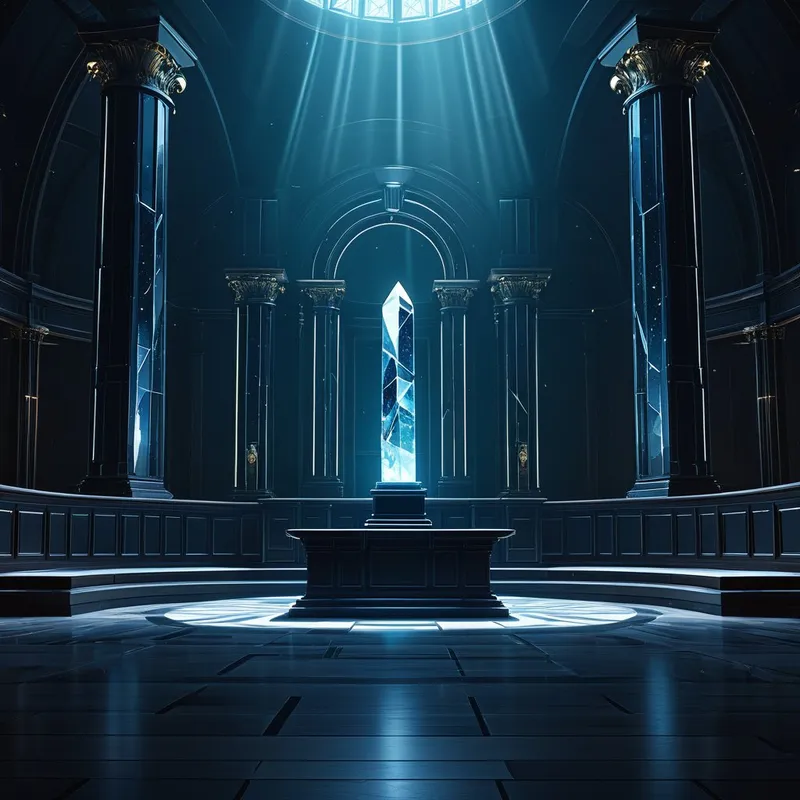
I am standing in a vast, empty chamber of dark, polished stone. Before me is a simple wooden podium, but my hands are fused to its surface, my fingers turned to cold, unyielding marble. I try to speak, to offer my account, but my voice is only static—a dry, crackling noise. From the shadows, a single, disembodied ear floats forward, hovering patiently, waiting for a sound that will not come.
This is the alchemy of the choked utterance: the psyche staging the very paralysis that must be dissolved, presenting the mute witness to itself so that the first, impossible word might be forged.

The False Lead
This is not a dream about public speaking anxiety or a fear of judgment. To mistake it for such is to confuse the cathedral for the scaffolding. The terror here is not of an audience’s opinion, but of the truth’s own devastating beauty and weight. It is not about the performance of a story, but the profound, structural shift that occurs when a story is finally acknowledged as real within the private sanctum of the self. The dream is not warning you of embarrassment; it is preparing you for the seismic event of self-recognition. The "courtroom" is internal. The jury is your own fractured consciousness, awaiting integration.
Psychological Architecture
To dream of testimony is to encounter the very architecture of your shadow. Within the internal family of the psyche, certain parts—often the most wounded, the most ashamed, the most furious—have been exiled to silent, soundproof rooms. They are the keepers of events deemed too destabilizing for the conscious self to hold. The dream of testimony is the moment these exiles petition for a hearing. It is shadow work of the most direct kind: the establishment of an internal jurisdiction where what was denied a voice is granted a forum.
This is the individuation process in one of its most potent forms. It is the ego, the manager of the conscious self, being compelled to step down from the bench and take the stand. It must relinquish its role as judge and become the witness. The pressure you feel is the strain of this reconfiguration—the old, protective identity dissolving so a more complete, truthful one can begin to narrate itself into existence. The psyche is restructuring its own foundation to include the buried cornerstone.
Mythic Resonance
We see this eternal drama in the myth of Cassandra, gifted with the clarity of prophecy but cursed never to be believed. Her testimony was flawless, her vision true, yet it echoed in a void of willful deafness. The modern dreamer’s curse is often internalized: we are both Cassandra and the dismissive court of Troy within one skull. The myth reminds us that the first, most harrowing stage of testimony is not delivery, but the lonely, unwavering certainty of the truth itself, even in the face of one’s own internal disbelief.
Similarly, the Egyptian ritual of the Weighing of the Heart before Osiris was the ultimate testimony. The heart, containing every deed and word, was placed on a scale against the feather of Ma’at, truth and order. But the critical act was not the weighing; it was the prior confession, the "Negative Confession," where the deceased testified "I have not committed evil..." This was not a denial, but a sacred declaration of one’s own accounted-for life. The dream places us at this precipice, asking us to compile our own negative confession—to name what we have not done to our own truth: we have not spoken it, not heard it, not borne witness.
Symbolic Nodes
- Muted Voices, Broken Microphones, Silent Screams: The mechanics of expression are sabotaged, highlighting the internal censorship.
- Empty Courtrooms, Vast Auditoriums, Abandoned Podiums: The stage is set for a significance that has been postponed, emphasizing the solitude of this initial reckoning.
- Scrolls with Blank Text, Fogged Glass, Sealed Envelopes: The information is present but inaccessible, representing conscious resistance to the content.
- A Single Listener (an ear, a child, an animal, a recording device): The focus shifts from the grandeur of delivery to the purity of being received, even if by just one impartial witness.
- Fused Hands, Bound Mouths, Heavy Chains: The somatic prison of the secret, showing how the untold story physically constrains the self.
Archetypal Resonance
The Orphan Archetype is the primary actor in the dream of testimony. Not its shadow victim, but the Orphan in its core, resilient truth: the Realist who has survived an experience of abandonment—not necessarily by others, but often by one’s own conscious awareness. This archetype knows the raw, unvarnished facts of the inner world. Its energy resonates with the somatic echo of lonely weight and the choked throat, for the Orphan carries the memory of being unheard. Its alchemical potential lies precisely in its survival: it has held the truth intact, waiting for the moment it can finally step forward and declare, "This happened. This is real. I am here to testify to my own existence." The act of testimony is the Orphan’s ultimate journey from silent endurance to sovereign self-advocacy.
The Alchemical Process
The transmutation here is of silence into language, of frozen history into fluid narrative. The heat is the unbearable vulnerability of the first admission, often felt as shame or terror. The pressure is the sustained courage to hold that admission in consciousness without fleeing into denial or dissociation. This is the solve et coagula of the soul: first, you must dissolve the rigid identity built around the absence of this truth (the "I am fine" narrative). This dissolution feels like a breakdown, a cracking open—like the marble hands on the podium.
Then, from that liquefied state, a new substance must coagulate: the integrated identity that contains the story. The alchemical vessel is your own attentive, compassionate awareness. You are not melting down the truth, but melting down the walls that kept it imprisoned. The gold produced is not a happy ending, but sovereign authenticity—the power that comes from no longer being at war with a part of your own being.
The Integration Protocol
Question 1: If the part of me that is mute in the dream could make one sound—not a word, but a tone, a pitch, a vibration—what would it feel like in my body?
Question 2: Who or what inside me has been playing the role of the 'disbelieving court'? What fear does that part serve?
Question 3: What is the very first, smallest sentence of this testimony? It does not need to be spoken aloud, only acknowledged inwardly. (e.g., "Something happened." "I was afraid." "It was not my fault.")
Action 1 (Somatic Unbinding): Sit quietly and place a hand gently on your throat. Breathe deeply, feeling no need to speak. With each exhale, imagine the breath moving through the constriction like warm water, softening the held tension. This is not about producing sound, but about restoring the potential for sound.
Action 2 (Unsent Testimony): Take a pen and paper. Set a timer for five minutes. Write in the third person, as if you are a court scribe recording a statement: "The witness reports that..." Do not stop writing. Do not edit. Let the scribe record fragments, sensations, and disjointed facts. Burn or shred the paper afterward. The act is in the recording, not the keeping.
Action 3 (Ritual of the First Listener): Find a small, smooth stone. Hold it and state quietly, "You are the first witness." Go to a private place—a park, your backyard, a quiet room. Speak one sentence of your truth aloud, directly to the stone. Then, bury the stone or place it in a body of water. You have transferred the testimony from the internal prison to the silent, holding world.
Final Validation
The dream of testimony arrives because you are strong enough to hold what you once had to exile. The paralysis, the mute terror, the empty courtroom—these are not signs of failure, but evidence of a profound intelligence preparing for a monumental shift. It is difficult because it matters. It is heavy because it is real. Your psyche is not torturing you; it is building a courtroom of impeccable integrity within you, where every exiled part will finally get its day. To stand in that silent chamber and feel the pressure to speak is to already be halfway home. The courage is not in the eloquence of the delivery, but in the willingness to turn, at last, and face the solitary, waiting ear of your own soul.