
The Alchemy of the Pause: Dreaming of Temporary Rest
The Somatic Echo
Before the mind forms an image, the body knows the signature of this dream. It is not the heavy, leaden fatigue of exhaustion, nor the blissful surrender of deep sleep. It is a specific, hollow resonance in the solar plexus—a feeling of being between. The breath catches, suspended between inhalation and exhalation. The muscles are not tense, but neither are they relaxed; they hold the memory of a recent effort and the anticipation of a future one. There is a lightness in the limbs, but it is the lightness of a bridge cable, taut and humming with potential energy. It is the visceral sensation of a comma in the sentence of your life, a held note in your personal symphony. The world outside continues its frantic pace, but within this somatic echo, there is a silent, pressurized chamber where everything has momentarily stopped to listen to its own becoming.
The Dreamer's Log
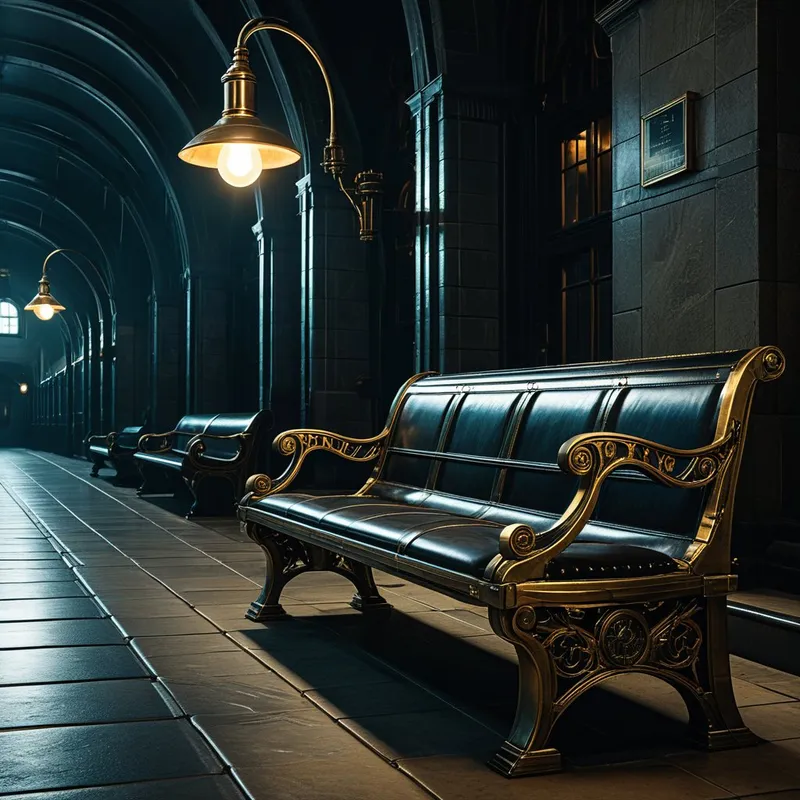
You are in a vast, deserted train station at night. The destination board is blank. You sit on a cold, polished bench, your luggage beside you. You know your train is coming, but the schedule is unknown. There is no anxiety, only a watchful, crystalline calm. You are simply… waiting.
This dream is an alchemical vessel, holding the psyche in a state of potent latency, where the old identity has disembarked and the new one has not yet arrived.
The False Lead
Do not mistake this for mere procrastination, laziness, or a depressive stall. The energy of true Temporary Rest is active, not passive. It is not the absence of motion, but a different kind of motion—inward, vertical, and deeply structural. It is the opposite of being lost; it is being so precisely located at a critical juncture that forward momentum must cease for re-calibration. The false lead is to interpret the pause as failure, to fill the sacred silence with noise, to mistake the dismantling of a scaffold for the collapse of the building. This is not a breakdown of purpose, but a deliberate and necessary intermission in its performance.
Psychological Architecture
Beneath the calm surface of the waiting room dream lies a profound architectural shift. The psyche, in its journey toward wholeness, does not move in a relentless, linear march. It progresses in cycles of expression and digestion. We build a life, a role, an identity—we live out its patterns, its victories, and its limitations. Then, inevitably, that structure reaches its useful end. Its walls become constraints; its floorplan no longer fits the soul’s expanding blueprint.
This is where the dream of Temporary Rest arrives. It is the psyche’s own decree of a moratorium. It is the Shadow work of allowing dissolution. The ego, which identifies with the previous structure, must consent to a state of unstructured potential. This is the terror and the grief: to be nobody, nowhere, en route. The Individuation process demands these fallow periods. It is in the fertile void of the "between" that the disparate parts of the self—the internal family of exiles, managers, and firefighters—can cease their roles and simply be. Without a script, the true Self, the silent conductor behind the internal system, can begin to whisper the notes of the next movement. The pause is the crucible where the dross of outworn identity is separated, not through force, but through the patient gravity of silence.
Mythic Resonance
We see this eternal pattern in the myth of the Greek god Cronus, who swallowed his children to prevent his prophesied overthrow. He represents a consciousness that cannot tolerate the birth of the new, that tries to hold time itself in a permanent, static grip. The dream of Temporary Rest is the antithesis of Cronus. It is the willing surrender to time’s rhythm, the conscious ingestion of the present moment to gestate the future. It echoes, too, in the Christian concept of Holy Saturday—the day between the crucifixion and the resurrection. It is the day of absolute, bewildering silence from God, a day when the old covenant is definitively dead and the new one is not yet manifest. It is not a day of despair, but the essential, dark soil from which impossible hope germinates. These myths are not about endings, but about the sacred, unbearable, and necessary middle that makes all true transformation possible.
Symbolic Nodes
- Empty Stations, Airports, or Waiting Rooms: Liminal spaces designed for transition, now held in abeyance.
- Paused Vehicles (Cars with the engine off, docked boats): Tools of journey and agency in a state of deliberate inactivity.
- Half-Built or Half-Dismantled Structures: The visible architecture of a psyche in metamorphosis.
- Blank Canvases, Empty Pages, or Silent Instruments: Potential that has been acknowledged but not yet acted upon.
- Hibernating Animals or Dormant Seeds: Life in its most condensed, potent, and waiting form.
Archetypal Resonance
The energy of this theme resonates most deeply with The Magician Archetype, specifically in its latent, shadow-tending phase.
This is the Magician not in the act of wielding power, but in the essential, vulnerable phase of recharging it. The Magician’s core gift is transformation—the knowledge of how to change reality from one state to another. But every alchemical operation requires a nigredo, a blackening, a dissolution of the base material into prima materia. The Temporary Rest is this nigredo. The somatic echo of suspension is the Magician’s consciousness holding the volatile elements in solution, preventing a premature reaction. The archetype’s shadow—the Manipulator or Illusionist—arises when we fear this void and try to fake the transformation, to create the illusion of progress without the necessary, terrifying period of unstructured rest. To dream of this pause is to be invited into the Magician’s most sacred chamber: the silent core where the true work of transmutation begins, not with a spell, but with a breath held in perfect patience.
The Alchemical Process
The alchemy of Temporary Rest is the process of Solution. In the old texts, solve (to dissolve) precedes coagula (to coagulate). The intense psychological heat and pressure here are not of fire, but of absolute stillness. It is the pressure of non-action in a world that worships motion. It is the heat of your own anxiety, your grief for the chapter that has closed, and your impatience for the next, all held in a conscious container without being acted upon.
This is the transmutation: to allow the solid, defined shape of your previous self—your ambitions, your failures, your certainties—to dissolve into the liquid state of pure experience and potential. The terror is the loss of form. The grief is for the shore you have left. The sovereignty is won by realizing you are not the form that dissolved, nor are you the formless liquid. You are the vessel that contains the process. You are the awareness that can hold the "between" without rushing to fill it. The new structure that eventually coagulates from this solution will be inherently wiser, more flexible, and more authentically yours, because it was born from a conscious pause, not a frantic reaction.
The Integration Protocol
Question 1: What chapter of my life has definitively ended? Can I name the specific identity, role, or striving I am waiting to leave behind on that deserted platform?
Question 2: Where in my body do I feel the impulse to "fill the silence" or "get moving again"? What would it feel like to offer that part of myself compassion, but not obedience?
Question 3: If this period of rest is not a void but a fertile dark soil, what is the most fragile, seed-like possibility beginning to stir within it that requires this very silence to grow?
Action 1 (The Vessel of Stillness): For five minutes, sit in a chair and do nothing. Do not meditate, pray, plan, or even breathe with intention. Simply be the empty station. When thoughts of past or future arrive, acknowledge them as trains passing through, but do not board them. Your only task is to hold the space.
Action 2 (Mapping the Liminal): Create an expressive, non-linear map of your "between." Use a large sheet of paper. Draw the landscape of your pause. Where are the blank spaces? The half-built bridges? The dormant seeds? Use symbols, textures, and colors—not words—to document this internal territory. This is not art for display; it is a cartography of the soul's interim state.
Action 3 (The Ritual of Unpacking): Physically open your bag, briefcase, or a drawer you use daily. Remove one item that belongs to the "previous chapter" you identified. Hold it. Thank it for its service. Then, consciously place it somewhere else—a storage box, a donation pile, a different room. Perform this as a small, deliberate ceremony of making space in your literal vessel for what is to come.
Final Validation
This pause is not your failing. It is your depth asserting itself. The modern world, with its cult of perpetual momentum, fears the interval, the caesura, the rest. But your soul does not. Your soul, in its ancient wisdom, has called for this time out of time. It is perhaps the most courageous act: to stop, truly stop, and listen to the hollow hum of your own potential. The platform is not empty; it is pregnant. The schedule is not blank; it is being written in a language you are only now learning to hear. Trust the rest. It is the most active thing you are doing.