
The Alchemy of the Temporary Refuge
The Somatic Echo
It begins not as a thought, but as a texture in the bones. A specific, hollowed-out relief. The shoulders drop from a tension you had forgotten you were carrying, but the drop is not into softness—it is into a temporary, brittle stillness. The breath comes easier, yet it feels shallow, held in a chamber that is not your own. There is a profound sense of pause, but it is the pause of a system in safe mode, its core functions suspended while a deeper, unseen diagnostic runs. The body knows it is in a reprieve, not a resolution. It is the visceral knowledge of shelter during a storm, coupled with the unshakable awareness that the walls are thin, the lock is flimsy, and dawn will demand you move on. This is the somatic signature of the Temporary Refuge: gratitude laced with the metallic taste of impermanence.
The Dreamer's Log
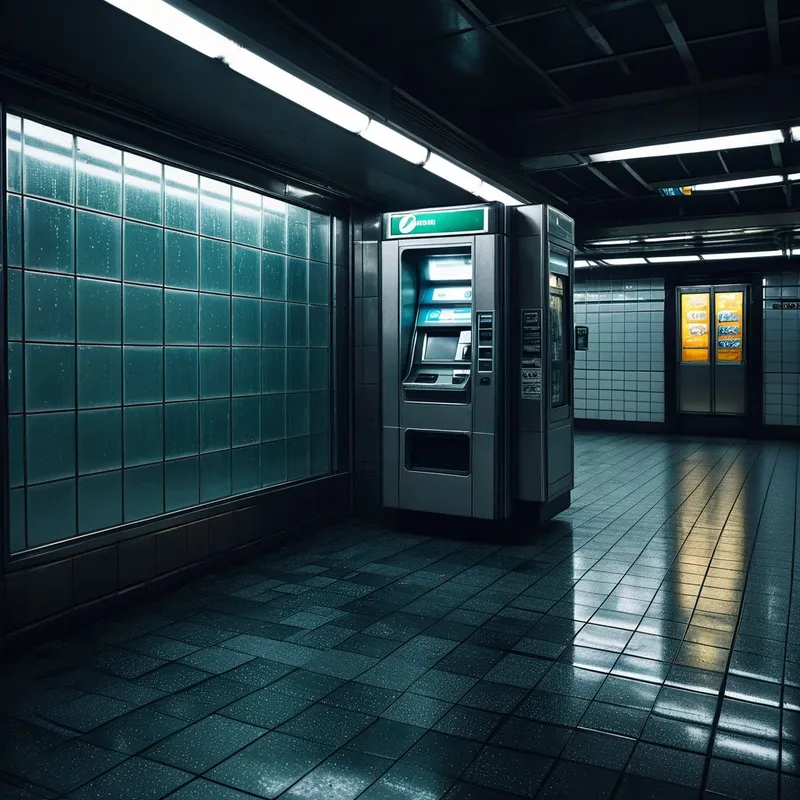
The dreamer finds themselves in a cavernous, abandoned subway station, long past the last train. The only light comes from a single, flickering vending machine. They have a suitcase, but it is half-unpacked, clothes spilling onto the grimy tiles. They know, with absolute certainty, they cannot stay here, but for now, the hum of the machine and the deep silence are a perfect, desperate sanctuary.
Here, the psyche constructs a holding cell of concrete and artificial light, a literal way-station, to contain the messy, unpacked business of a life in transition. The alchemical interpretation: The conscious self, having fled a collapsed structure, takes inventory of its scattered parts in a liminal space that permits breath but forbids roots.
The False Lead
Do not mistake the Temporary Refuge for failure, cowardice, or a sign that you are lost. It is not the same as being perpetually adrift or refusing to commit. The wanderer may never seek a home; the soul in a Temporary Refuge is actively between homes. It has left one shore and has not yet sighted the next. This theme is also distinct from mere escapist fantasy. The refuge in these dreams carries the weight of reality—it is damp, it is spare, it is temporary. The grief is present. The relief is real but partial. To misinterpret this as "bad luck" or a "setback" is to pathologize the essential, sacred function of the psyche’s decompression chamber. It is not a breakdown of the journey; it is its most critical, hidden mechanism.
Psychological Architecture
Beneath the dream image lies a profound operation of Shadow work and Individuation. The Temporary Refuge represents the ego’s conscious negotiation with a deeper, systemic upheaval. An old internal paradigm—a relationship, an identity, a belief system that once provided coherence—has been decommissioned. Its collapse is not a mistake, but an inevitable phase in the psyche’s growth. Yet, the new structure cannot be built on the still-smoldering ruins.
So, the Self, the totality of the psyche, orchestrates a retreat. It cordons off a sector of inner space. This is the refuge: a psychic clean room. Here, in this enforced pause, the components of the old self are laid out—like the half-unpacked suitcase. You are meant to see what you brought with you: what is essential, what is worn through, what belongs to a ghost. This is the shadow work: facing the orphaned parts of yourself that clamored for the old, collapsed structure. The grief you feel is not for the external loss alone, but for the internal identities that died with it. The refuge is the workshop where you dis-identify. It is where the Orphan learns it is not alone, but part of a larger, reorganizing system. Sovereignty begins not with building a new castle, but with the lonely, courageous act of sorting through the rubble in a borrowed room.
Mythic Resonance
This process echoes in the myth of the katabasis, the night-sea journey. Inanna does not simply die and resurrect; she is stripped, layer by layer, at each of the seven gates of the underworld, and hung as a corpse on a hook. The hook is her temporary refuge—a state of utter suspension, neither in the world of the living nor fully integrated into the realm of the dead. It is a horrific, necessary stasis. Similarly, the Buddha, after leaving his palace, did not immediately find the Bodhi tree. He wandered, practiced extreme asceticism, and finally accepted a simple meal of milk-rice from Sujata. That act of receiving nourishment in a humble setting was not the enlightenment, but the temporary refuge that made enlightenment possible. It was the moment the system stopped fighting its own depletion and allowed itself to be held, just enough, to continue.
Symbolic Nodes
- Waystations & Transit Hubs: Airports at night, empty bus depots, deserted subway platforms.
- Borrowed or Impermanent Dwellings: Hotel rooms, a friend's spare room, a childhood bedroom you no longer live in.
- Provisional Shelters: A lean-to in a forest, a cave, a car parked in a vast, empty lot.
- Objects of Temporary Sustenance: A vending machine, a single candle, a half-empty water bottle.
- Unpacked or Half-Packed Luggage: Suitcases, backpacks, boxes—always in a state of transition, never fully stored away.
Archetypal Resonance
The energy of the Temporary Refuge is most acutely channeled through The Orphan Archetype. This is not the Shadow Orphan, who wallows in victimhood, but the Orphan in its essential, realist form: the part of us that knows what it is to be without shelter, to feel the raw edge of existence, and to develop a fierce, pragmatic survival intelligence. The somatic echo of hollow relief is the Orphan’s body memory—the profound gratitude for any port in a storm, coupled with a deep, unsentimental knowledge that safety is provisional. The alchemical potential here lies in the Orphan’s ultimate lesson: that true refuge is not found in a permanent external structure, but in the internal capacity to create sanctuary wherever one is. The Temporary Refuge dream is the Orphan’s training ground, where it learns to distinguish between needing a home and becoming one.
The Alchemical Process
The transmutation here is from Fragmented Refugee to Integrated Sovereign. The prima materia is the raw grief and disorientation of collapse. The heat is applied by the very impermanence of the refuge itself. Its temporary nature creates a gentle, persistent pressure—a deadline felt in the soul. You cannot get comfortable. This pressure forces a crucial choice: to numb out and pretend the refuge is permanent (a regression), or to use the limited time and space to do the inner work.
The alchemical operation is Separatio and Solutio—separation and dissolution. In the quiet of the refuge, you separate your core Self from the shattered identities of the past (the unpacked suitcase). You allow the tears—the aqua permanens—to dissolve the brittle glue that held the old self together. This is not destruction, but a merciful unmaking. The terror is the fear that nothing will remain. The grief is for what is being washed away. But as the non-essential dissolves, a nucleus of authentic being, previously obscured by the rubble, begins to gleam. Sovereignty is born from recognizing this indestructible nucleus as your true, mobile home. The refuge, by being temporary, teaches you that you carry the foundation within.
The Integration Protocol
Question 1: What old "room" in my psyche or life have I just left? What was the final piece of furniture I had to abandon at the door?
Question 2: What three things are in my "half-unpacked suitcase" in this current refuge? One item I know I need, one I'm surprised I brought, and one I am now ready to leave here.
Question 3: If this temporary refuge could speak, what one piece of instructions would it give me for the journey ahead? Not a comfort, but a command.
Action 1 (Somatic Anchoring): For one week, practice this upon waking: Feel your feet on the floor. Name one thing this body can do right now (e.g., "breathe," "blink," "feel the weight of the blanket"). This grounds the refugee in the simple, sovereign fact of the living body.
Action 2 (Unstructured Cartography): Without planning, draw the floor plan of your dream refuge. Then, using a different color, draw the path of your movement through it. Where did you pause? Where did you not go? Let the map reveal the logic of your psyche's chosen holding pattern.
Action 3 (Ritual of Gratitude & Release): Find a small stone. Hold it, imbuing it with your gratitude for the respite your refuge provided. Then, imbue it with what you are ready to leave behind. Journey to a bridge, a crossroads, or a moving body of water. Thank the stone and drop it. Do not look back.
Final Validation
It is excruciating to be held in a pause you did not choose, to feel gratitude for a shelter you know will vanish. This tension is the precise, calibrated friction the soul requires for its next becoming. Honor the exhaustion. Honor the strange peace. The refuge is not a sign that you are broken, but a masterpiece of psychic engineering—a life raft built in the midst of the shipwreck itself. You are not waiting. You are being reconfigured. And when the time comes to step from its threshold, you will not leave as the one who arrived, seeking shelter, but as the one who carries the blueprint for sanctuary within.