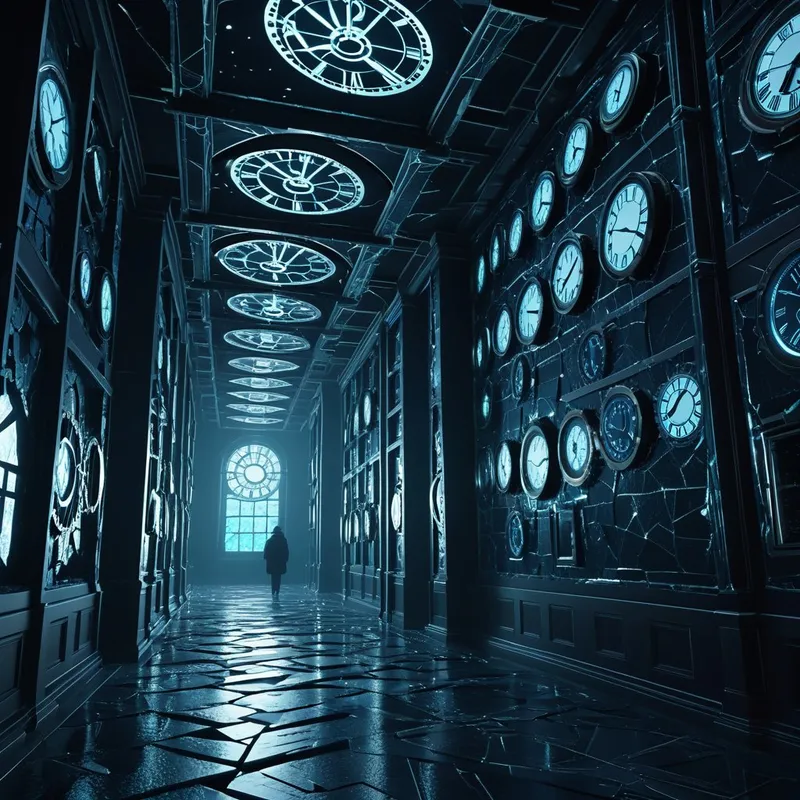
The Dream of Temporal Dislocation: An Alchemy of the Internal Timeline
The Somatic Echo
Before the mind can parse the narrative, the body knows. It is a feeling of profound, vertiginous un-anchoring. The stomach drops not in fear, but in a silent, weightless free-fall. The breath catches, not from panic, but from the sudden, disorienting absence of rhythm—the internal metronome has gone quiet. There is a hollow resonance in the chest, as if the heart is beating in a chamber that no longer echoes forward or back. This is the visceral signature of temporal dislocation: a deep, cellular sense that the thread of continuity—the story you tell yourself about your own becoming—has momentarily frayed and snapped. You are not lost in space, but adrift in the very substance of your own history and potential. The ground beneath you is not earth, but time, and it has turned to liquid.
The Dreamer's Log
I am in my apartment, but it is both my current home and my childhood bedroom simultaneously. The light from my modern desk lamp pools warmly on the floor, but it casts the shadow of my old bunkbed against the wall. I try to check the time on my phone, but the screen displays a calendar from 1998, the dates bleeding into next week’s meetings. A profound, quiet grief settles in my chest—not for the past, but for the present that feels impossibly distant.
Alchemical Interpretation: The psyche is staging a council of selves, forcing a dialogue between the exiled child who built the foundational walls and the adult who now inhabits them, revealing that the architecture of "now" is built upon un-integrated "thens."

The False Lead
This is not a dream about nostalgia or mere anxiety about the future. To mistake it for simple longing for the "good old days" or fear of what's to come is to miss its radical, structural message. Temporal dislocation is not about content (missing a specific time), but about container—the very framework of sequential selfhood is undergoing a seismic audit. It is not a malfunction of memory, but a deliberate, if terrifying, upgrade to the operating system of identity. The terror does not come from being in the wrong time, but from the revelation that the linear timeline you considered your bedrock is, and perhaps always was, a compelling fiction.
Psychological Architecture
Beneath the disorientation lies a profound act of Shadow work and Individuation. We exile parts of ourselves that do not fit the current chapter—the vulnerable child, the failed aspirant, the un-lived potential. We consign them to "the past," a psychic landfill we vow never to visit. But the Self, in its drive toward wholeness, refuses this exile. Temporal dislocation is its method of jailbreak. It dissolves the walls of the internal chronology, allowing the "then" and the "might-have-been" to walk into the "now." This is not regression; it is reclamation. The grief felt is for the persona—the simplified, time-bound version of you that must now die to make room for the more complex, timeless entity. You are not falling out of time; you are being asked to become the synthesizer of your own timeline, to hold the multiplicity of your being in a single, sovereign awareness. The process feels like disintegration because it is—the disintegration of a false, linear unity to make way for a true, holographic totality.
Mythic Resonance
We see this in the story of the Fisher King, ruler of a wounded land that mirrors his own inner wound. His kingdom exists in a perpetual, cursed present—a literal temporal dislocation where spring cannot come, and the land is stuck in a sterile, repeating cycle. The healing does not come from going backward to before the wound, but from the Grail Question that integrates the past (the wound) into a new, fertile present: "Whom does the Grail serve?" The question itself is a temporal key, unlocking the frozen now. Similarly, in Orpheus's descent, his fatal glance backward is not merely a mistake of doubt, but a catastrophic collision of timelines—the moment he holds Eurydice (the reclaimed, integrated soul) is shattered by his reversion to the old narrative of loss and separation. The underworld here is not a place, but a state of dislocated time, where what is retrieved and what is lost exist in a quantum superposition until the moment of integration is either achieved or failed.
Symbolic Nodes
- Anachronistic Technology: A smartphone showing a rotary dial, a typewriter printing live news feeds.
- Architectural Blending: A childhood home's layout superimposed on a workplace.
- Non-Functional Timepieces: Frozen clocks, melting watches, calendars with repeating or missing dates.
- Seasonal Collisions: Snow falling in a sun-drenched room, autumn leaves on a summer lawn.
- Ageless or Wrong-Aged Loved Ones: Seeing a parent as a child, or oneself in the mirror at a different age.
Archetypal Resonance
The core energy here is that of The Magician Archetype, specifically in its shadow phase as the Illusionist. The Shadow Magician is the master of the false framework, the one who convinced you that time is a strict, linear chain and that your exiled parts are safely locked away in dead yesterdays. The somatic echo of dislocation is the shock of the Illusionist's spell breaking—the curtain pulled back to reveal the gears and pulleys of your own constructed chronology. The alchemical potential lies in seizing the Magician's true power: not to manipulate the illusion, but to transmute the very elements of perception. From the ashes of the shattered timeline, the integrated Magician learns to operate from the pleroma, the full presence, where past, present, and future are not sequence but spectrum, available for conscious, sovereign recombination.
The Alchemical Process
The transmutation of temporal dislocation is an alchemy of synthesis under the intense heat of paradox. The prima materia is the grief and terror of the lost narrative. The heat is applied by consciously holding the impossible tension: I am the child who was hurt, and I am the adult who is whole. That future I fear is already here, as a potential in my psyche. This pressure cooks away the dross of sequential logic. The vessel is your own aware consciousness, which must expand to contain these contradictions without seeking premature resolution. The solve (dissolution) is the allowing of the timeline to fracture and the exiled selves to speak. The coagula (recombination) is not rebuilding the old line, but learning to stand at the still point, the nunc stans (the eternal now), where all parts of the self are acknowledged, felt, and woven into a new, multi-dimensional identity. The gold produced is Temporal Sovereignty—the ability to visit your past with compassion, inhabit your present with fullness, and approach your future without being haunted by either.

The Integration Protocol
Question 1: In the moment of dislocation in the dream, what quality of feeling (not era) was most present? Was it the innocence of childhood, the anxiety of a past transition, or the weight of a future responsibility? Follow the emotion, not the decade.
Question 2: Which part of your current life feels most like a "waiting room"—on hold for a future resolution or defined by a past event? How does that exiled part need to be welcomed into your present-day decisions or relationships?
Question 3: If your life were not a line but a sphere, with all experiences existing simultaneously at different points within the whole, what central, timeless truth would sit at the core, giving meaning to all the points on the surface?
Action 1 (Somatic Re-anchoring): When you feel untethered in waking life, place one hand on your heart and one on your abdomen. Breathe deeply, and with each exhale, mentally whisper: "I am here. This breath is now." Do not rush to fix the feeling; simply host it in the physical vessel of the present body.
Action 2 (Timeline Collage): Create a non-linear collage. Gather images, words, and textures that represent different eras, moods, and potentials of your life—from childhood memories to future aspirations. Arrange them not in order, but in a way that feels like a true, simultaneous map of your inner world. Let the overlaps and juxtapositions speak.
Action 3 (Council of Selves Ritual): Light a candle to signify the eternal present. Speak aloud, giving voice to an exiled "self" from a different time (e.g., "I am the sixteen-year-old who felt abandoned..."). Then, speaking from your current awareness, respond with witness and acknowledgment (e.g., "I see you. Your fear taught me resilience. You are welcome here."). Do not argue or correct; simply integrate through acknowledgment.
Final Validation
The disorientation is real, and its ache is a testament to the courage of a psyche no longer willing to live in fragments. It is terrifying to feel the floor of time give way. But remember: you are not falling into chaos. You are being invited to learn a new kind of gravity—the gravity of the center, where all times are held in orbit around a sovereign "I." The dream of dislocation is not a sentence to wander. It is a summons to become the architect of your own eternity.