
The Dream of Your Deepest Nature: Alchemy of Temperament & Personality
The Somatic Echo
Before the dream forms an image, it begins as a vibration in the bones. It is not an emotion, but the ground from which emotions arise. You feel it as a specific density—a slow, tectonic patience, or a quick, electrical restlessness humming in your marrow. It is the somatic signature of your prima materia, the raw, unrefined substance of your being. This echo might manifest as a peculiar solidity in your chest, a feeling of being anchored to a specific gravity, or conversely, a sensation of being a conduit for winds you cannot name. It is the body’s ancient knowing of its own fundamental operating system, long before the mind writes its programs of identity, before the world names you shy or bold, melancholic or sanguine. This is the dream’s first whisper: Remember the elemental you.
The Dreamer's Log
I am in a library of infinite shelves, but all the books are blank. I run my fingers over the empty pages, and where I touch, intricate coastlines and mountain ranges rise in delicate relief, as if the geography of an unknown continent is being written from my fingerprints. I feel a profound loneliness, not for company, but for the one mapmaker who understands this cartography.
Alchemical Interpretation: The dream reveals the Self as the sole author of its own innate, topographic truth, grieving the exile from its own foundational blueprint.

The False Lead
This theme is not about improving your social skills or adopting a more “effective” personality. It is not a mandate to become more extroverted if you are introverted, or more stoic if you are sensitive. That is the language of adaptation, of the persona. The dream of temperament is a descent beneath the persona. It is the difference between sanding the rough edges off a stone and discovering the unique, crystalline structure within the stone itself. A dream urging you to “be more fun” is likely about persona; a dream presenting you with immutable, internal landscapes—vast deserts, deep forests, still lakes within your own chest—is speaking of temperament. The false lead is to mistake the soul’s architecture for a faulty design in need of renovation.
Psychological Architecture
Here, Shadow work is not about confronting a hidden monster, but about reconciling with a forgotten ancestor. Your temperament is your psychological ancestry, the lineage of impulses and inclinations you inherited from the deep Self. To individuate is not to build a new personality on top of this, but to consciously inhabit it fully. The Shadow of temperament is all the parts of this core nature you were taught to disown: the slow, deliberate pace labeled as “lazy,” the quick reactivity dismissed as “hysterical,” the profound sensitivity shamed as “weak.” Individuation is the reclamation project. It is allowing the internal weather systems you were told to calm—the sudden squalls of passion, the long winters of contemplation—to move through you without apology. You are not learning to control the climate of your soul, but to become a knowledgeable native of its unique ecology.
Mythic Resonance
Consider the Greek myth of Proteus, the ancient sea god who knew all things past, present, and future. To gain his knowledge, one had to grasp him as he shifted through terrifying forms—lion, serpent, tree, water. The seeker had to hold on through the terrifying metamorphoses until Proteus returned to his true, weary, old-man shape. Your temperament is your Proteus. The world sees—and you may feel—only the frightening shifts: the sudden rage (the lion), the slippery evasion (the serpent), the rigid stubbornness (the tree), the flood of tears (the water). The dream asks you to hold on, not to the chaotic shapes, but to the essential, knowing core that wears them. The truth you seek is not in stopping the change, but in enduring it to meet the ancient, elemental truth at the center.
Symbolic Nodes
- Elemental Landscapes: Vast, immutable interiors—deserts, oceans, forests, tundra—within a room or your own body.
- Unchanging Objects: A specific stone, a unique piece of weathered wood, a singular, unmelting ice crystal.
- Native Animals: An animal that simply is what it is (a sloth moving slowly, a hawk in perfect stillness, a fox in solitary stealth), often observing you.
- Foundational Blueprints: Maps of unknown lands, architectural schematics for a house with impossible geometry, the periodic table with new, personal elements.
- Inherited Tools: A uniquely shaped key, a weapon that fits only your grip, a musical instrument only you can hear the tone of.
Archetypal Resonance
Not the naive child, but the essential child—the one who exists prior to conditioning, whose nature is pure, unnegotiated being. This archetype resonates with the core energy of temperament because both point to the original, pre-verbal self. The somatic echo of temperament—that bone-deep knowing—is the Innocent’s intuitive trust in its own existence. Its alchemical potential lies in its profound resilience: the Innocent does not build trust or authenticity; it is that state, and the work is to clear away the debris of “should” and “must” to stand again on that primal ground. The dream calls you not to become innocent, but to remember you are made of that substance, to return to the sovereignty of your own given nature.
The Alchemical Process
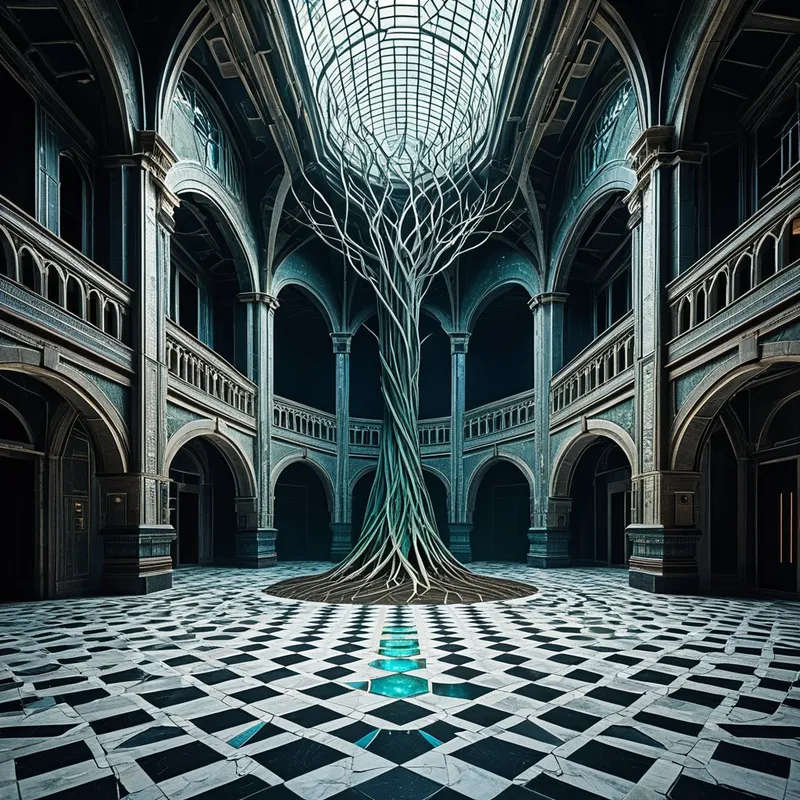
The transmutation here is from confusion to clarity, and the required heat is the fire of paradox. Your temperament is a set of inherent contradictions: fierce independence coupled with a need for deep belonging; a lightning-fast mind in a body that demands slow ritual. The alchemical vessel is your conscious awareness, and the heat is applied by holding these opposites together without seeking to resolve them into something more comfortable. You must feel the grief of the exile—the part of you that had to hide its true rhythm to survive—and the terror of embracing a nature that may not be convenient or easily loved. The pressure is the societal, and often internal, demand to choose one pole: be strong or be soft, be logical or be intuitive. The transmutation occurs when you stop choosing and start containing. The lead of “I am flawed in my design” becomes the gold of “My design is the flaw that makes me whole.” Sovereignty is born when you stop apologizing for the fundamental composition of your soul.
The Integration Protocol
Question 1: In the dream, what element (earth, water, air, fire) or landscape most persistently announced itself? How does its essential quality—stillness, fluidity, volatility, solidity—mirror a core, non-negotiable rhythm in your waking life?
Question 2: Where in your body do you feel the most consistent, unchanging “tone” or presence, whether it’s a calm weight or a buzzing current? This is your somatic anchor—how have you been taught to distrust or ignore it?
Question 3: If your personality is a house, what is the one room that is always there, regardless of how you redecorate the others? What is the immutable furniture in that room?
Action 1 (Elemental Attunement): For one week, spend 10 minutes each day in simple, sensory contact with the element that resonated in your reflection (e.g., hold a stone, sit by moving water, feel the wind, watch a candle flame). Do nothing but observe its nature. Let your own inner rhythm sync to its pace.
Action 2 (Blueprint of Being): Create a non-verbal “map” or “blueprint” of your temperament. Using collage, abstract drawing, or even arranging found objects on a surface, depict the internal landscape. Use shapes, textures, and spatial relationships—not symbols—to represent your innate solidities, fluidities, voids, and connections. Let the logic be felt, not explained.
Action 3 (Ritual of Reclamation): Identify one small, daily act that is a pure expression of your core rhythm (e.g., if your nature is slow, deliberately walk a block without rushing; if it is quick, allow yourself a burst of spontaneous dance). Perform it not as a task, but as a sacred gesture of allegiance to your own grain. Whisper to yourself: “This is my native language.”
Final Validation
It is profoundly difficult to encounter the bedrock of the self. It can feel like a sentence, a limitation, a final verdict on all you can ever be. The world rewards the chameleon and often punishes the oak for not bending. To feel the weight of your own nature can be a lonely gravity. But this is not your cage; it is your compass. That unyielding core is not there to restrict you, but to orient you. Every act that feels like a struggle against your grain is a life lived in translation. The dream does not ask you to change your nature. It asks you to come home to it, to build your life upon its unshakable, and utterly unique, ground. The sovereignty it offers is the peace of no longer being a tourist in your own soul.