
The Cryptography of the Unspoken: Dreams of Suppressed Emotions
The Somatic Echo
It begins not as a thought, but as a climate. A low-pressure system settles in the chest, a density behind the sternum that feels less like sadness and more like a geological event—the slow formation of a new, unseen stratum. The breath becomes shallow, a cautious negotiation with an internal atmosphere that feels both fragile and volatile. The jaw tightens, not in anger, but in the silent, sustained labor of containment. The shoulders curve forward, not in defeat, but as a living archway, bearing the weight of everything you have carefully chosen not to say, not to feel, not to be. This is the body’s pre-verbal logbook, a ledger of withheld tears, swallowed words, and smiles that were architectural feats of engineering. It is a silence so loud it hums in the bones.
The Dreamer's Log
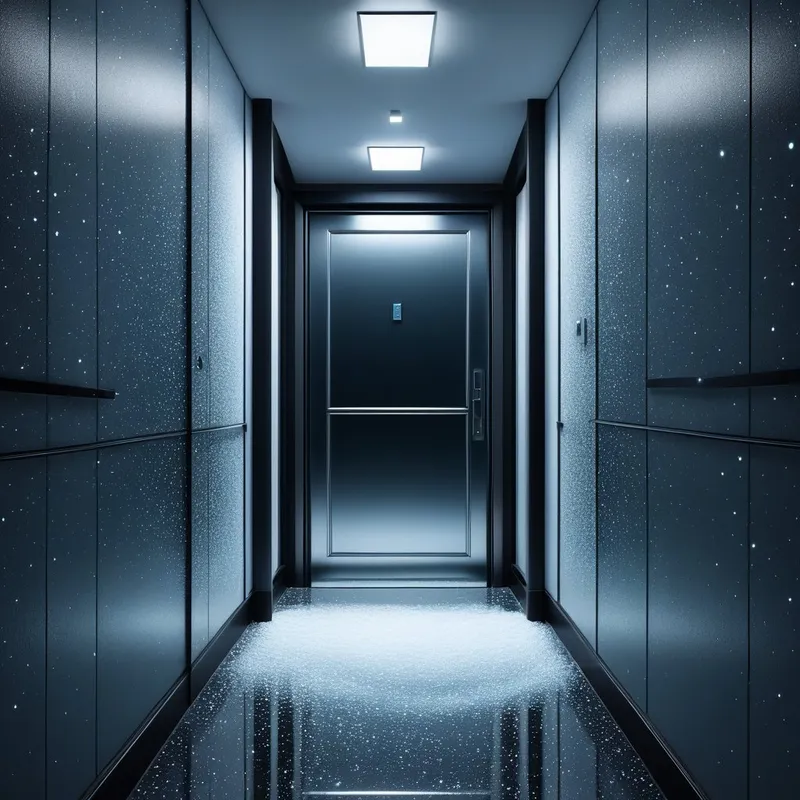
You are in your apartment, but it feels unfamiliar, elongated. You walk down a hallway you don’t recognize, lined with identical, seamless doors. Behind one, you hear a faint, rhythmic thumping—a slow, persistent beat like a muffled heart. You know, with dream-certainty, that it is a room you have never entered. Your hand reaches for the chrome handle, but it is sealed shut, covered in a layer of cold, crystalline frost that burns your skin. You wake with your own heart pounding in your throat.
This is the psyche’s elegant, desperate attempt to deliver a certified letter: a sealed chamber within the self is demanding recognition, its contents pulsing with a life of their own, threatening to crystallize the very mechanisms meant to keep it contained.
The False Lead
This theme is not about a single, forgotten memory or a moment of simple stress. It is not a psychic trash bin needing to be emptied. To interpret it as mere “bad luck” or random anxiety is to mistake the tectonic plate for the tremor. The dream is not showing you a problem to be solved, but a system to be understood. The sealed door is not a flaw in your psychic architecture; it is the architecture. The suppression is not an error, but a once-necessary protocol, a firewall erected by a younger self for reasons that were, at the time, utterly valid. The dream asks you to audit the protocol, not to blame the architect.
Psychological Architecture
To suppress is not to destroy. It is to relocate. The exiled feeling—be it grief, rage, shame, or a wild, unpermitted joy—does not vanish. It is deported to the shadowlands of the psyche, where it ceases to be a passing weather and becomes a permanent, semi-autonomous entity. In the language of internal family systems, it becomes an exile, a part of the self frozen in time, holding the original pain. Around it, managers and firefighters—other parts of the self—work tirelessly: the manager builds the seamless door, enforces the “fine, thanks” narrative; the firefighter distracts with scrolling, shopping, or any anesthetic that keeps the thumping from being heard.
The individuation process here is a delicate, sacred diplomacy. It is the conscious ego, no longer identifying solely with the managers, turning toward the inner hallway. It is developing the capacity to sit outside the frosted door, not to break it down with force (which would re-traumatize the exile), but to announce your presence. To whisper, “I know you are there. I feel your rhythm. I am ready to listen.” This is the end of the civil war within. It is the reintegration of disowned sovereignty.
Mythic Resonance
We see this in the story of Psyche and Eros. Aphrodite, threatened by Psyche’s beauty, commands Eros to make her fall in love with a monster. Instead, he falls for her himself, becoming her invisible, nocturnal husband with one condition: she must never look upon him. For a time, the arrangement works—a life of bliss in the dark, founded on the suppression of her burning curiosity. But the suppressed emotion (here, a need for truth, for sight) does not die; it grows. Eventually, guided by the light of a forbidden lamp, she looks. The “suppression” breaks, and catastrophe seems to follow: Eros flees, and Psyche is cast into a harrowing series of trials. Yet this rupture is not the end of the story; it is the brutal, necessary beginning of her true initiation. The suppressed curiosity, once integrated, becomes the driving force that ultimately earns her divinity. The condition of not-looking was the sealed door; the act of looking was the frost burning her hand.
Symbolic Nodes
- Sealed/Stuck Doors, Locked Rooms, Impassable Gates: The architecture of containment.
- Frozen Objects, Ice, Frost: Emotions in suspended animation, preserved but inaccessible.
- Muffled Sounds, Heartbeats Through Walls, Dull Thuds: The somatic echo becoming audible.
- Swallowed Objects, Choking, Gagged Mouths: The physical act of suppression.
- Flooded Basements, Burst Pipes, Rising Water: The pressure of the suppressed content breaching its container.
- Vaults, Safes, Hermetically Sealed Containers: The psyche’s high-security storage.
- Dense Fog, Heavy Atmospheres, Static: The ambiguous, charged climate of the unexpressed.
Archetypal Resonance
The energy here resonates most powerfully with The Shadow Caregiver. At its light, the Caregiver nurtures and protects. But in its shadow aspect, it smothers and martyrs itself, operating under a brutal, unspoken motto: “To keep the peace, I must silence myself.” This is the archetype that builds the sealed door, believing it is protecting the whole system from a dangerous, messy, or inconvenient truth. Its core energy is a love so fearful of conflict or burdening others that it turns inward, becoming a warden of its own heart. The somatic echo—the tight chest, the shallow breath—is the Shadow Caregiver’s armor, a constriction mistaken for strength. The alchemical potential lies in this archetype’s profound capacity for holding; it must learn to hold the exiled emotion with compassion, rather than imprisoning it with fear.
The Alchemical Process
The transmutation of suppressed emotion is not an exorcism, but a thawing. The alchemical vessel is your own mindful awareness. The heat is the unbearable tension of holding two opposing truths: the gratitude for the protection the suppression once offered, and the acute suffering its maintenance now causes. The pressure is the sustained, gentle focus on the somatic echo—the weight in the chest, the knot in the throat—without immediately trying to analyze or fix it.
The process follows three stages:
- Recognitio (Recognition): You stop labeling the echo as “anxiety” or “stress” and begin to greet it as a specific, unnamed guest. “Ah, you are here again. What are you?”
- Conversio (Turning): You turn your inner gaze from the manager’s frantic activity (the need to stay busy, positive, fine) toward the exile’s frozen landscape. You listen to the thump behind the door. This is the most intense phase, where grief and terror may surface.
- Unio (Union): The exiled emotion, finally witnessed and felt in the body without judgment, begins to lose its monolithic, terrifying quality. The grief softens into sorrow, the rage into righteous fire, the shame into vulnerable humanity. It is reintegrated, not as a tyrant, but as a voice in the chorus of the self. The energy used to suppress it is liberated, becoming a source of profound vitality and authentic presence.

The Integration Protocol
Question 1: Where in my body do I feel the most persistent, familiar tension or numbness? If that sensation had a texture, a temperature, and a shape, what would they be?
Question 2: What is the oldest memory I have of feeling this same somatic echo? What was the situation, and what did I believe would happen if I fully expressed what I felt then?
Question 3: What beautiful, necessary, or powerful part of me might be locked away alongside the pain I’ve suppressed? (e.g., Is my bound grief also the keeper of my depth? Is my capped rage also the source of my boundaries?)
Action 1 (Somatic Mapping): For one week, carry a small notebook. Three times a day, pause. Close your eyes. Scan your body from head to toe. Note the single most prominent sensation (e.g., “tightness,” “buzzing,” “cold,” “heaviness”). Write only the location and the sensation—no story, no analysis. This builds a non-verbal relationship with your inner climate.
Action 2 (Unstructured Writing): Set a timer for 10 minutes. Write by hand, starting with the prompt: “What I have not said is…” Do not lift the pen from the paper. Do not edit, spell-check, or judge. If you stall, rewrite the prompt. When the timer ends, read it once, then safely destroy the paper (burn it, shred it). The act is for expression, not for record-keeping.
Action 3 (Elemental Release Ritual): Find a private outdoor space. Hold a stone in your hand. Speak aloud, to the air, one sentence that names a feeling you have carried silently. It can be as simple as “I am angry about…” or “I am sad that…” Then, throw the stone as far as you can into a body of water, or bury it deeply in the earth. The ritual physically externalizes the internal act of release.
Final Validation
This work is not a failure of positivity; it is the courage of depth. To feel the weight of what you carry is not a sign of being broken, but of being exquisitely alive in a world that often asks for less. That frosted door was built by a part of you that loved you enough to try and keep you safe. Now, a wiser part of you is learning to love yourself enough to gently melt the seal, to welcome home the exiled ones, and to discover that the power you feared was a monster is, in truth, the missing key to your own sovereignty. The thumping is not a threat. It is your own heart, beating in a room you forgot was yours, waiting to be remembered.