
The Alchemy of Substitution: When the Psyche Trades Its Parts
The Somatic Echo
It begins not as a thought, but as a hollow. A specific, resonant absence in the solar plexus, as if a familiar weight you’ve carried for years has been silently removed, leaving only the ghost of its pressure. This is followed by a disorienting lightness, a vertigo of vacancy. Then, a cold, metallic taste at the back of the tongue—the taste of a new, unknown element introduced into your internal chemistry. The body knows the transaction before the mind can name it. Something essential has been swapped out. The old anchor is gone, and in its place is not freedom, but a strange, floating object you do not recognize as your own. The dream of substitution is the somatic record of a psychic trade. It is the echo of an internal handshake where one part of you, often a burdened and weary part, agrees to step aside so that something else—something latent, potential, or exiled—can take its seat at the table of your consciousness.
The Dreamer's Log
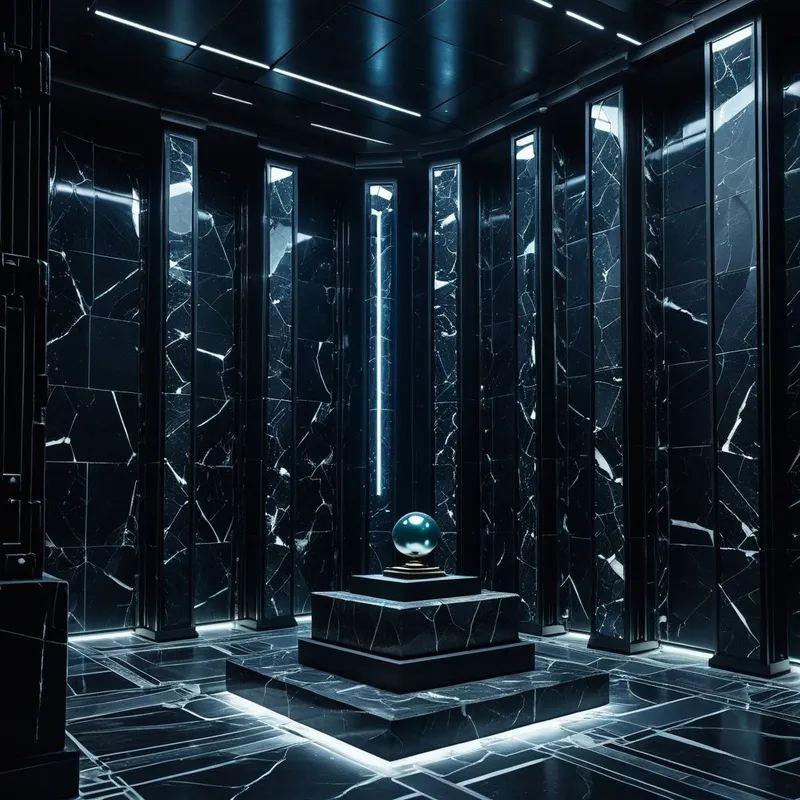
I am in the heart of a vast, silent data archive. My task is to retrieve the Core File—a glowing, warm sphere of light I know is my purpose. But when I reach its pedestal, I find only a cold, heavy iron key. The sphere is gone. The key fits a lock I cannot see, on a door that does not yet exist.
Alchemical Interpretation: The dream transmutes the known warmth of a perceived purpose (the sphere) into the unknown, utilitarian potential of a tool (the key), forcing the dreamer to exchange passive illumination for active, searching agency.
The False Lead
This is not a dream of mere loss or bad luck. To interpret it as such is to mistake the alchemist’s crucible for a thief’s empty hand. The substituted object is never random; the new element is never arbitrary. This theme is not about external forces robbing you of something precious. It is about an internal committee—your own psychic parliament—voting to decommission an outdated function and install a provisional, often more resilient, one. It is a structural retrofit of the soul, not a burglary. The grief is real, but it is the grief of necessary demolition, not meaningless destruction.
Psychological Architecture
Beneath the strange narrative lies the deep Shadow work of Individuation. We are not monolithic selves, but ecosystems. Within us reside sub-personalities: the Inner Critic, the Pleaser, the Stoic Survivor, the Wounded Child. These parts form our internal family system, each holding a role, a memory, a strategy for navigating the world. A dream of substitution occurs when this system undergoes a profound re-organization. The psyche identifies a part whose strategy, though once vital, has become a limitation. Perhaps the relentless Inner Critic, which once kept you safe from failure, now stifles all creativity. Or the People-Pleaser, which secured belonging, now erodes your boundaries.
The dream stages a coup. Not a violent overthrow, but a negotiated settlement. The old part is not destroyed; it is relieved of duty. Its energy, its core function, is alchemically transferred to a new, often nascent, part. The Critic’s sharp discernment may be handed to a nascent Inner Editor. The Pleaser’s attunement may be given to a budding Empathic Witness. This is the shadow work: to consent to the death of a familiar identity, to sit in the terrifying silence of the interim, and to learn the language of the new tenant who has moved into the vacant room of your psyche. It is the slow, often painful, process of trading a known weakness for an unknown strength.
Mythic Resonance
We see this universal firmware in the myth of Psyche and Eros. Aphrodite, enraged, sets Psyche a series of impossible tasks. In one, she must fetch wool from the golden, murderous sheep of the sun. Psyche, about to give in to despair, is guided by a whispering reed to wait until dusk, when the sheep descend to the river and leave their wool caught on the brambles. Here, the direct, heroic confrontation (the substitution of force for force) is replaced by a strategy of patience, timing, and receptivity. She exchanges the tool of battle for the tool of witness. The myth of Odysseus and the Cyclops offers another layer. Trapped in the cave, Odysseus substitutes his given name—“Nobody”—for his true, famed identity. This linguistic substitution, this strategic self-effacement, is what ultimately allows his escape and return to sovereignty. He trades the glory of recognition for the utility of anonymity, a profound psychic trade for a man bound to his own legend.
Symbolic Nodes
- Wrong Keys, Misfitting Shoes, Incorrect Tools: The new object almost fits, but not quite, symbolizing the awkward integration phase.
- Swapped Faces in Mirrors/Photographs: A direct image of identity substitution, where the self-image is literally exchanged.
- One Object Morphing Into Another (Pearl to Stone, Book to Blank Slate): The alchemical process made visible, the transmutation in real-time.
- Empty Pedestals or Plinths: The honored, familiar thing is gone, emphasizing the void left by the departed part.
- Receiving the Wrong Package or Message: The conscious ego expecting one input (validation, a known answer) and receiving another (a challenge, a cryptic symbol).
Archetypal Resonance
The core energy of substitution is most potently held by The Magician Archetype. The Magician’s domain is the transformation of reality through the application of hidden laws and conscious will. Substitution is the Magician’s fundamental act: turning lead into gold, illness into health, ignorance into knowledge. In its shadow form, as The Shadow Magician (Manipulator/Illusionist), this archetype manifests as the painful substitution we often fear—the feeling of being tricked, of our reality being swapped for a false one without our consent, or of using psychological sleight-of-hand to avoid real change.
The somatic echo of the hollow and the metallic taste is the Magician’s laboratory in your gut, where elements are being weighed and recombined. The alchemical potential lies in moving from the Shadow to the Light: from feeling subject to a substitution (the victim of the Manipulator) to becoming the agent of your own necessary transformations. It is about learning the sacred technology of your own psyche, understanding that you are not just the experiment, but also the alchemist conducting it. The Magician archetype, when integrated, grants the sovereignty to choose what must be transmuted within you.
The Alchemical Process
The transmutation here is Calcination and Solution—the first two stages of the alchemical Magnum Opus. First, Calcination: the intense, dry heat of confrontation. This is the psychological pressure of realizing a core part of your identity or strategy is no longer functional. It burns away the superficial attachments to “how I’ve always been.” The grief, the hollow, the terror—this is the fire. Then, Solution: the dissolving of the calcined remains in the solvent of tears, introspection, and the unconscious. The solid, rigid identity-part is liquefied, its essential quality released from its outdated form. This is the stage of the dream itself—the symbolic solution where the sphere becomes a key. The old form dissolves so its quintessence can be recast. The sovereignty gained is not control, but fluidity: the capacity to hold your identity as a dynamic process of conscious trade and recombination, rather than a fixed and brittle statue.

The Integration Protocol
Question 1: What familiar, heavy "tool" in my life has recently felt useless or burdensome? What has it been trying to build or protect that no longer needs that particular form of defense?
Question 2: If the object that appeared in my dream is the new "tool," what is its most basic, functional property? (e.g., a key unlocks, a blank slate receives, a stone anchors). What in my waking life feels locked, empty, or ungrounded?
Question 3: What exiled or forgotten part of myself might be represented by the new, unfamiliar element? What quality have I disowned that is now demanding a seat at the table?
Action 1 (Somatic Reclamation): For one week, upon waking, place one hand on the hollow in your solar plexus. Breathe into that space for three cycles. Do not seek to fill it. Simply acknowledge the vacancy as a sacred chamber where an alchemical reaction is taking place.
Action 2 (Creative Council): Draw two simple symbols on a single page. On the left, a symbol for the object that was lost or taken in the dream. On the right, a symbol for the object that appeared. In the space between them, using non-dominant hand, let your hand scribble, draw, or write the process of the change. Do not think. Let the line itself be the transmutation.
Action 3 (Ritual of Conscious Exchange): Find a small stone. Hold it, imbuing it with the energy of the old, burdensome part or strategy you are ready to release. Then, find a different natural object—a leaf, a seed, a feather. At a threshold (a doorway, a park entrance), consciously leave the stone. Walk across the threshold holding the new object, silently welcoming its unknown potential into your day.
Final Validation
The disorientation is real. The grief for the familiar burden is valid, for even a cage provides the known geometry of its bars. To have that structure swapped out for an open field can feel like a cruel promotion. But trust the intelligence of your inner Magician. This substitution is not a mistake in your psychic code; it is a necessary, elegant patch written by your deepest self. You are not being dismantled. You are being upgraded. The process asks you to trade the comfort of the known map for the sovereign authority of the compass that now points toward a truer, if uncharted, north. The key is cold and heavy in your hand because it is real. It fits a lock you have not yet found because the door it opens is one you must now, courageously, build.